
Same Diagnosis, Different Cure: Where Malone and I Converge on Ebola — and Where It Could Finally Go Right
Robert Malone just confirmed the core of my Epstein–Ebola investigation — from the opposite end of the evidence

Robert Malone just confirmed the core of my Epstein–Ebola investigation — from the opposite end of the evidence, using entirely mainstream sources. Where he lands is a fork in the road: sovereign, America First preparedness. With the right leadership and real grassroots accountability, it may be the way out of the trap rather than deeper into it.
A companion note to The Epstein Files Investigation. The two essays discussed here are Robert Malone’s “The Political Epidemiology of Preparedness” and my own Part IV. Read both. Then read this.
On July 11, Robert Malone published an essay called “The Political Epidemiology of Preparedness.” It is about the Ebola outbreak burning through eastern Congo right now — the Bundibugyo strain, roughly six hundred dead and still climbing — and on its surface it has nothing whatsoever to do with the investigation I have been running for months into the Epstein files, Bill Gates, and the birth of the biosecurity state.
Reading it, I had a strange experience. I watched a fellow traveler walk a completely different road and arrive at the exact structural conclusion I reached back in February.
He got there through the World Health Organization, The Lancet, Africa CDC, and the U.S. State Department. I got there through newly released Department of Justice documents. He is looking at a live outbreak in 2026. I was looking at the last week of September 2014. He never mentions Epstein, Gates, or donor-advised funds. I built my entire case on them.
And yet the load-bearing claim underneath both essays is, almost word for word, the same.
When two investigators start in different chapters of the same story, use different evidence, carry different assumptions, and still end up standing in the same room — the room is probably real.
The claim we both make
Strip my Part IV down to its skeleton and you get one sentence: the response to Ebola was governed by incentives that had nothing to do with the disease. In my telling, those incentives moved through an informal network of private capital, philanthropic vehicles, and unelected officials — the machinery I have been documenting since Part I.
Now here is Malone, saying the same thing in the plainest possible terms. Preparedness and outbreak response, he writes, are shaped as much by political and economic incentives as by disease burden. The world mobilizes fast when a crisis threatens wealthy nations, and invests almost nothing in preventing those crises where they actually begin.
He even demotes the virus the way I do. The virus is the catalyst, he writes; the real story is the public policy and the geopolitical conflict underneath it. My Part IV made the identical move: Ebola did not create a system in 2014, it activated one that already existed.
Two essays. One thesis: the disease is the pretext, and the real action is upstream, in the incentives.
Obama, Gates, and Epstein: The Week Emergency Rule Became Global Policy

View the X post dedicated to this story here.
The echoes get specific
This is not a vague thematic rhyme. We describe the same events.
We both anchor the story to the 2014–2016 West African epidemic. We both note the U.S. military deployment to Liberia — I wrote that Washington announced a military deployment to West Africa; Malone, who says he worked the front lines of that response, recalls thousands of American troops sent into Liberia.
Most telling, we describe the same acceleration in nearly the same words. When Ebola reached the West, I wrote, emergency funding authorities expanded and policy timelines collapsed under urgency. Malone’s version: regulatory barriers fell, research funding expanded, clinical trials launched. He even fixes the moment it flipped — the day Ebola reached a hospital in Dallas and a nurse fell ill in Madrid. That is precisely the threshold I described from the other side: the machine only wakes up when the wealthy world feels the threat.
We open the same way, too — both of us promising the reader that the honest story lies past the virology, in the politics.
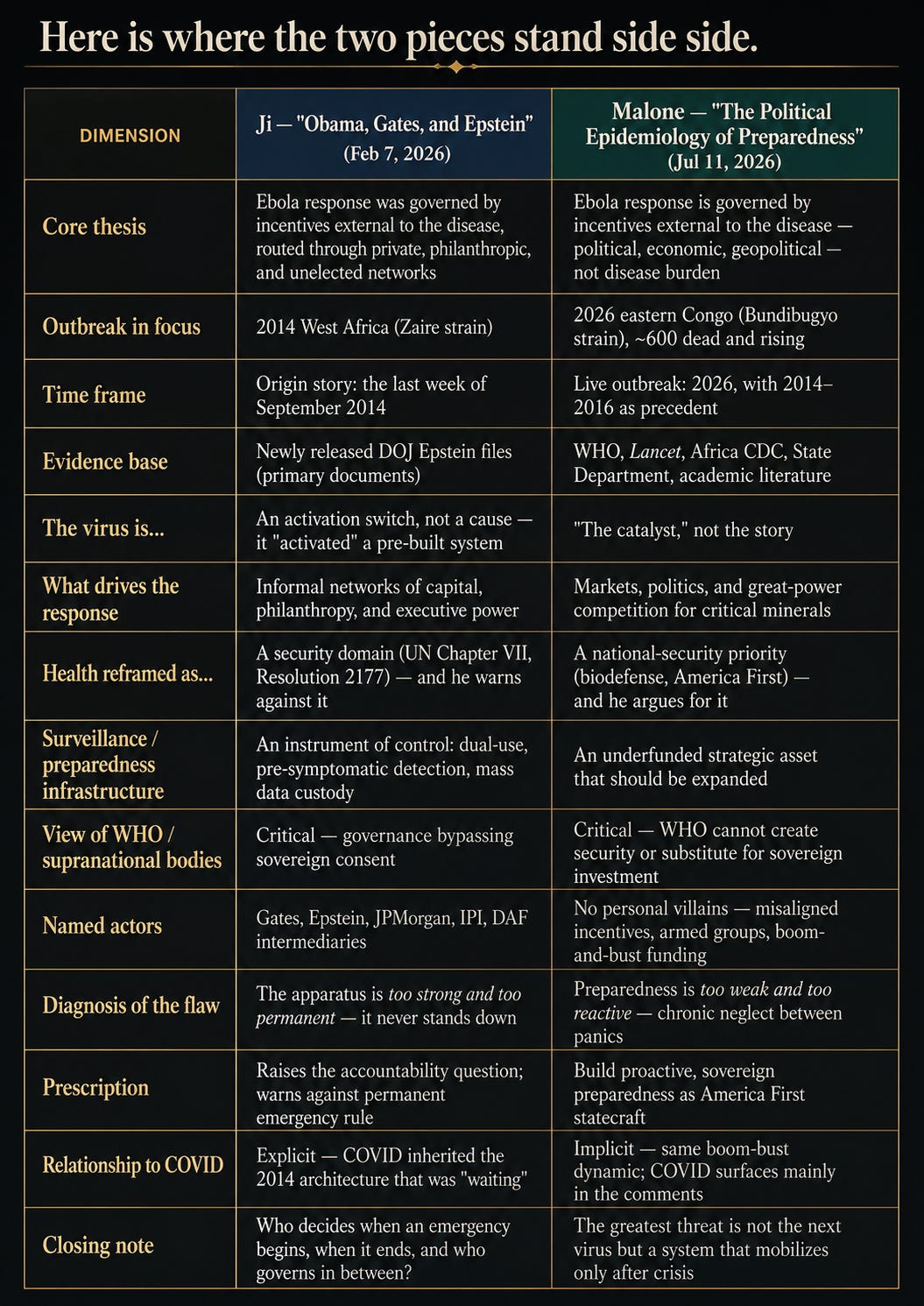
Here is where the two pieces stand side by side.
Where the roads fork
Now the divergence, and it is not a small one.
My investigation ends in alarm that the biosecurity architecture is too strong. I documented an apparatus that, once switched on in 2014, never switched off: surveillance reframed as prevention, emergency authority outliving the emergency, a system that was simply waiting when COVID arrived. My fear is permanence — the standing machine that no election can turn off.
Malone’s essay ends in alarm that preparedness is too weak. His whole piece is a lament for boom and bust — panic, investment, complacency, neglect — and his remedy is to build more: proactive surveillance, standing laboratories, always-ready countermeasures, treated as strategic national assets. He wraps it in an explicit America First frame. If the United States wants Congo’s cobalt and coltan, he argues, it should also fund the public-health infrastructure of the regions that produce them, as a matter of national security.
Read quickly, that looks like a flat contradiction. He wants to build the very machine I have spent four installments warning about.
Read slowly, though, something more interesting appears.
The agreement hiding inside the disagreement
Look at what Malone distrusts. He is scathing about the limits of international institutions. The WHO, he writes, cannot create security, cannot build functioning public institutions, cannot substitute for sovereign investment. He wants preparedness owned by an accountable nation-state, not floating in the supranational ether.
That is my argument about sovereignty, wearing a different coat.
My entire critique of 2014 is that governance was conducted through channels that bypassed sovereign consent — private networks, philanthropic opacity, a surveillance line item that financed infrastructure outside sovereign consent. Malone and I are, underneath, both sovereigntists. We both distrust unaccountable, supranational, incentive-driven control of health. We both insist on knowing who governs, and by what authority.
So the fork is narrower and sharper than “more preparedness versus less.” Malone offers the accountable, sovereign, national version of preparedness as the answer to exactly the private, opaque, supranational capture I documented. In effect, he is answering my closing question — who governs in between? — with a name: the accountable nation-state, not Gates, not the WHO, not a switchboard of unelected intermediaries.
It is a serious answer. And I am increasingly convinced it may be the right one.
The trap
Here is why I still cannot rest on it, and why I refer to this as the preparedness trap.
The architecture has a logic of its own.
Everything in my files suggests the tools of prevention resist staying tools of prevention. Pre-symptomatic detection at population scale — the Weill Cornell technology routed through Epstein in October 2014 — is not neutral. Mass testing, data aggregation, reporting pipelines, and compliance enforcement do not become dangerous only when the wrong people hold them. They carry the capacity for control in their very structure. Emergency authority, once stood up, outlives the emergency that justified it. I watched that happen across the entire arc from Ebola to COVID.
So the real question the two of us are circling is the one neither essay quite asks out loud:
Can an always-on biosurveillance and countermeasure apparatus ever remain under democratic, accountable, sovereign control — or does it, once built, follow its own gravity toward permanent emergency governance, no matter whose flag flies over it?
Malone is betting that a sovereign, America First version stays accountable. For most of my career I would have said the odds were against him — that prepared and governed drift apart the instant a crisis is invoked, and that someone is always standing ready to invoke one. What has changed, and I do not say this lightly, is the leadership now in place and the movement standing behind it.

For the first time in my lifetime, the American health apparatus is being stewarded by someone who came up through the very grassroots that spent decades fighting institutional capture. Robert F. Kennedy Jr. did not arrive at HHS from the revolving door between agency and industry. He arrived from the other side of it, as one of its greatest critics. And the MAHA movement that carried him there is not a foundation or a think tank operating behind closed doors — it is a decentralized citizens’ movement with its own eyes on the machine, and a demonstrated willingness to use them.
And as the co-founder of Stand for Health Freedom and senior advisor to MAHA Action, I do not describe that movement from the outside. I have spent years helping build exactly this kind of grassroots infrastructure — the citizen networks and state-level advocacy that exist to hold agencies accountable when no institution will do it for us. I have seen what ordinary people can force into the open. That is why I no longer assume the machine must always slip its keepers.
That is the variable my earlier work could not account for. The danger in a standing biosecurity architecture was never only what it was. It was who held it, and whether anyone could check them. Sovereign stewardship plus genuine grassroots accountability is not a guarantee — accountability never is. But it is the first real answer I have seen to the question I have been circling for four installments: who governs the governors?
So no, I do not think Malone is naïve. I think he has identified the same disease I have — and reached for a cure that, in accountable hands and with the public watching, may finally be safe to hold.
The convergence is the point
Step back from the fork and the larger fact is this: a prominent physician-scientist who worked the front lines of Ebola, writing from entirely mainstream sources about a live 2026 outbreak, has independently confirmed the structural thesis of an investigation I built from the government’s own releated court documents about 2014.
We approach the cure from opposite directions — and even there, less separates us than it first appears. On the diagnosis, we do not disagree at all.
Preparedness does not follow disease. It follows incentives, markets, and geopolitics — Malone says minerals; I say the informal networks that trade in access and capital. Both can be true at once. In fact the two essays complete each other: his supplies the motive layer my governance-capture story leaves open — why the machine runs where it runs, why some outbreaks summon armies while others are left to smolder above a cobalt seam.
The questions I closed Part IV with have not moved:
Who decides when an emergency begins?
Who decides when it ends?
And who governs in between?
To those I will now add the one Malone’s essay brought to the surface:
Once we build the machine that keeps us safe, what keeps it from becoming the machine that keeps us governed?
For the first time, I think we may be closer to an answer than we have ever been. Not a permanent one — accountability never is. But the same one every free people has ever relied on: leadership that answers to the governed, and a citizenry awake enough to hold it to that. Sovereignty is not the danger. Unaccountable power is. And the antidote to unaccountable power is exactly what the grassroots was built to supply.
The architecture is not destiny. We are.
Read the full Epstein Files Investigation Series:
Part I — Breaking the Epstein Files: Illuminating the Network
Part II — Inside Project Molecule: JPMorgan, Power, and Reputation
Part III — The Switchboard: From Epstein to Mandelson
Part IV — Obama, Gates, and Epstein: The Week Emergency Rule Became Global Policy
An ongoing example of the dangers of misuse of biosurveillance that provides a simple analogy is Flock cameras, which police and sheriff departments are using to follow people, not just license plates as the company desperate to control the misuse narrative naively asserts.
Those who abuse their positions with officious use of the Flock system to follow romantic prospects, partners and ex-partners' dates are driven by lower emotions, such as anger and jealousy that highjack their pre-frontal executive functions: dozens of times a day and hundreds of times over a few months. And those are only the ones who have been caught.
More details at: https://substack.com/home/post/p-206579051
I subscribe to both Robert Malone and Sayer Ji and see from both the desire to leave this world better than they found it. Or at least, help us to appreciate the natural world….. and both are brave enough to follow their truth no matter the circumstances.