

Inside Project Molecule — How JPMorgan and the Gates Foundation Turned Biology into Investable Infrastructure
Biosecurity as Governance, and the Quiet Erosion of Sovereignty - PART 2 of a Series

This is Part 2 in a series.
Read, share, and comment on the X thread dedicated to this post.
Buried in the Epstein files is a 14-page JPMorgan proposal called Project Molecule—a formal partnership with the Bill & Melinda Gates Foundation to transform pandemic preparedness into a permanently governed, privately controlled, transnational system of vaccine procurement, surveillance, and global health finance—developed within the same institutional ecosystem in which a convicted sex offender operated as a connective broker between Wall Street, global health, and political power.
(This is Part II of my investigation. It should be read as a direct continuation of Part I: BREAKING: The Epstein Files Illuminate a 20-Year Architecture Behind Pandemics as a Business Model—With Bill Gates at the Center of the Network.)
In Part I, I documented the emails, text messages, financial agreements, and planning documents that revealed pandemics and vaccines being treated as standing financial and strategic categories years before COVID-19. Offshore arms “especially for vaccines.” Pandemic as a donor-advised fund vertical. Strain pandemic simulation as a technical deliverable. Career placement into vaccine teams and pandemic reinsurance units — brokered through a convicted sex offender’s phone.
I described a fire station built beside a factory that stores accelerants, owned by the same people who wrote the building code.
What the newly released DOJ materials now make clear is that the fire station had blueprints. They were fourteen pages long. And they had a name.
Project Molecule.
Executive Summary
The architecture had a name: A 14-page JPMorgan client proposal — Version 13, dated August 31, 2011 — reveals a transnational charitable-investment vehicle called “The Gates & J.P. Morgan Charitable Giving Fund,” linking the Bill & Melinda Gates Foundation, ultra-high-net-worth global donors, donor-advised funds, offshore charitable structures, and concrete biological interventions.
The structure was designed to be permanent: The deck’s stated objectives include “perpetual operation and governance succession” — not a time-limited campaign but a self-governing institution designed to outlive its founders, with no sunset clause and no mandatory payout requirements.
The governance was private: Five layers of committees — Board, Investment, Grant Distribution, Management, and Audit — populated by Warren Buffett, George Kaiser, Mary Erdoes, Melinda Gates (chair), Susan Rice, Seth Berkley (Gavi), Jeffrey Sachs, and Queen Rania of Jordan. No elected officials. No treaty obligations. No public accountability beyond what the entity’s own audit committee determined.
The money was operational: A single slide allocates $150 million in specific biological interventions — $40M for polio vaccines in Afghanistan, $40M in Pakistan, $20M to “finance the surveillance network in Pakistan,” $20M for MenAfriVac in Africa, and $30M for rotavirus vaccines in Latin America.
The offshore arm Epstein described was being built: Project Molecule’s three-entity structure — a U.S. public organization, a foreign foundation in a “tax neutral jurisdiction,” and country-specific conduits — is the institutional architecture for the “offshore arm — especially for vaccines” that Epstein outlined to Mary Erdoes in the same month this deck was drafted.
Epstein’s fingerprints are on the architecture: The deck was produced by the same JPMorgan private wealth division run by Jes Staley. Erdoes — the same executive who received Epstein’s “offshore arm” email — appears as a non-voting Investment Committee member. The parallel channels converge on the same structural endpoint.
When “Project Molecule” Turns Out to Be Literal
Throughout Part I, I used the term “architecture” to describe a pattern: the gradual transformation of global health and pandemic preparedness into an investable, governable system — built before crisis and activated during it.
That word was more precise than I knew.
Project Molecule is not a metaphor. It is a JPMorgan client proposal — Version 13, dated August 31, 2011 — explicitly designed to create a transnational charitable-investment vehicle linking the Bill & Melinda Gates Foundation, ultra-high-net-worth global donors, donor-advised funds, offshore charitable structures, and concrete biological interventions: vaccines, surveillance networks, and disease eradication campaigns.
The cover page is unambiguous:
PROJECT MOLECULE — CLIENT DRAFT Wednesday, August 31, 2011 J.P. Morgan
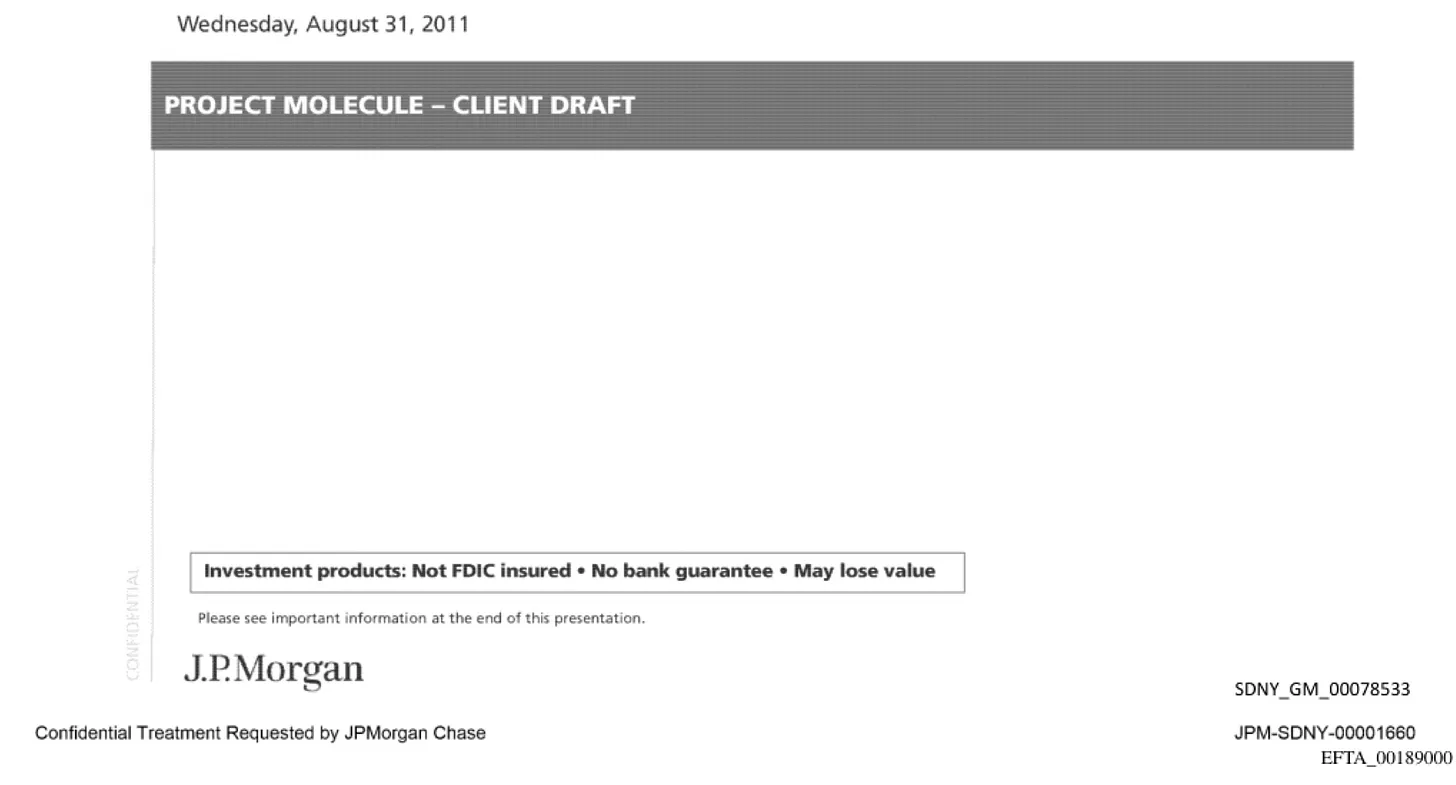
(Source: Project Molecule — Client Draft, Version 13. SDNY_GM_00078533; JPM-SDNY-00001660; EFTA_00189000 )
This document was produced in the Southern District of New York litigation and entered the federal record with Bates stamps from both the JPMorgan production (JPM-SDNY) and the Epstein Files Task Act production (EFTA). It was not leaked. It was not alleged. It was disclosed under legal process.
Version 13. Think about what that means. This was not a first draft. This was a document that had been revised, reviewed, debated, and refined at least twelve times before this version was sent. Whatever Project Molecule was, it was deliberate.
Two Channels, One Architecture
To understand what Project Molecule is, you have to read it alongside the emails documented in Part I. Because when you do, something emerges that is more unsettling than either set of documents alone: point by point, line by line, the informal channel and the formal channel describe the same system.
Start with duration.
On August 17, 2011, Epstein emailed Mary Erdoes — CEO of JPMorgan Asset and Wealth Management, writing from vacation in Maroon Bells, Colorado — and described a fund that would “exist in perpetuity, with succession controls.” Not a thematic spend-down. Not a time-limited initiative. A permanent vehicle designed to outlive its creators (EFTA01256269).
![[IMAGE: Epstein’s August 17 email to Erdoes — EFTA01256269]](https://substackcdn.com/image/fetch/$s_!LJz1!,f_auto,q_auto:good,fl_progressive:steep/https%3A%2F%2Fsubstack-post-media.s3.amazonaws.com%2Fpublic%2Fimages%2F7b0cd8a9-041d-4cbd-ab25-0a6d52a85982_1676x2232.png "[IMAGE: Epstein’s August 17 email to Erdoes — EFTA01256269]")
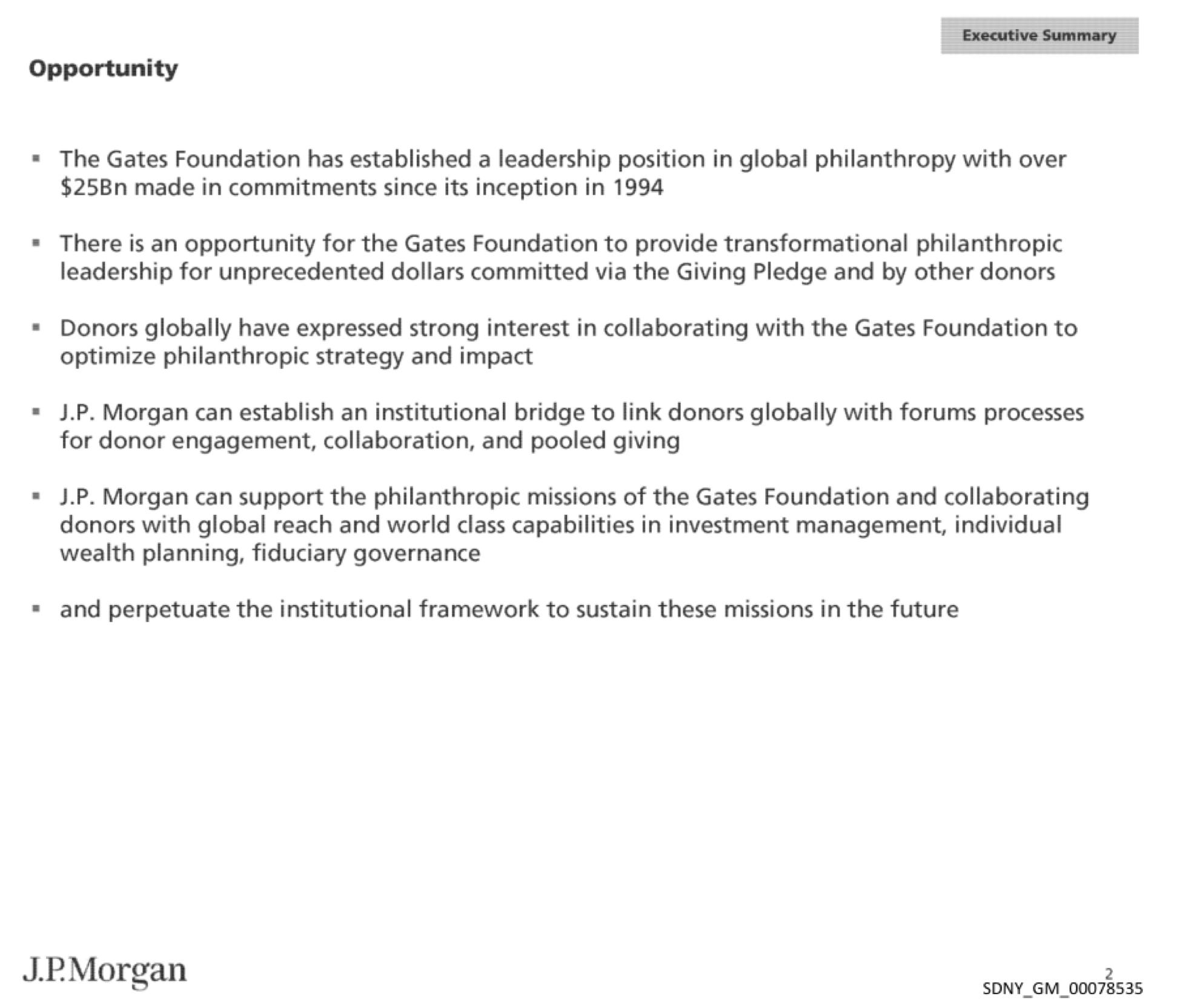
Fourteen days later, the Project Molecule deck landed. Page 3, Executive Summary. Among its stated objectives: “Allow for perpetual operation and governance succession.”
The same word. The same concept. The same month. One in an email from a convicted sex offender to a bank CEO. The other in a polished client presentation stamped Version 13.
Now consider structure.
Epstein’s email describes a fund that would be “mostly initially American” but adds: “However we should be ready with an offshore arm — especially for vaccines” (EFTA01256269). He envisions custom investment portfolios, predefined “silos,” and donor anonymity.
The deck, page 4, proposes three parallel entities under a unified board:
A U.S. sponsoring public organization (with Donor Advised Fund subaccounts and Type I Supporting Organizations for donors contributing $100 million or more)
A foreign private charitable foundation in a “tax neutral jurisdiction”
A domestic qualifying entity for country-specific donor conduit
![[IMAGE: Project Molecule organizational chart — EFTA01301118]](https://substackcdn.com/image/fetch/$s_!l2pA!,f_auto,q_auto:good,fl_progressive:steep/https%3A%2F%2Fsubstack-post-media.s3.amazonaws.com%2Fpublic%2Fimages%2Fdff019e0-c54c-427f-beb1-489e2115aab1_2230x1772.heic "[IMAGE: Project Molecule organizational chart — EFTA01301118]")
(Source: SDNY_GM_00078537; EFTA_00189004 / EFTA01301118, p. 4.)
The “offshore arm” Epstein described is entity number two — a foreign foundation in a tax-neutral jurisdiction. The deck notes this structure would provide “maximum flexibility for appropriate donors” and “permit donor anonymity”
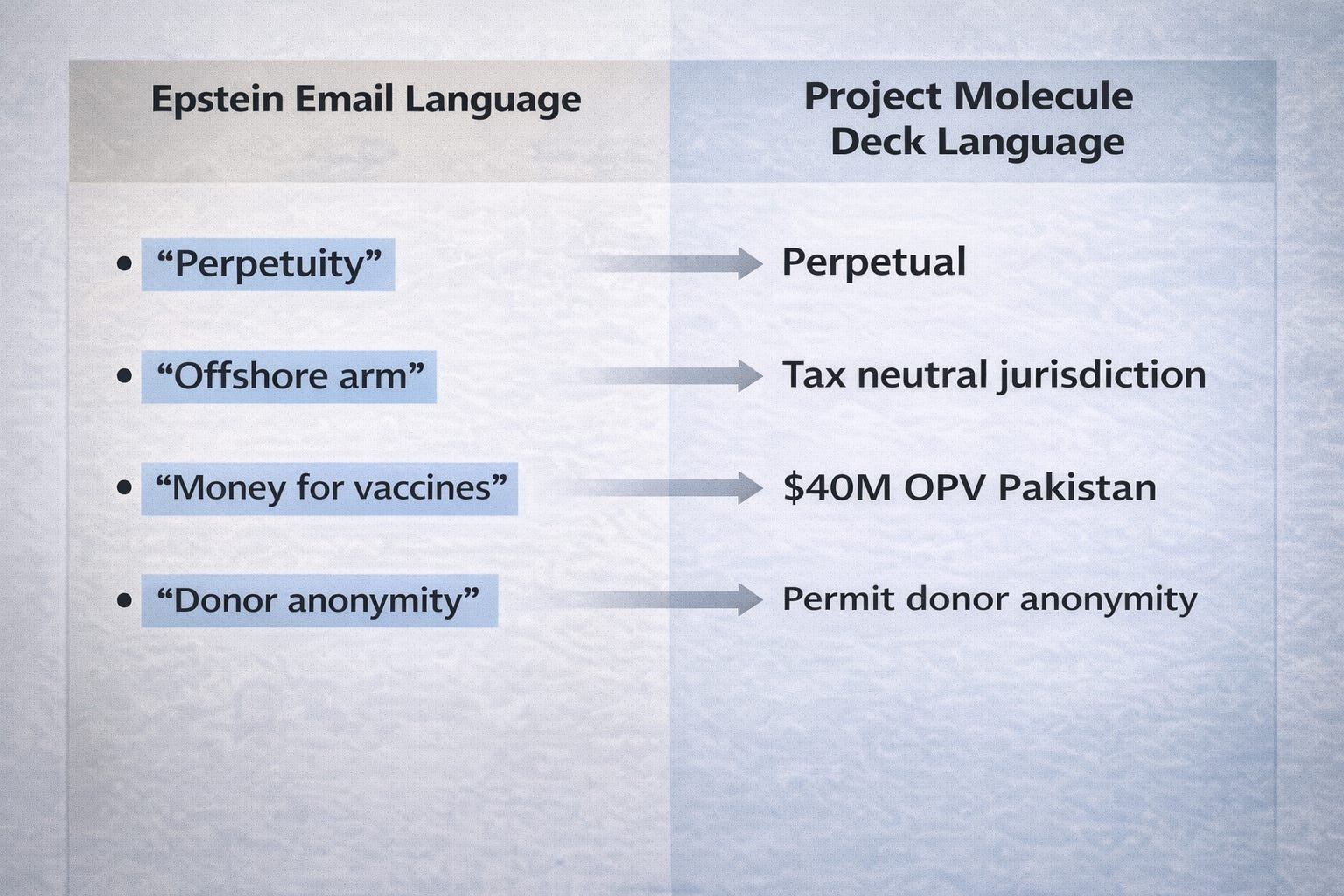
“Offshore arm” → “foreign private charitable foundation in a tax neutral jurisdiction.” “Donor anonymity” → “permit donor anonymity.” This is not a coincidence of language. It is a convergence of design. The email sketches the architecture in shorthand. The deck renders it in corporate detail. They were produced in the same month, by the same division, for the same client.
Now consider purpose.
On August 28, 2011, Epstein sent Staley and Erdoes a follow-up email explaining that “Bill is terribly frustrated” and insisting that the presentation include the phrase “additional money for vaccines” (EFTA01301108).
![[IMAGE: “Bill is terribly frustrated” email — EFTA01301108]](https://substackcdn.com/image/fetch/$s_!XV_l!,f_auto,q_auto:good,fl_progressive:steep/https%3A%2F%2Fsubstack-post-media.s3.amazonaws.com%2Fpublic%2Fimages%2Fdfd52815-5465-465f-a04b-d0b9de8ccf8d_1640x530.heic "[IMAGE: “Bill is terribly frustrated” email — EFTA01301108]")
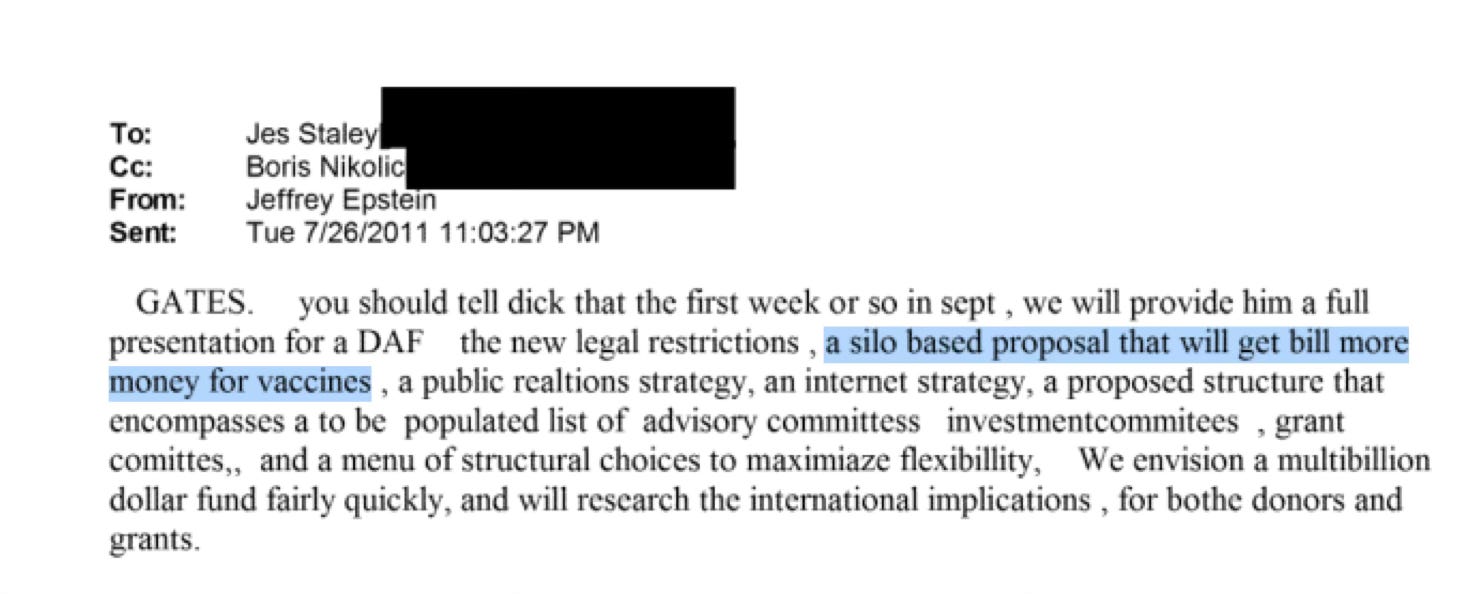
Vaccines were the hook — the narrative justification for the financial structure. Eleven days earlier, he had described the fund as “a silo based proposal that will get Bill more money for vaccines” (EFTA01860211).
The deck, page 9, translates that narrative into a budget. Under the heading “Collaborative Philanthropy,” it allocates $150 million across specific biological interventions — including $80 million in polio vaccines for Afghanistan and Pakistan, $20 million for a surveillance network in Pakistan, and $30 million for rotavirus vaccines in Latin America.
“Additional money for vaccines” is not a phrase anymore. It is a line item.
And finally, consider scale.
Epstein projected “billions of dollars” in the first two years and “tens of billions by year 4.” He described the bottleneck as JPMorgan’s capacity to build what he had already designed: “depends only on JPM ability to organize, legal, structure, internet presence, staffing” (EFTA01256269).
The deck’s objectives include leveraging “J.P. Morgan’s global reach, infrastructure investment management, and individual wealth structuring capabilities” and creating structures to “accept, manage, and liquidate unique and/or illiquid assets.” The minimum gift threshold: $100 million. The entity name: “The Gates & J.P. Morgan Charitable Giving Fund.”
Two channels. One architecture. The only thing missing from the deck is the name of the man who helped design the table.
Committees Instead of Parliaments
The governance structure proposed in Project Molecule reveals a particular theory of authority — one in which legitimacy flows not from democratic mandate but from capital contribution.
The deck proposes five layers of governance:
A Governing Board of Directors (8–10 members) responsible for oversight, strategic planning, committee oversight, and senior management hiring
An Investment Committee (board and advisory members) overseeing investment assets, formulating policies, and monitoring portfolio compliance
A Strategic Program / Grant and Distribution Committee (board and advisory members) responsible for reviewing program initiatives, conducting due diligence, and directing funds to charitable recipients
A Management and Governance Committee reviewing governance, compensation, and personnel policies
A Finance / Audit Committee overseeing financial reporting, internal control, spending policy, budget, compliance, and officer compensation
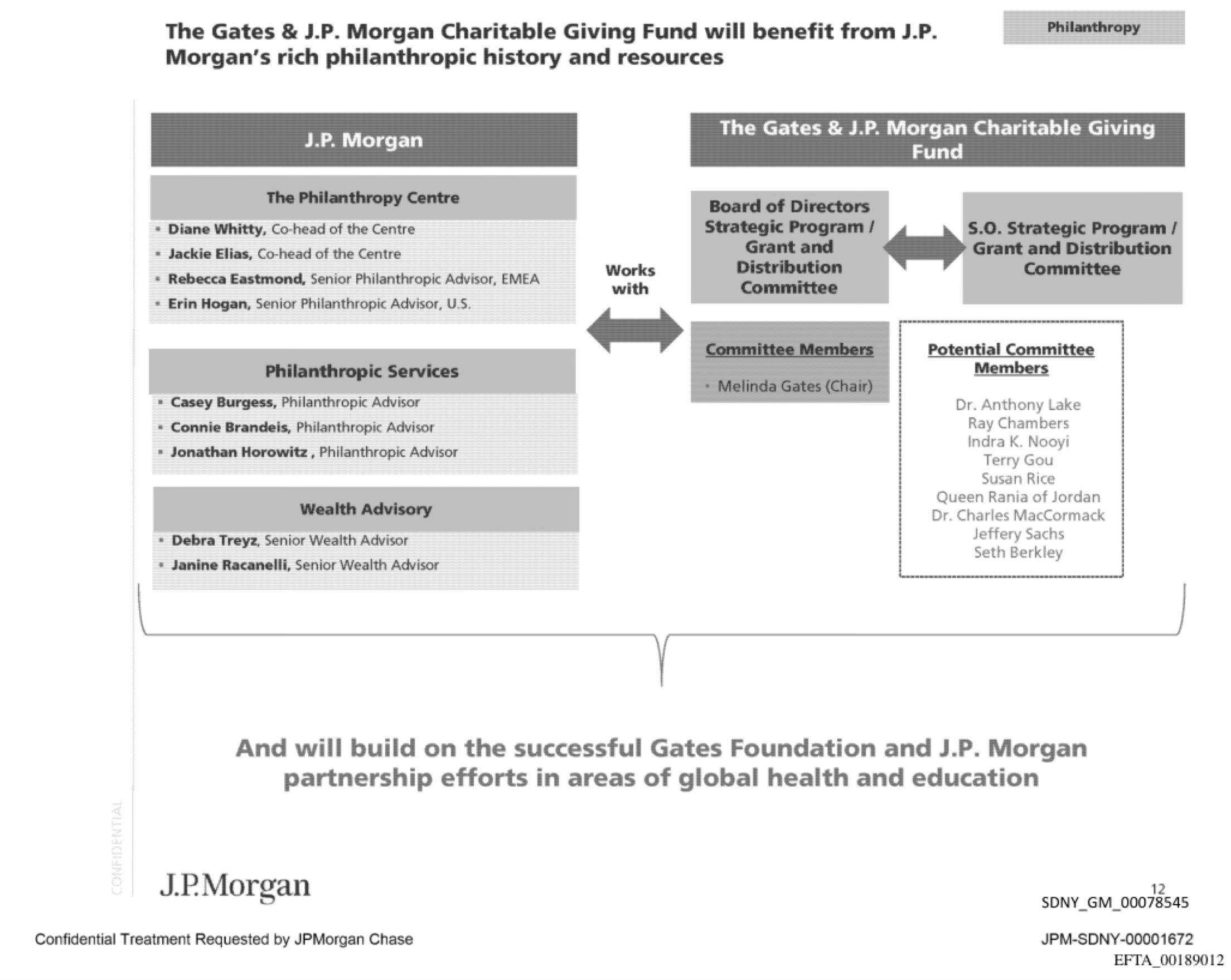
(Source: SDNY_GM_00078539; EFTA_00189006 / EFTA01301120, p. 6.)
This is a complete governance apparatus — legislative, executive, fiduciary, and audit — housed entirely within a private charitable entity. The people who fund it govern it. The people who govern it direct its interventions. And the interventions, as we will see, include purchasing vaccines for sovereign nations, financing surveillance networks, and setting eradication timelines.
Who was proposed to sit on these committees matters enormously.
Investment Committee (Voting Members):
Warren Buffett
George Kaiser
Investment Committee (Non-Voting Members):
David Rubenstein
Mary Erdoes (CEO, JPMorgan Asset and Wealth Management)
Mike Cembalest (Global Head of Investment Strategy, JPMorgan)
Ted Forstmann
Lee Cooperman
Strategic Program / Grant and Distribution Committee:
Melinda Gates (Chair)
Potential Committee Members:
Dr. Anthony Lake
Ray Chambers
Indra K. Nooyi
Terry Gou
Susan Rice
Queen Rania of Jordan
Dr. Charles MacCormack
Jeffrey Sachs
Seth Berkley (CEO, Gavi, the Vaccine Alliance)
Consider what this committee structure represents. The Investment Committee — deciding how billions of dollars would be deployed — would include the two wealthiest men in America at the time, with the CEO of JPMorgan’s asset and wealth management division and the bank’s chief investment strategist in advisory roles. The Grant and Distribution Committee — deciding which countries receive which vaccines, which surveillance networks get funded, which eradication campaigns proceed — would be chaired by Melinda Gates, with a roster drawn from the intersection of global diplomacy, corporate governance, and institutional public health.
These were not retired philanthropists lending their names to a letterhead. In August 2011, Susan Rice was U.S. Ambassador to the United Nations — in the middle of the Libya intervention, the Arab Spring, and the most consequential year of Obama’s foreign policy. Seth Berkley had taken over as CEO of Gavi, the global vaccine alliance, just months earlier and was redesigning its entire funding model. Queen Rania was navigating Jordan’s response to regional revolution. Jeffrey Sachs was running the UN Millennium Villages Project across sub-Saharan Africa while advising the Secretary-General on global development goals. Indra Nooyi was CEO of PepsiCo, one of the world’s largest food and beverage companies.
These are not advisors to a charity. They are people who, in their day jobs, already governed — nations, alliances, corporations, multilateral institutions. Project Molecule proposed to give them a second jurisdiction: biology. And unlike their official roles, this one would have no term limits, no parliamentary oversight, no electorate, and no freedom-of-information obligations.
The entity they would govern was designed to be perpetual — with built-in succession mechanisms, no mandatory payout requirements (unlike private foundations), and the ability to operate in any jurisdiction through country-specific subsidiary entities.
This is what a government looks like when it is not called a government.
So what would this government do?
Where the Money Goes — and What It Buys
The answer is on page 9 of the deck. And it is the slide that turns Project Molecule from a financial abstraction into something you can feel in your stomach.
Under the heading “Collaborative Philanthropy,” the deck presents specific planned interventions — not aspirations, not program areas, but dollar figures matched to target geographies:
$40M — Purchase oral polio vaccines (OPV) in Afghanistan
$40M — Purchase oral polio vaccines (OPV) in Pakistan
$20M — Finance the surveillance network in Pakistan
$20M — Deliver MenAfriVac in the African meningitis belt
$30M — Purchase rotavirus vaccine in Latin America for three years
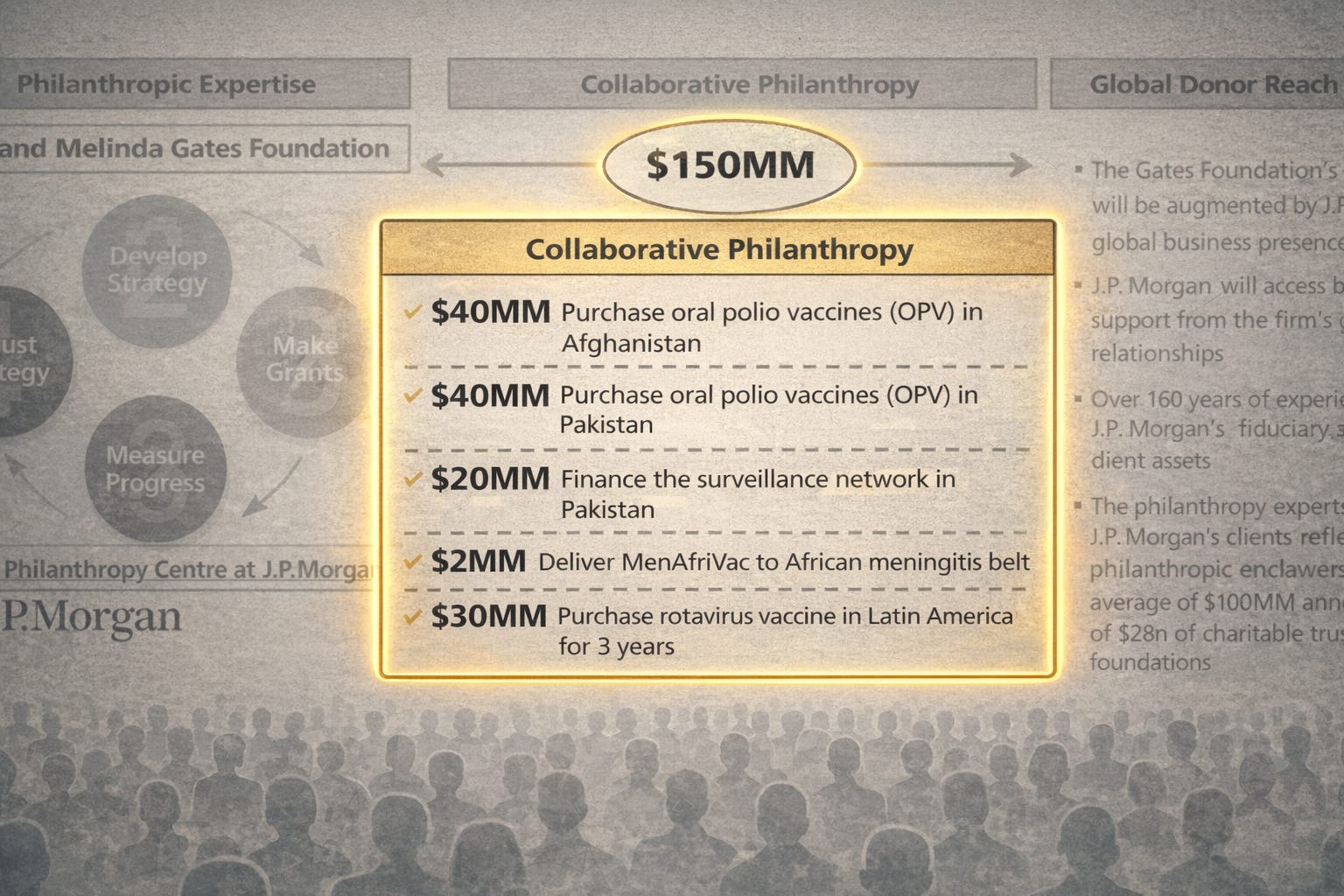
This is not a wish list. It is a budget. And the budget makes explicit what the governance slides imply: Project Molecule was designed not merely to pool and invest philanthropic capital but to deploy it operationally, across sovereign borders, into specific countries, for specific biological interventions, with specific dollar commitments.
The total shown on this single slide — $150 million in pooled giving from three hypothetical donor case studies — would fund vaccine procurement in South Asia, surveillance infrastructure in Pakistan, and vaccination campaigns across Africa and Latin America.
Now read the third line item again, slowly:
“Finance the surveillance network in Pakistan.”
Not “support public health monitoring.” Not “contribute to WHO disease tracking.” Finance the surveillance network. As in: build it, fund it, own it. A surveillance network in a sovereign nation, financed by a private charitable entity governed by unelected committees in a tax-neutral offshore jurisdiction.
That is the line item that should stop you.
In Part I, I noted that Epstein used the phrase “additional money for vaccines” and described it as “the language of capital formation, not charity.” This slide is the same language translated into a budget. The word “surveillance” appears not metaphorically, not as a policy aspiration, but as a funded program with a dollar figure attached.
This is the point at which philanthropic infrastructure becomes something else entirely.
The Carpenter and the Table
Jeffrey Epstein does not appear in the Project Molecule deck. Not as a signatory. Not as a committee member. Not as a named participant.
But by now, the reader has seen the parallel channels — the emails and the deck, the shorthand and the engineering, arriving at the same structural endpoint in the same month from the same division at the same bank. “Perpetuity” and “perpetual.” “Offshore arm” and “tax neutral jurisdiction.” “Money for vaccines” and a $150 million budget slide. The convergence is not a matter of interpretation. It is a matter of reading.
The question is not whether Epstein authored Project Molecule. He almost certainly did not. The question is whether the polished deck is the institutional translation of the architecture he was sketching informally — and whether the reason his name doesn’t appear is not that he was uninvolved, but that the formal channel was designed to be the clean version of the informal one.
Remember how the relationship worked. In February 2011, JPMorgan’s Juliet Pullis sent Epstein a structured questionnaire — at Jes Staley’s direction — asking him to define the architecture of a Gates-linked fund. Epstein replied the same evening with a fully formed vision: a donor-advised fund with “a stellar board, broken down into investment committee and distribution,” tied to the Giving Pledge’s sixty billion dollars in committed capital. Staley’s response: “We need to talk.” By August, Erdoes was emailing Epstein directly — from vacation — asking for answers before the 31st. She got them the same night.
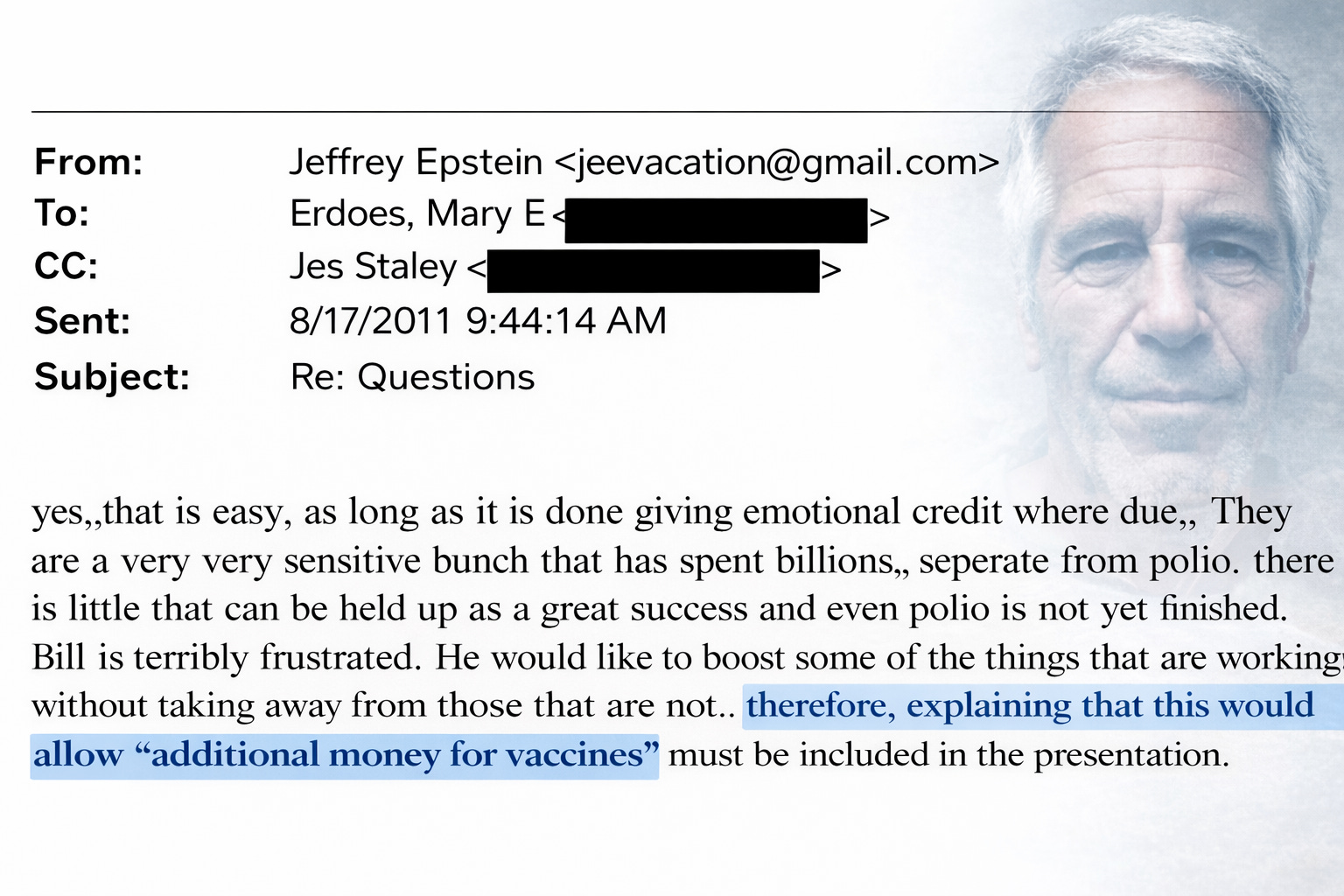
That is not a man on the periphery. That is a man at the center of the design process — coaching a bank CEO on how to handle a billionaire’s insecurities (”Bill is terribly frustrated”), dictating what “must be included” in the presentation (”additional money for vaccines”), projecting timelines and scale (”billions of dollars… tens of billions by year 4”), and insisting on offshore structures “especially for vaccines.”
Project Molecule is the table. Polished, presented to the client, stripped of the carpenter’s fingerprints. Whether that constitutes coordination or coincidence is a judgment the reader can make. But the documents are in the federal record. And they say what they say.
What $20 Million Buys in a Sovereign Nation
Every line item on that slide deserves scrutiny. But one of them demands it.
$40 million for polio vaccines in Pakistan. $20 million to “finance the surveillance network” in the same country. Sixty million dollars in biological operations — vaccine procurement and surveillance infrastructure — directed at a single sovereign nation by a private charitable entity governed from New York.
To understand what that means, you have to understand what was happening in Pakistan in 2011.
By that year, Pakistan was one of three remaining countries where polio was endemic (along with Afghanistan and Nigeria). The country’s polio status had become a matter of international reputation, trade eligibility, and diplomatic standing. The WHO had declared a Public Health Emergency of International Concern (PHEIC) related to polio spread, and countries with endemic transmission faced travel restrictions and reporting obligations.
The Epstein files themselves include correspondence showing Bill Gates meeting Pakistan’s Prime Minister at the United Nations in 2013, explicitly discussing polio eradication and the country’s National Emergency Action Plan. Publicly, this is cooperation — and it genuinely is.
But consider the layered reality that Project Molecule reveals when cross-referenced with the broader documentary record:
Pakistan’s international mobility and reputation were directly tied to disease status — specifically, to vaccination metrics defined by external actors.
Surveillance infrastructure was not financed by the Pakistani government. It was financed by foreign philanthropic capital, channeled through a private entity governed by unelected committees.
Eradication timelines were set not by Pakistan’s parliament but by the Global Polio Eradication Initiative — a partnership between the WHO, UNICEF, Rotary International, the CDC, and the Gates Foundation, with the Gates Foundation as the largest non-governmental funder.
Vaccination campaigns required military and police escorts due to local resistance — resistance that intensified after the CIA’s use of a fake hepatitis B vaccination campaign to gather intelligence in Abbottabad prior to the bin Laden raid in 2011, the same year Project Molecule was drafted.
That last point deserves emphasis. In the same year that JPMorgan proposed financing a surveillance network in Pakistan through a Gates-linked charitable vehicle, the CIA was running a fake vaccination campaign in the same country to collect DNA intelligence on Osama bin Laden’s compound. The operation was exposed, vaccination workers were subsequently murdered, and community resistance to foreign-funded health programs became a permanent feature of Pakistan’s public health landscape.

Project Molecule’s architects either knew this — in which case the surveillance line item takes on a different dimension — or they didn’t, in which case the obliviousness is itself a form of institutional arrogance. Either way, the document proposes building foreign-funded biological surveillance infrastructure in a country where foreign-funded biological programs had just been weaponized by an intelligence agency.
This is not occupation. No one is claiming it is. But it is a form of conditional governance — one in which a sovereign nation’s disease status, its access to international standing, its internal surveillance capacity, and its compliance with externally set health targets are all mediated by private capital operating through extraterritorial charitable structures.
Project Molecule did not invent this dynamic. But it proposed to institutionalize it — permanently, at scale, and under private governance.
And none of the above requires bad intent to produce structural harm. Once disease status becomes the mechanism through which a country’s international legitimacy is assessed — through travel eligibility, aid conditionality, reputational standing, and emergency declarations — what you have is not a health program. What you have is a credentialing system. The credentials are biological. The evaluators are private. And the consequences are sovereign.
Project Molecule does not merely fund vaccines. It funds the surveillance that tracks compliance. It funds the metrics that define success. It creates the governance structures that set targets. And it builds the institutional permanence that ensures the process continues regardless of political change — regardless of who wins the next election in Islamabad, or what the Pakistani parliament decides its health priorities should be.
The fire station was not merely designed. It was staffed, budgeted, and given jurisdiction over the building code.
The Carpenter’s Fingerprints
Jeffrey Epstein does not appear in the Project Molecule deck. Not as a signatory. Not as a committee member. Not as a named participant. But the reader has now seen both channels — the emails and the deck, the shorthand and the engineering — and watched them converge on the same architecture, in the same month, from the same division, at the same bank.
Remember how this relationship worked. In February 2011, JPMorgan sent Epstein a structured questionnaire — at Jes Staley’s direction — asking him to define the architecture of a Gates-linked fund. He replied the same evening with a fully formed vision. By August, Erdoes was emailing him directly — from vacation — asking for answers before the 31st. She got them the same night, from a man whose email signature read: “It is the property of Jeffrey Epstein.”
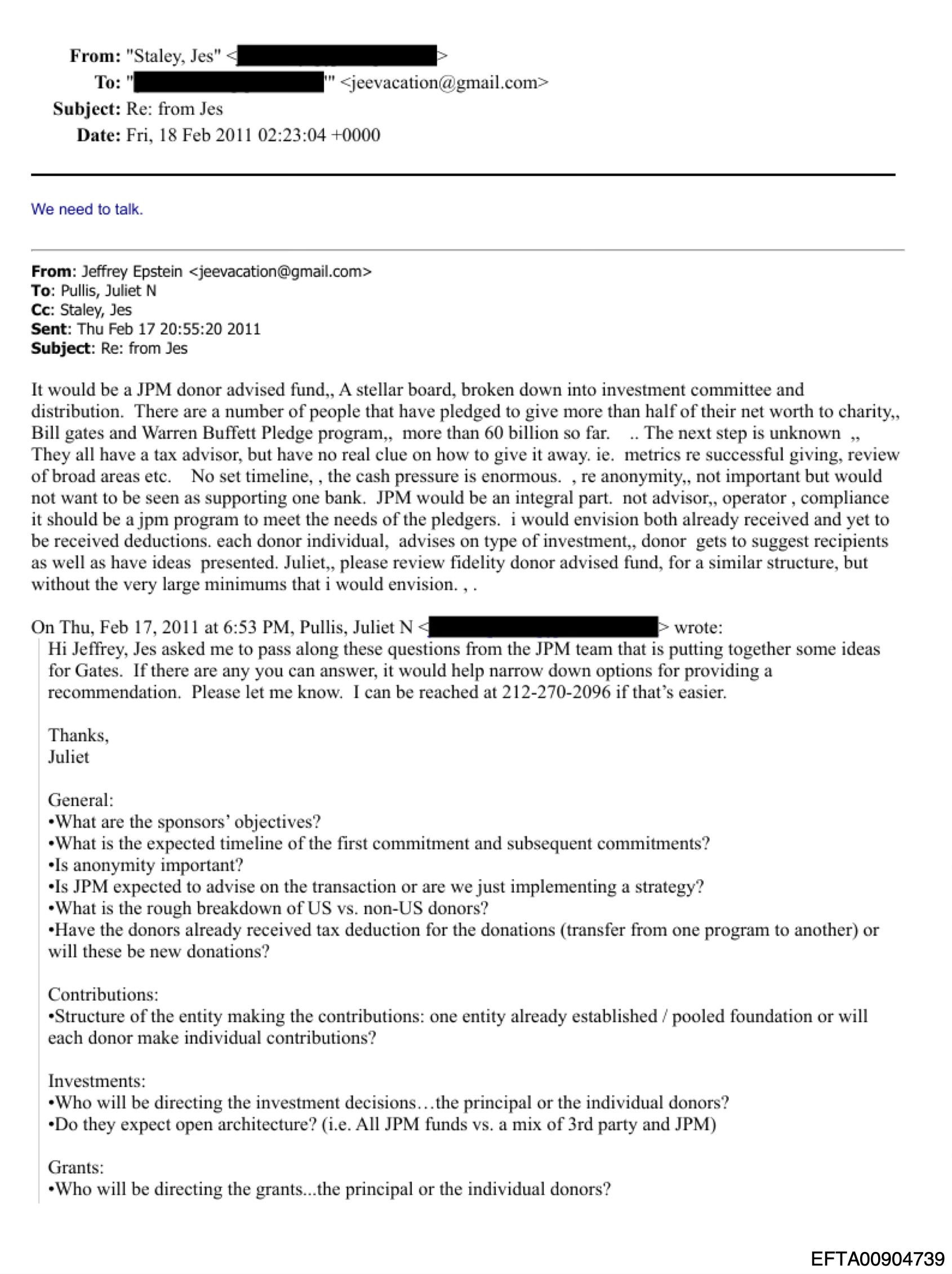
Source: Email thread titled “Re: from Jes” dated February 17–18, 2011. (EFTA00904739–40)
That is not a man on the periphery. That is the carpenter. And Project Molecule is the table — polished, presented to the client, stripped of his fingerprints. The building code has been written to accommodate the structure exactly as designed.
The Innocent Explanation — and Its Structural Limits
Let me be explicit about what the most charitable reading of this evidence looks like, because an investigation that cannot articulate the strongest counterargument to its own thesis is not an investigation. It is advocacy.
Project Molecule was a JPMorgan business development proposal. Major banks routinely pitch ultra-high-net-worth clients on bespoke charitable vehicles. The Gates Foundation’s leadership in global health made it a natural anchor client. The Giving Pledge, launched in 2010, created a market of billionaires looking for philanthropic infrastructure. JPMorgan saw a business opportunity and designed a structure to capture it. That is what banks do.
Within mainstream Western public health discourse, several assumptions are widely held and rarely questioned: that polio is a clearly defined viral disease; that mass vaccination campaigns save lives at scale; that surveillance networks are essential for disease detection and control; and that coordinated international health initiatives are both necessary and historically responsible for the eradication or suppression of diseases that once killed millions.
Operating within this framework, the individuals named on the proposed committees — including Warren Buffett, Bill and Melinda Gates, Susan Rice, Seth Berkley, and Jeffrey Sachs — are, by most conventional accounts, sincerely committed to improving global health outcomes. Many have devoted decades of their professional lives to public health, development, and humanitarian work, and their actions are generally understood, within this paradigm, as motivated by beneficence and urgency rather than malice.
All of this can be true.
And all of this can coexist with a structural critique that is equally true:
When the same institutions design the response, fund the response, measure the response, govern the response, and benefit from the permanence of the response — the system has no external check. When biological status becomes the basis for a country’s international standing, and the metrics are defined by the funders, and the funders are governed by private committees with no democratic accountability, the result is a governance system operating under the legal cover of charity.
The benign reading requires you to believe that every structural feature of this system — the offshore arms, the perpetual duration, the surveillance budgets, the committee governance, the donor anonymity — was simply good planning. The documents invite a different question: good planning for whom?
Project Molecule is not evidence of conspiracy. It is evidence of a system designed so thoroughly that conspiracy is unnecessary. The incentives align. The structures perpetuate. And no one needs to break the law when the law has been engineered to accommodate the architecture.
What Project Molecule Forces Us to Confront
The deeper revelation of Project Molecule is not that pandemics were planned. That is a separate evidentiary question, and one this investigation does not purport to resolve.
The revelation is that biology itself was being deliberately organized into a governance system — complete with boards of directors, investment committees with voting and non-voting members, grant distribution committees chaired by the spouse of the world’s richest man, surveillance networks funded by private capital, vaccine procurement budgets allocated by geography, offshore entities in tax-neutral jurisdictions, country-specific conduits for regulatory arbitrage, perpetual operational mandates with succession planning, and unified control over both the capital and the intervention.
This architecture was not improvised in 2020. It was being sketched — by name, in a Version 13 draft — in August 2011. And it was being sketched through two parallel channels that arrived at the same destination: one informal, routed through a convicted sex offender who was coaching Wall Street executives on how to handle the world’s richest man; and one formal, stamped with Bates numbers and presented to the client without a trace of the man who helped shape it.
That convergence is the question this investigation leaves on the table. Not whether the architecture existed — it did, and it is now part of the federal record. Not whether it was designed to be permanent — the deck says “perpetual” in black and white. Not whether it crossed sovereign borders — the budget slide names the countries and the dollar amounts.
The question is: what structural safeguard existed — or exists — to prevent this system from operating in the interest of the people who built it?
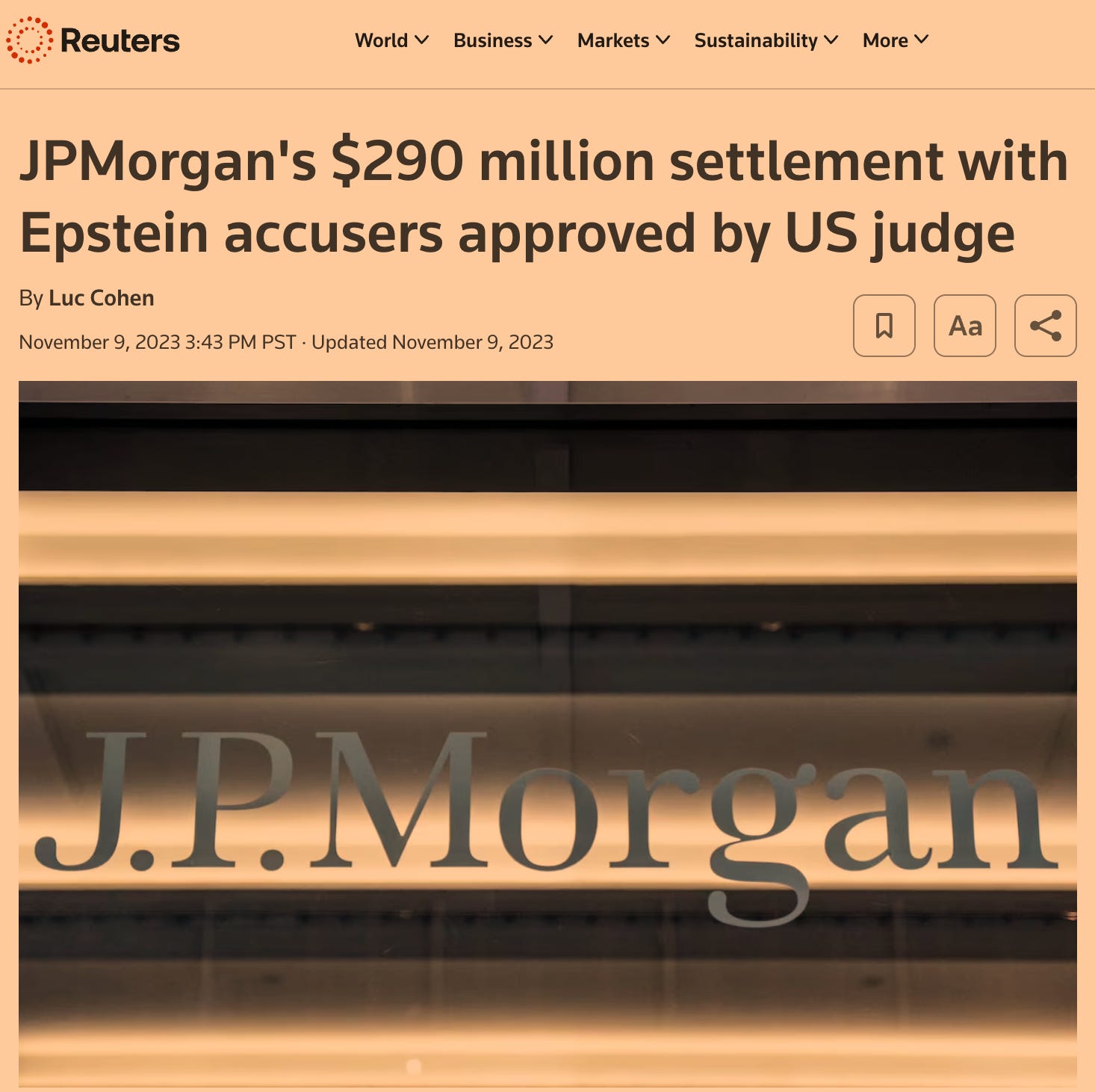
Not trust. Trust is what JPMorgan extended to a convicted sex offender for a decade — until a $290 million settlement and a federal judge’s rebuke proved that trust without accountability is not a safeguard. It is a liability.
Not transparency. The structure was specifically designed to “permit donor anonymity,” to operate through offshore entities in “tax neutral jurisdictions,” and to deploy capital through country-specific conduits that insulate the governing body from the governed populations.
Not democratic oversight. The committees answer to no parliament, no electorate, no freedom-of-information regime. The entity was designed to outlive any elected government that might question it.
If the people who design the financial vehicles also fund the simulations, hold the patents, develop the reinsurance triggers, place the personnel, set the eradication timelines, finance the surveillance, and chair the committees — then the question is not whether they would act in their own interest. The question is what mechanism exists to ensure they don’t. And if the answer is that no such mechanism was built into the architecture — that the architecture was, in fact, specifically designed to operate without one — then the architecture itself is the problem.
Project Molecule is fourteen pages long. It bears three sets of Bates stamps. It was revised at least twelve times. And it proposed to govern biology — permanently, privately, and across sovereign borders — from a boardroom populated by people who were never elected and can never be recalled.
The documents are in the federal record. They say what they say. And they are waiting for the questions that should have been asked in 2011 — by regulators, by legislators, by journalists, by anyone with the authority to demand answers from the people who designed this system and the institutions that housed them.
Sunlight remains the most effective public health intervention ever devised. It costs nothing. It requires no patent. And it has no side effects — except for those who prefer to operate in the dark.
This is Part 2 in a series.
Read, share, and comment on the X thread dedicated to this post.


A Note on Sources
Every claim in this article is sourced to documents produced under legal process in the Southern District of New York, bearing Bates stamps from the JPMorgan production (JPM-SDNY), the SDNY Government production (SDNY_GM), and/or the Epstein Files Task Act production (EFTA). Page-level citations are provided in the text. The Project Molecule deck itself spans EFTA01301114 through EFTA01301128 (14 pages, including the cover).
No claim in this article relies on anonymous sourcing, leaked documents, or unverified allegations. The documents cited are part of the federal record.
Just having Gates involvement says trouble for me.
I worked for IBM when PCs were fairly new. Bill Gates company was contracted to build an operating system for a new type of PC. After months of delay, IBM had to create a team to build the system in parallel, even though Gates was paid to do it. It turns out that Gates was building a competing device to the exact machine he was delaying. He wanted to be first out on the market! IBM let it go because Gates had a small business at the time and they didn’t want to play Goliath against David.
Secondly, Gates was involved with a vaccine distribution in some African countries that surreptitiously injected a substance that rendered women infertile. I’m told there are places over there where he would be shot on sight!
He just can’t be trusted.
You are absolutely knocking it OUT of the PARK, sir. Some may even say, that man is on FIRE! Please be careful, and please don’t ever stop being who you. This is reporting at its finest. And speedy! You’re an animal haha And yes, thank you🙏