

Why We Built Our Fermented Natto on Chickpeas and Not Soy

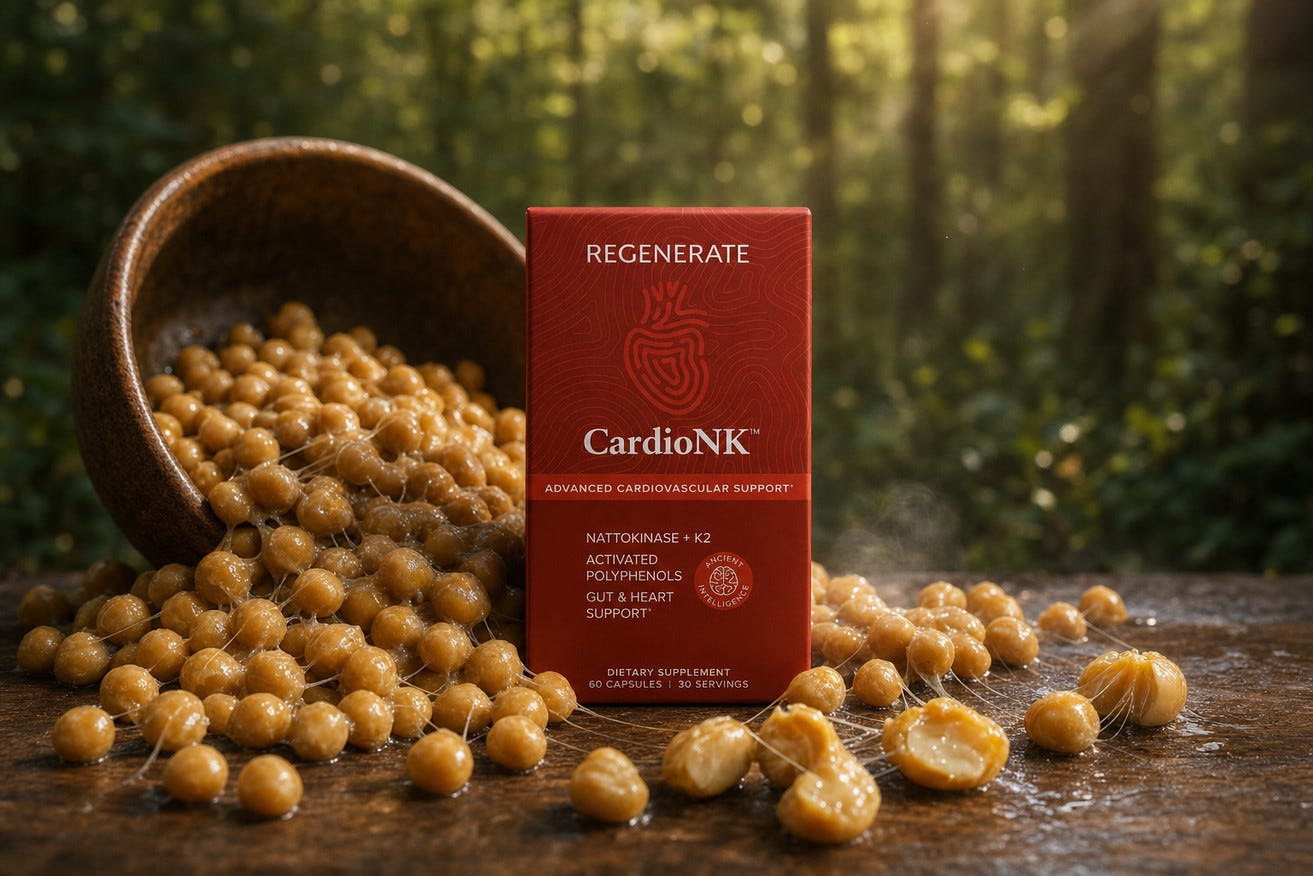
The substrate is not a side note. It’s the story behind CardioNK.
Our wildly popular CardioNK product has a powerful central starter ingredient — natto — and it accounts for why we have received so much customer feedback already on its beneficial effects for digestion and regularity. And one of the most consistent questions we have received is: does it contain soy?
Indeed, when most people picture natto, they picture soybeans — slimy, pungent, threaded together with the unmistakable strings of Bacillus subtilis var. natto at work. That image is a thousand years old, and it has shaped the entire modern nattokinase and vitamin K2 (MK-7) supplement category. Walk down any cardiovascular aisle and the soybean is the silent assumption behind every capsule.
We chose to break that assumption. Our fermented natto is built on chickpeas (Cicer arietinum), and the decision was not aesthetic. It was driven by what the bacterium actually needs to produce a high-activity enzyme, by what the consumer actually needs in a daily delivery vehicle, and by what the published science says about the substrate as a living matrix — not merely a food for the microbe, but a structural partner in the final product.
This is the long-form explanation of why.
1. The substrate is the bacterium’s environment — and chickpea is the better one
The first thing to understand is that nattokinase and MK-7 are not chickpea molecules or soybean molecules. They are Bacillus subtilis molecules. The legume is the bacterium’s habitat — its food, its scaffold, its signaling environment. Change the habitat, and you change the bacterium’s behavior.
When researchers actually run the comparison head to head, chickpea wins on the metrics that matter:
In an optimized solid-state fermentation, cracked chickpea produced nattokinase activity of ~356 FU/g — about 22% higher than cracked soybean under identical conditions, with only ~28% of the γ-PGA (poly-γ-glutamic acid) byproduct that soy fermentation generates (Toku Health summary of Wei et al.).
A separate Chinese patent on a high-yielding B. subtilis DC-Tx strain reported fibrinolytic activity up to 3,000 FU/g on chickpea substrate, with hydroxyl-radical scavenging of 88.5% and iron-reducing power 3.33× that of unfermented chickpea — i.e. the fermentation itself amplifies the antioxidant chemistry of the bean (CN104212741A patent).
A comparative study of ten plant substrates fermented by B. subtilis var. natto showed MK-7 yields are not soy-exclusive — most legumes and seeds support strong menaquinone-7 biosynthesis, and several non-soy substrates outperformed soy (Sciendo, 2021).
The takeaway is plain: the long-held assumption that “soy = best substrate” is a cultural inheritance, not a biochemical one. Chickpea matches or exceeds soy on enzyme activity while shedding most of soy’s downsides.
2. Chickpea fibers actively trigger Bacillus subtilis biofilm formation
This is the part of the science that genuinely surprised us, and it is the reason chickpea became non-negotiable for us.
A 2021 study in Nutrients — Amoah et al., “Chickpea-Derived Prebiotic Substances Trigger Biofilm Formation by Bacillus subtilis“ — demonstrated that chickpea-derived fibers (CPF) are not a neutral growth medium. They are a signaling molecule. (PMC8704855)
Specifically, the researchers showed:
Chickpea fiber upregulates the tapA operon — one of the master biofilm-matrix genes in B. subtilis — in a dose-dependent manner. Cellulose and other generic fibers do not produce the same effect.
CPF triggers robust pellicle formation (the air–liquid biofilm) and the production of pulcherrimin, an iron-binding antimicrobial pigment that protects the colony from pathogenic competitors.
Scanning electron microscopy showed B. subtilis cells physically embedding onto and into the chickpea fibers — not just floating in suspension. The fiber becomes part of the bacterial architecture.
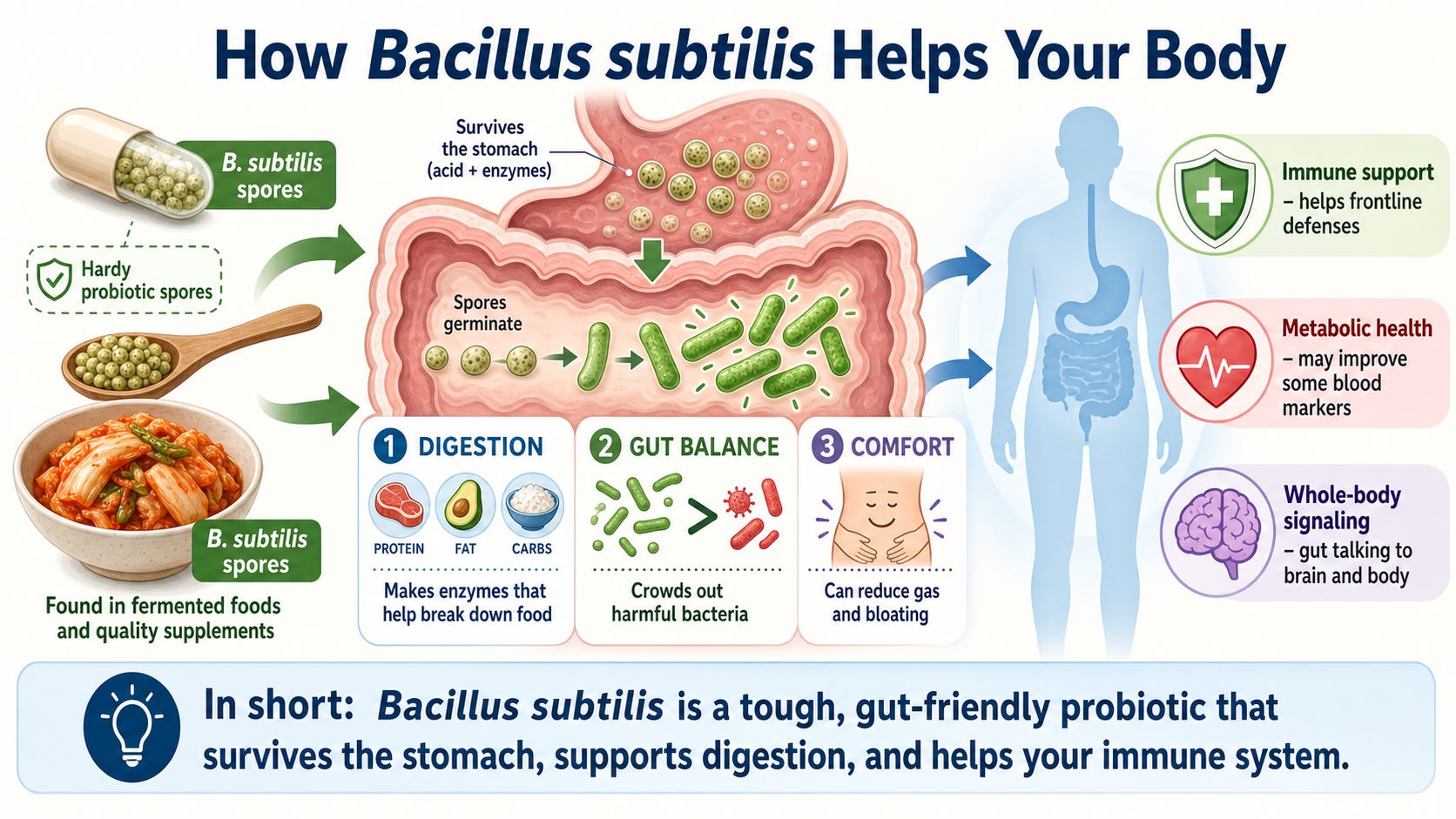
Why does this matter for a finished natto product? Because biofilm-encapsulated B. subtilis is a fundamentally different organism than planktonic B. subtilis. It is more metabolically active, more resistant to environmental stress, and — critically for a supplement — more likely to survive the trip through the stomach.
3. Chickpea fiber acts as a protective matrix through digestion
The Amoah team did not stop at imaging. They ran the chickpea-encapsulated B. subtilis through a simulated digestion system and measured survival.
The result: chickpea-fiber-grown B. subtilis survived simulated gastric and intestinal digestion at roughly 100-fold higher rates than control cells — a 2-log CFU/mL increase over standard media, and significantly better than wheat fiber (0.6 log) or cellulose fiber (1 log) (PMC8704855).
This is the protective-matrix claim, validated experimentally. Chickpea is not just a food the bacterium grows on. It is:
A biofilm inducer (via tapA upregulation and pulcherrimin synthesis)
A physical scaffold the cells colonize and adhere to
A gastric shield that carries viable, metabolically competent B. subtilis into the lower GI tract, where it can continue to produce metabolites, support the microbiome, and exert downstream effects
For a fermented natto product whose value proposition includes both the enzyme (nattokinase, MK-7) and the living organism (probiotic B. subtilis), this is a substrate that does double duty. Soy does not do this. Cellulose does not do this. Wheat fiber does not do this. Chickpea does.
4. The allergen, phytoestrogen, and γ-PGA problem
There is also what chickpea doesn’t bring with it.
Soy allergy. Soy is one of the U.S. “Top 9” allergens. For a daily cardiovascular supplement intended for long-term use, building it on one of the most common food allergens is a design choice with consequences. Chickpea is not on the Top 9 list and represents a completely different allergen class.
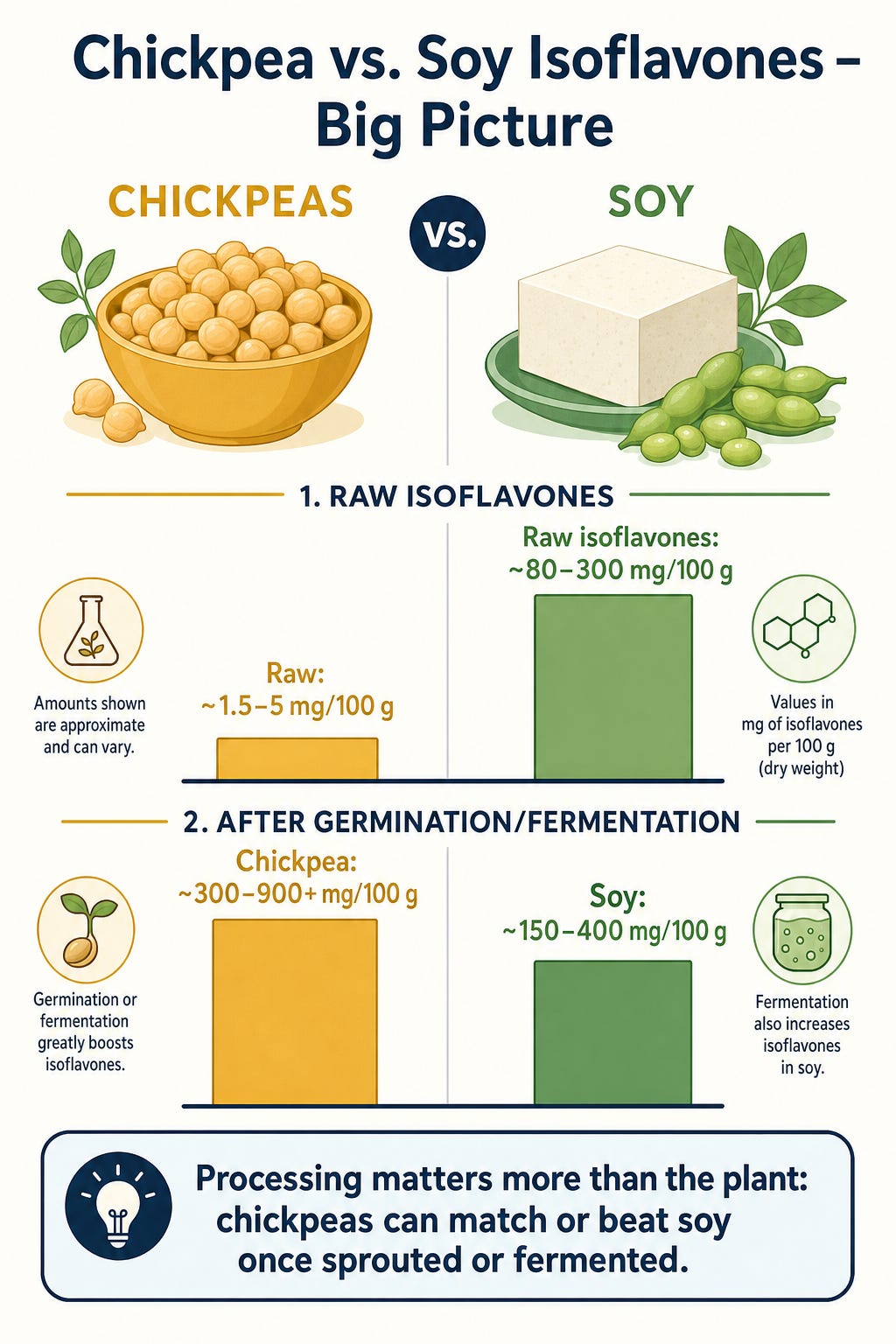
Phytoestrogens. Soy carries one of the highest dietary isoflavone loads of any common food — daidzein and genistein in totals that routinely reach 100–200 mg per 100 g in soy flour, per the USDA Isoflavone Database. Chickpea’s profile is dominated by biochanin A and formononetin — different isoflavones, at substantially lower concentrations in the unsprouted bean (Yang et al., J. Agric. Food Chem. 2015). For consumers and clinicians concerned about long-term hormonal exposure from daily supplementation, this is a meaningful reduction.
γ-PGA (poly-γ-glutamic acid). This is the sticky, stringy polymer that gives traditional natto its signature texture — and it is also the byproduct most associated with natto’s allergenic reactions and the purification headaches that plague commercial nattokinase manufacturing. Chickpea fermentation generates roughly 72% less γ-PGA than soy fermentation under matched conditions (Toku Health summary). Less PGA means cleaner extraction, lower allergenicity, and a more stable final product.
5. The phytoestrogen story is better than “less” — it’s “the right ones, made bioavailable”
There is a subtlety worth drawing out, because it is one of the most interesting things about building natto on chickpea rather than soy — and it deserves to be stated plainly rather than buried.
Section 4 noted that the raw chickpea carries a far lighter isoflavone load than soy. That is true of the bean as it sits in the bag. But CardioNK is not raw chickpea — it is fermented chickpea, and processing changes the phytoestrogen picture substantially. Germination alone can increase chickpea isoflavone content by over 100-fold, with germinated chickpea surpassing germinated soybean roughly five-fold in total isoflavonoid content (Wu et al., J Agric Food Chem 2012). The “low-phytoestrogen” intuition applies to the raw seed, not to processed chickpea.
The body sees the same molecules. It simply arrives at them from a precursor that is gentler on the way in.
Chickpea’s two signature isoflavones are biochanin A and formononetin. Soy’s are genistein and daidzein. For years these were treated as different families with different effects. They are not. In the gut and liver, biochanin A is O-demethylated into genistein, and formononetin into daidzein — meaning the chickpea isoflavones converge on the same bioactive end-products as soy at the systemic level (Megías et al., J Funct Foods 2016).
What fermentation adds is bioavailability. Microbial β-glucosidases cleave the bound glucoside forms of these isoflavones into free aglycones — the form the small intestine absorbs fastest and most completely (Hsiao et al., J Funct Foods 2020). Significant levels of these absorbable aglycones are found almost exclusively in fermented foods like tempeh and miso. A fermented chickpea is therefore not a weaker phytoestrogen source than soy; it is a cleaner-precursor, higher-bioavailability one — the same beneficial end-products, in their most absorbable form, without soy’s allergen profile and with a fraction of the γ-PGA.
The clinical literature on these isoflavones is not soft. Biochanin A and formononetin show documented anti-inflammatory activity (COX-2, iNOS, NF-κB, and NLRP3 inflammasome suppression), cardiovascular effects (reduced LDL oxidation and lower VCAM-1/ICAM-1/MCP-1 expression on vascular endothelium), insulin-sensitizing action, bone-protective effects in ovariectomized models, and neuroprotective signaling through the PI3K/AKT and Nrf-2/HO-1 pathways (de Camargo et al., Int J Mol Sci 2019; Yang et al., Int J Mol Sci 2022). These are precisely the cardiometabolic and vascular targets CardioNK is built around — which means the substrate’s phytochemistry is pulling in the same direction as its enzyme and vitamin payload.
The honest version: Choosing chickpea did not mean giving up the documented benefits of dietary isoflavones. It meant keeping those benefits, converting them into their most absorbable form through fermentation, and shedding the allergen and texture-polymer liabilities bundled with soy. The phytoestrogen is not a cost we minimized — it is another instance of the substrate doing work.
6. Chickpea has its own clinical record — separate from the bacterium
Even before fermentation, chickpea is one of the most clinically studied pulses in the human diet. The PubMed clinical-trial record for chickpea includes randomized controlled trials demonstrating:
Improved postprandial glycemic control and gut-hormone (GLP-1, PYY) secretion from chickpea-flour-enriched foods (Am J Clin Nutr, 2023; Food Res Int, 2024)
Improved endothelial function — sprouted chickpea flour in pasta increased brachial artery flow-mediated dilation in a randomized trial (Physiology International, 2019)
Cardiometabolic risk reduction in pulse-based dietary interventions for PCOS and metabolic syndrome (Nutrients, 2018)
Lower metabolizable energy than predicted by Atwater factors — chickpea delivers ~10% fewer absorbed calories than the label implies, with the difference fermented in the colon to short-chain fatty acids (Nutrients, 2025)
For a product whose primary clinical targets are cardiovascular and metabolic — blood viscosity, fibrinolysis, arterial calcification (MK-7’s domain), endothelial health — building on a substrate with its own independent cardiometabolic clinical evidence is a compounding effect, not a coincidence.
7. Summary: why chickpea, in one breath
We chose chickpea as the base for our fermented natto because it is the only substrate we evaluated that simultaneously:
Yields higher nattokinase activity than soy under matched conditions (~22% higher FU/g in head-to-head studies, up to 3,000 FU/g with optimized strains)
Supports robust MK-7 (vitamin K2) biosynthesis by B. subtilis — the same metabolic pathway that operates on soy, with no penalty
Actively induces biofilm formation in B. subtilis via dose-dependent upregulation of the tapA matrix operon — a signaling effect specific to chickpea fiber
Functions as a protective matrix that delivers ~100-fold higher B. subtilis survival through simulated gastric digestion
Eliminates soy allergen exposure, drops phytoestrogen load substantially, and cuts γ-PGA byproduct by ~72%
Carries an independent clinical record for postprandial glucose, gut hormones, endothelial function, and cardiometabolic risk — all directly relevant to the populations we expect to use the product
In other words: the substrate is doing work. It is feeding the bacterium, signaling the bacterium, housing the bacterium, shielding the bacterium through the stomach, and contributing its own clinically demonstrated benefits to the person taking the final product.
A soy-based natto is a fermentation. A chickpea-based natto, as we’ve built it, is a synbiotic delivery system — enzyme, vitamin, viable probiotic, and prebiotic matrix in a single fermented food.
That is why we chose the chickpea. The bean is not the side note. It is the architecture.
If you are looking for a product that is focused on supporting healthy gut health and healthy circulation, learn more about CardioNK.
Selected references
Amoah YS, Rajasekharan SK, Reifen R, Shemesh M. Chickpea-Derived Prebiotic Substances Trigger Biofilm Formation by Bacillus subtilis. Nutrients. 2021;13(12):4228. doi:10.3390/nu13124228. PMID:34959781.
Wei X, Luo M, Xu L, et al. Production of Fibrinolytic Enzyme from Bacillus amyloliquefaciens by Fermentation of Chickpeas. J Agric Food Chem. 2011;59(8):3957–3963. doi:10.1021/jf1049535.
Liu et al. Bacillus subtilis Producing Fermented Chickpea Having Fibrinolytic and Antioxidant Function. Patent CN104212741A, 2014.
Method for Producing Nattokinase by Fermenting Chickpea. Patent CN103387970A, 2012.
Berenjian A, et al. Advances in Enhanced Menaquinone-7 Production From Bacillus subtilis. Front Bioeng Biotechnol. 2021;9:679970. doi:10.3389/fbioe.2021.679970.
Popa A, et al. Preparation of Vitamin K2 MK-7 by Fermentation of Various Plant Materials by Bacillus subtilis var. natto. Acta Universitatis Cibiniensis. 2021.
Mahanta N, et al. Development of Menaquinone-7 Enriched Nutraceutical. J Food Sci Technol. 2014. PMCID:PMC4519498.
Wu Z, Song L, Feng S, et al. Germination Dramatically Increases Isoflavonoid Content and Diversity in Chickpea Seeds. J Agric Food Chem. 2012;60(35):8606–8615. doi:10.1021/jf3021514. PMID:22816801.
Gao Y, Yao Y, Zhu Y, Ren G. Isoflavone Content and Composition in Chickpea Sprouts Germinated under Different Conditions. J Agric Food Chem. 2015;63(10):2701–2707. doi:10.1021/jf5057524. PMID:25630489.
Megías C, Cortés-Giraldo I, Alaiz M, Vioque J, et al. Isoflavones in Chickpea Protein Concentrates. J Funct Foods. 2016;24:330–337. doi:10.1016/j.jff.2015.12.042.
Hsiao YH, Ho CT, Pan MH. Bioavailability and Health Benefits of Major Isoflavone Aglycones and Their Metabolites. J Funct Foods. 2020;74:104164. doi:10.1016/j.jff.2020.104164.
de Camargo AC, Favero BT, Morzelle MC, et al. Is Chickpea a Potential Substitute for Soybean? Phenolic Bioactives and Potential Health Benefits. Int J Mol Sci. 2019;20(11):2644. doi:10.3390/ijms20112644. PMID:31146372.
Yang SE, Lien JC, Tsai CW, Wu CR. Therapeutic Potential of Novel Simple O-Substituted Isoflavones against Cerebral Ischemia Reperfusion. Int J Mol Sci. 2022;23(18):10394. doi:10.3390/ijms231810394. PMID:36142301.
Clark JL, Taylor CG, Zahradka P. Insulin-Sensitizing Actions of Soybeans, Chickpeas, and Their Bioactive Compounds. Nutrients. 2018;10(4):434. doi:10.3390/nu10040434. PMID:29601521.
Milán-Noris AK, Gutiérrez-Uribe JA, Santacruz A, et al. Peptides and Isoflavones in GI Digests Contribute to the Anti-Inflammatory Potential of Cooked or Germinated Chickpea. Food Chem. 2018;268:66–76. doi:10.1016/j.foodchem.2018.06.068. PMID:30064805.
Ali SE, El Badawy SA, Elmosalamy SH, et al. Reproductive and Metabolic Effects of Cicer arietinum L. Extract on Letrozole-Induced PCOS in Rat Model. J Ethnopharmacol. 2021;278:114318. doi:10.1016/j.jep.2021.114318. PMID:34111539.
Novotny JA, et al. Metabolizable Energy Value of Chickpeas and Lentils. Nutrients. 2025. PMID:40944115.
Toku Health. Soy-Free Nattokinase: Chickpea vs Soy Fermentation. 2026.
Updated May 30, 2026 • Based on peer-reviewed literature indexed in PubMed/NCBI and publisher databases • For educational purposes only • Consult a healthcare professional before making dietary or therapeutic decisions.
It is my understanding that even organic chickpeas are dehydrated with glyphosate. is it guaranteed that these chickpeas are not treated after they are grown and picked with glyphosate?
Does anyone understand why CardioNK can be taken with food while nattokinase supplements are taken between meals to hinder rubbery blood clots and help the blood circulation in general? Does CardioNK provide this type of benefit? If not should people take both CardioNK and nattokinase supplements? Has there been a discussion of this issue on Sayer Ji's substack? If so could you point me to that? Thank you for any help.