
When the WHO Lost the Plot—and the Funding

View and share the X thread dedicated to this post.
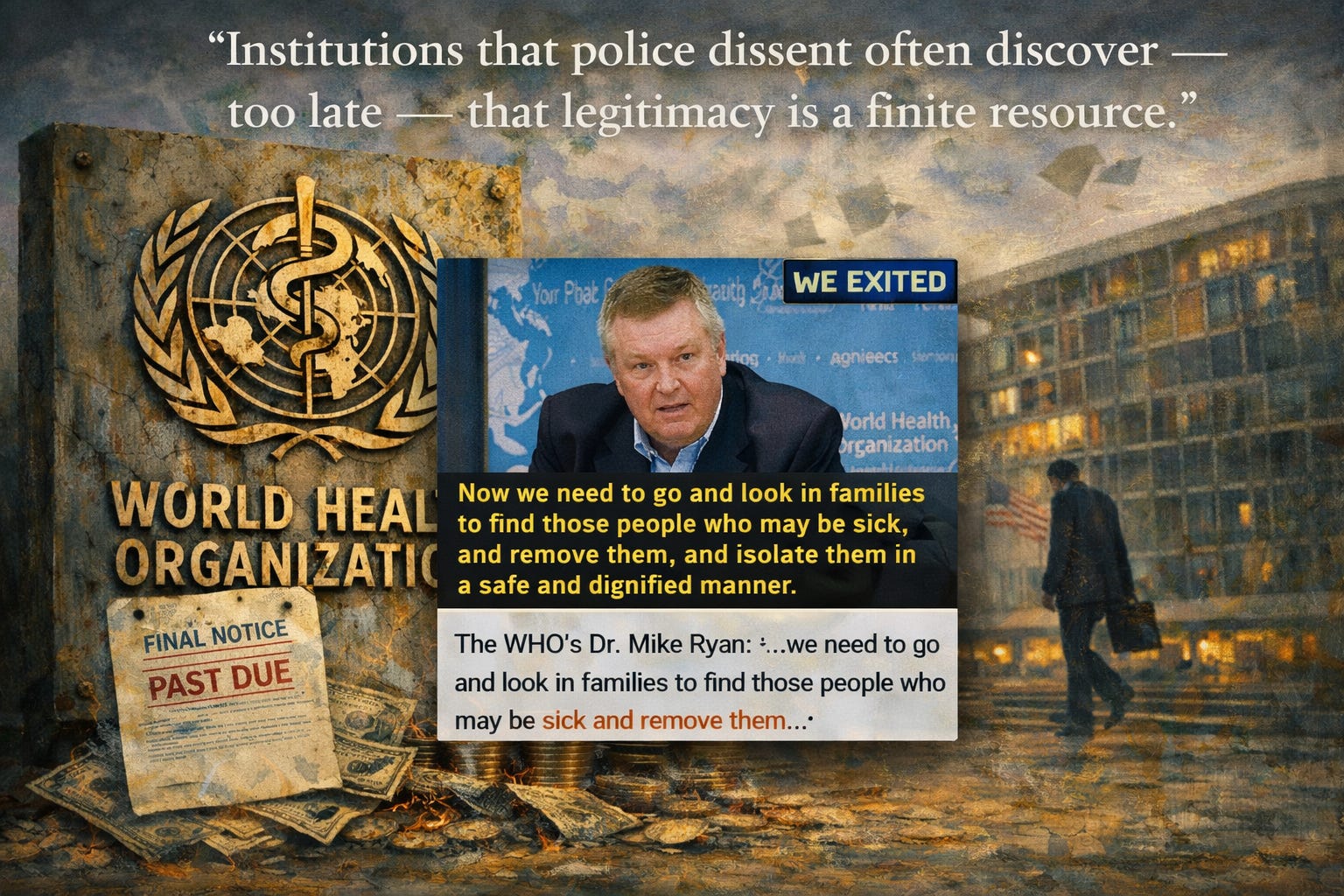
“Institutions that police dissent often discover—too late—that legitimacy is a finite resource.”
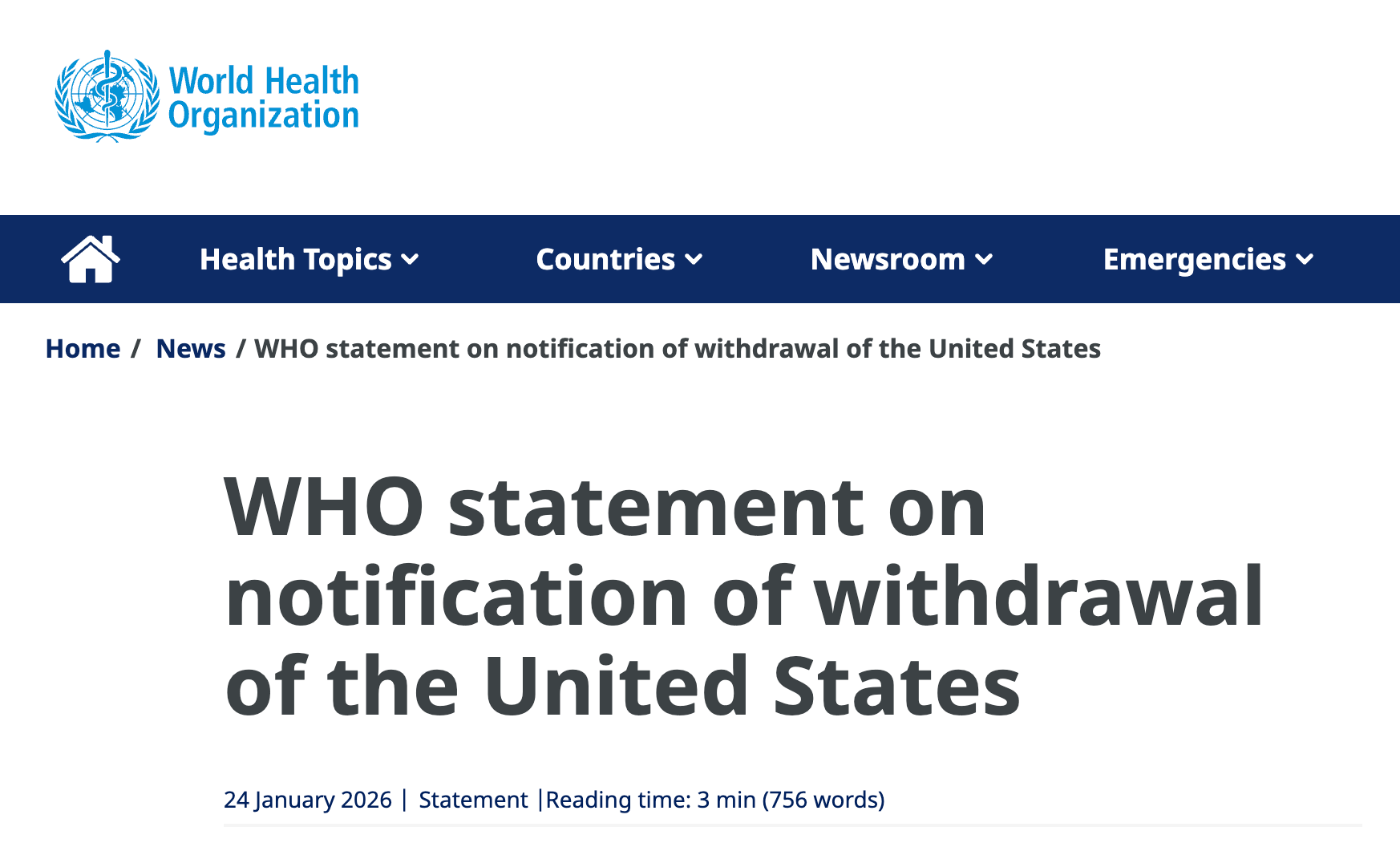
When the World Health Organization issued its carefully worded statement on January 24, 2026, responding to the formal notification of U.S. withdrawal, the tone was calm, regretful, and resolutely moral. The world, it warned, would be less safe without the United States. Cooperation saves lives. Science must transcend politics. The statement read less like an internal reckoning and more like a sermon delivered after the congregation had already walked out the door.¹
What the statement did not—and could not—say is that the WHO now finds itself living inside a paradox of its own making.
For years, the organization and its allied institutions aggressively framed critics of its pandemic policies as dangerous vectors of “misinformation.” Those who questioned lockdowns, mandates, data transparency, or conflicts of interest were not merely debated; many were actively marginalized—de-platformed on social media, demonetized, professionally stigmatized, and portrayed as threats to public safety. The message was clear: dissent itself was a contagion.
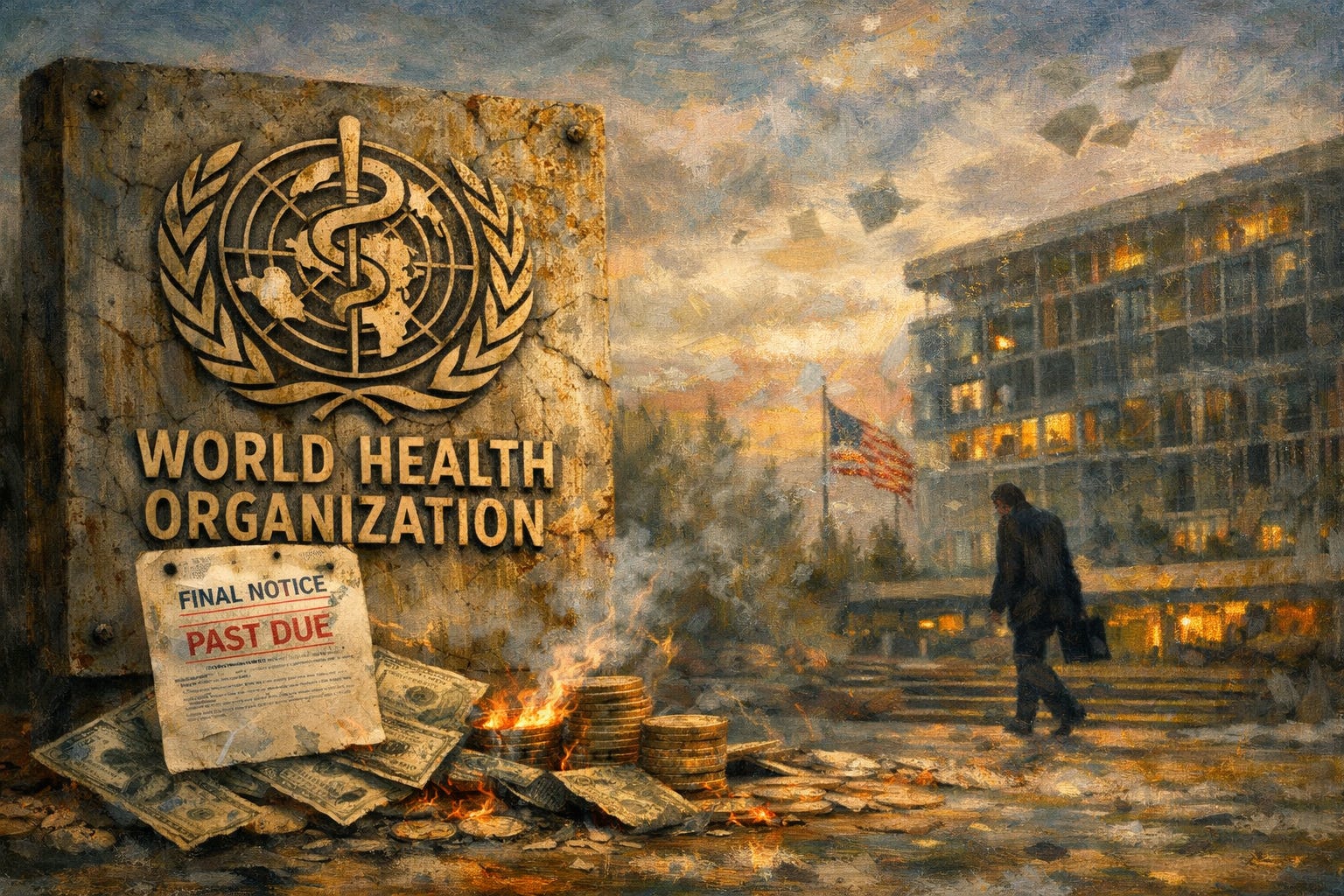
Now, in a reversal rich with irony, the WHO itself has been effectively demonetized.
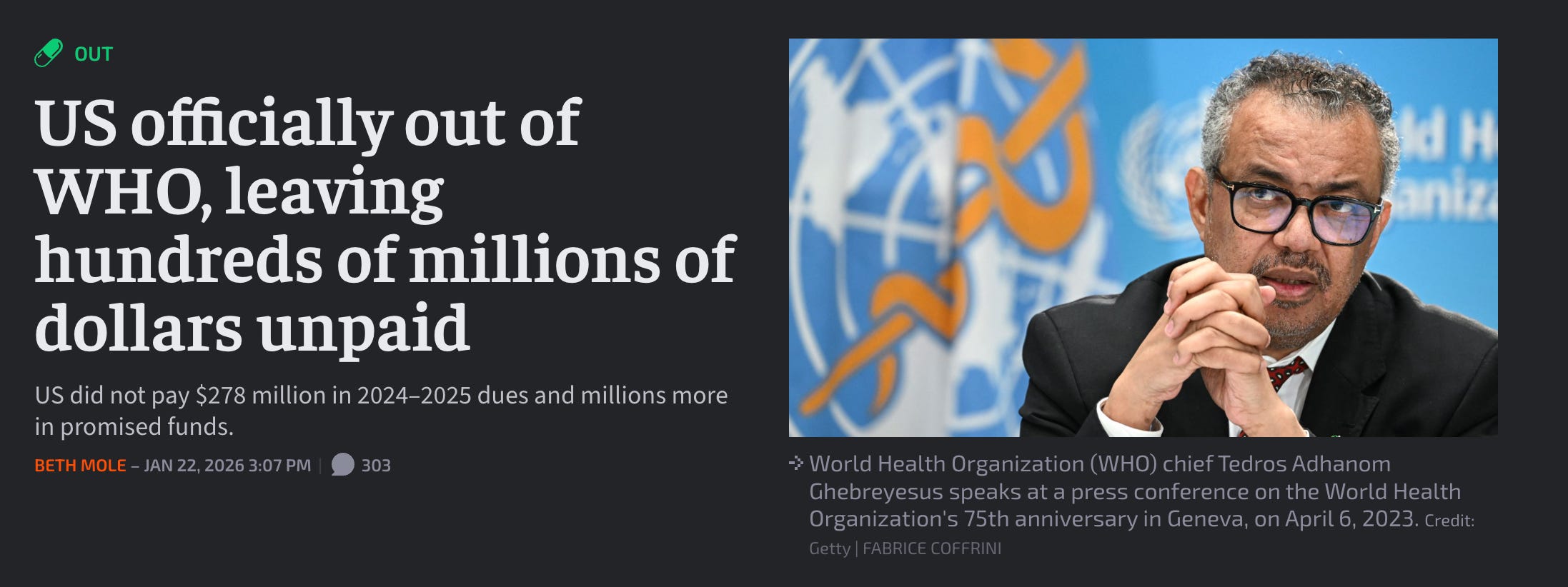
As Ars Technica reported, when the United States officially completed its withdrawal from the WHO on January 22, 2026, it did so while leaving behind roughly $260–$280 million in unpaid assessed dues—mandatory contributions, not optional grants.² The U.S. did not merely leave; it stiffed the organization on the way out. The result is not symbolic. It is structural. The WHO is now confronting budget shortfalls, hiring freezes, program cuts, and a forced re-evaluation of its operational capacity—precisely the kind of institutional fragility that critics warned could arise from over-centralization, political capture, and bureaucratic insulation.
For a fuller account of the political and constitutional implications of this moment, including how the withdrawal formally unfolded and why it represents a historic rupture rather than a symbolic gesture, see my earlier analysis: “Breaking: The U.S. Formally Exits the WHO.” That piece situates the funding decision within a broader framework of sovereignty, accountability, and democratic consent—context essential to understanding what follows.
The contrast between rhetoric and reality is stark. In its official statement, the WHO reaffirmed its impartiality and global indispensability, rejecting accusations of mismanagement and political influence.¹ Yet the organization’s financial model tells a more complicated story—one that reveals how power actually flowed during the pandemic years.
Long before the U.S. withdrawal, the WHO had already shifted away from stable, assessed contributions from member states toward voluntary, earmarked funding—much of it from private actors. Chief among them: the Bill & Melinda Gates Foundation. Over the past decade, the Gates Foundation has ranked as one of the WHO’s largest funders, accounting for roughly 9–10% of its total budget in some years.³ These are not neutral dollars. Voluntary contributions are typically earmarked for specific priorities, giving donors disproportionate influence over agenda-setting and program design.
This is where the irony sharpens.
Bill Gates, a software billionaire with no medical degree and no public mandate, became one of the most influential figures in global health governance—helping shape vaccine strategy, pandemic preparedness frameworks, and policy priorities worldwide. This influence was normalized, even celebrated, under the banner of philanthropy. Meanwhile, physicians, scientists, journalists, and citizens who raised uncomfortable questions were told they were “not qualified” to speak, that they were undermining trust, that platforms were right to silence them “for the greater good.”
In effect, authority was decoupled from accountability. Credentialism was enforced downward, while power flowed upward to institutions and individuals immune from democratic constraint.
Now the system has inverted. The WHO, once backed by the combined authority of governments, media, and platforms, finds itself exposed to the hard mechanics of money and sovereignty. Narrative control cannot pay salaries. Moral language cannot close budget gaps. And appeals to global solidarity ring hollow when the organization’s largest historical state funder has not only exited, but refused to settle its debts.²
This is not merely a funding crisis; it is a legitimacy crisis. An institution that helped normalize de-platforming and demonetization as tools of governance is now experiencing their functional equivalent at a geopolitical scale. The very tactics used to discipline critics—financial pressure, reputational framing, exclusion from systems—are now being applied to the institution itself, albeit by states rather than platforms.
One moment, in particular, crystallized this collapse of legitimacy for millions—and it is worth embedding and remembering in full. During a 2020 briefing, WHO emergencies director Mike Ryan calmly suggested that authorities might need to “go into families,” identify sick individuals, and remove them for isolation, framing even the potential seizure of children as something that could be done in a “safe and dignified manner.”
The statement was delivered casually, without legal qualification, without acknowledgment of constitutional limits, and without apparent awareness of the terror such language evokes in societies with histories of state abuse. It was not merely a misstatement; it was a revelation. For many listeners (and millions of Americans who took action through our multiple EXIT THE WHO campaign at Stand for Health Freedom), this was the moment the mask slipped—when public health guidance crossed into rhetoric of coercive family separation, and when an unelected international body appeared to contemplate powers no free society could morally or legally grant. That the media largely ignored the remark only deepened the rupture. Legitimacy does not survive threats to the most intimate human bond. And once an institution is heard—clearly and on the record—entertaining such an agenda, no amount of retrospective clarification or moral language can fully restore trust.
The WHO’s January 24 statement gestures toward hope that the United States may one day return.¹ But the deeper issue is not whether a single country rejoins. It is whether global health governance can survive a model that concentrated authority, suppressed dissent, and outsourced influence to private capital—while assuming that public trust and public funding were inexhaustible.
They weren’t.
And the lesson unfolding now is one that critics tried to articulate years ago, often at great personal cost: systems that treat disagreement as heresy eventually discover that compliance is a fragile foundation. When legitimacy erodes, funding follows. And when funding disappears, even the most powerful institutions are forced to confront the consequences of the narratives they once enforced.


References
World Health Organization. “WHO Statement on Notification of Withdrawal of the United States.” January 24, 2026. https://www.who.int/news/item/24-01-2026-who-statement-on-notification-of-withdrawal-of-the-united-states.
Beth Mole, “US Stiffs WHO Hundreds of Millions as It Officially Withdraws,” Ars Technica, January 22, 2026. https://arstechnica.com/health/2026/01/us-stiffs-who-hundreds-of-millions-as-it-officially-withdrawals/.
Kelley Lee and Owain Williams, “The Gates Foundation and Global Health Governance,” BMJ Global Health 10, no. 10 (2025): e015343. https://gh.bmj.com/content/10/10/e015343.
Gates and his crony billionaires are not and have never been philanthropists in any sense of the word. They are parasites paying their peons for power.
I still want a complete accounting of mortality by age and by number of Covid-19 shots fue every country and then a study of how foundries fared according to the level of compliance with WHO recommendations. It seems to me that the countries who disregarded the most recommendations fared the best. Then the WHi should fire everyone who gave bad advice. This will never happen, but we must demand more information.