
The Impossible Beauty of the Peacock
How the most astonishing color in nature is built from darkness — and why knowing exactly how only makes it more implausible.

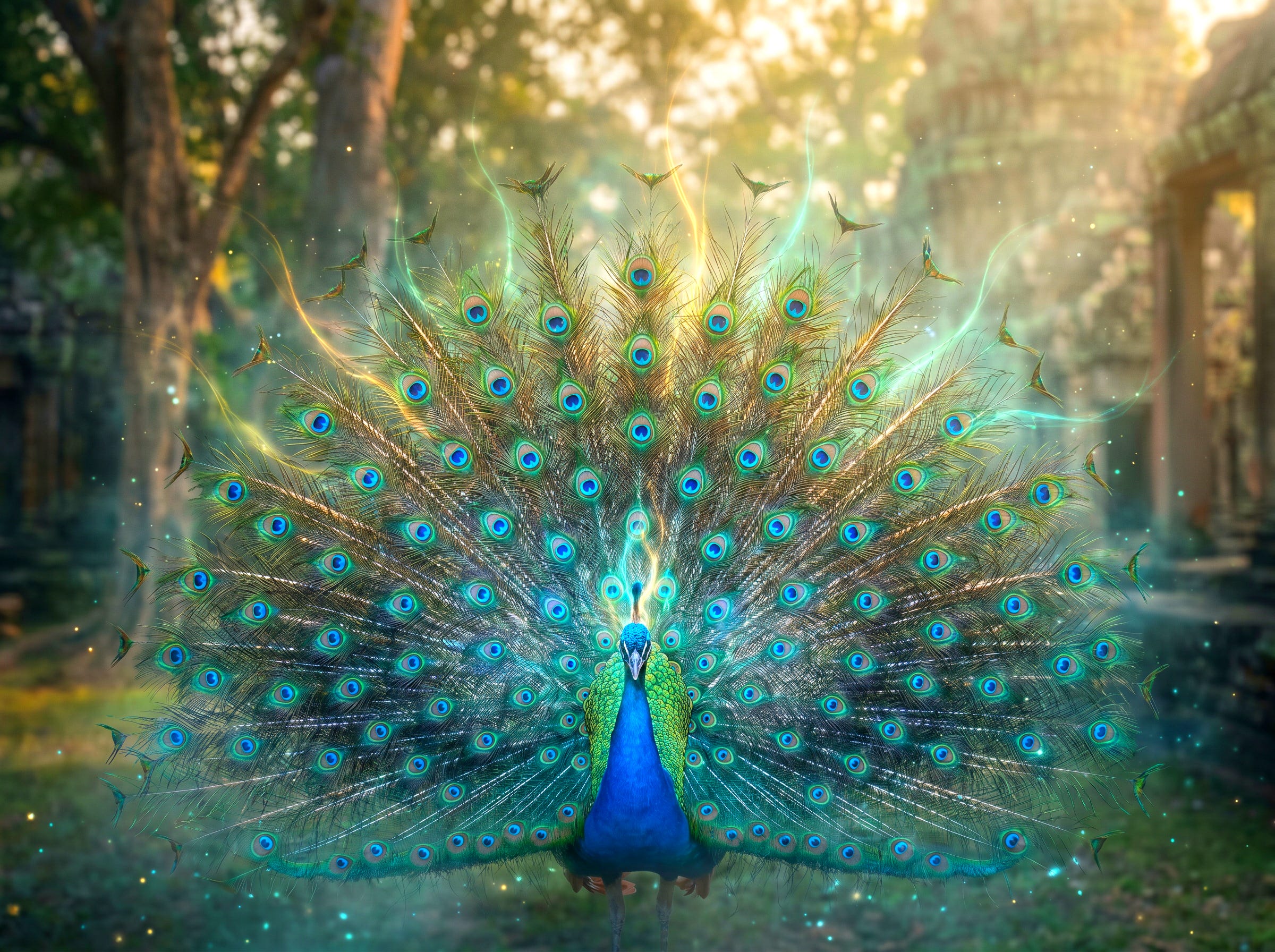
God made a rainbow flesh in a bird.
I’ll start with the obvious: we shouldn’t exist. But we do. Nothingness is the more plausible outcome — in nearly every case, it is easier for there to be nothing than something. And yet here is a universe instead: infinite, incomprehensible, inexhaustible. It is here. We can’t leave it, not even in death.
These may sound like philosophical abstractions — and they are, if you haven’t lived the awe personally. So let me start instead with something real, and specific, that also shouldn’t be here, and certainly not in the most impossibly gorgeous form I know: the peacock. It is a key. Turn it, and it unlocks the doors of perception at every scale at once.
The colors are not in the feather
Start with the secret almost no one who gasps at a peacock ever learns.
Grind a peacock’s train to powder and you get brown. Drab, dead-leaf brown. There is no blue pigment in the bird. No green. No gold. Chemically, the feather holds exactly one colorant: melanin — the same dark molecule that colors your skin and hair, and the darkest pigment in the living world.
So where does the fire come from?
Not from a substance. From a structure. The blue, the green, the copper-gold are not painted onto the feather. They are built out of its architecture — and the architecture is built out of the dark.
Here is the cleanest way to hold it. A pigment makes color by swallowing most of the light that hits it and letting one color bounce back; the color is a property of the stuff. The peacock does something else entirely. It has almost no colored stuff. Instead it grows a shape so precise that when ordinary white sunlight falls on it, the shape sends one color back to your eye and quietly disposes of the rest. Take the bird into the dark and the color vanishes — not dimmed, gone — because there was never any color in the feather to begin with. There was only a structure waiting for light to arrive so it could do its arithmetic again.
This is called structural color, and once you understand it, you cannot un-see it. It means the peacock’s blue is not a thing the bird has. It is a thing the bird does — computed fresh, every instant, out of whatever light is falling.
The crystal inside the barbule
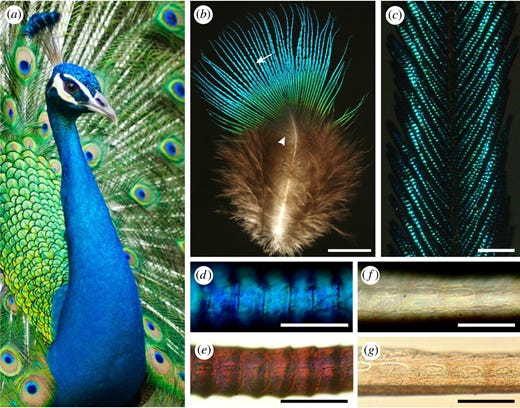
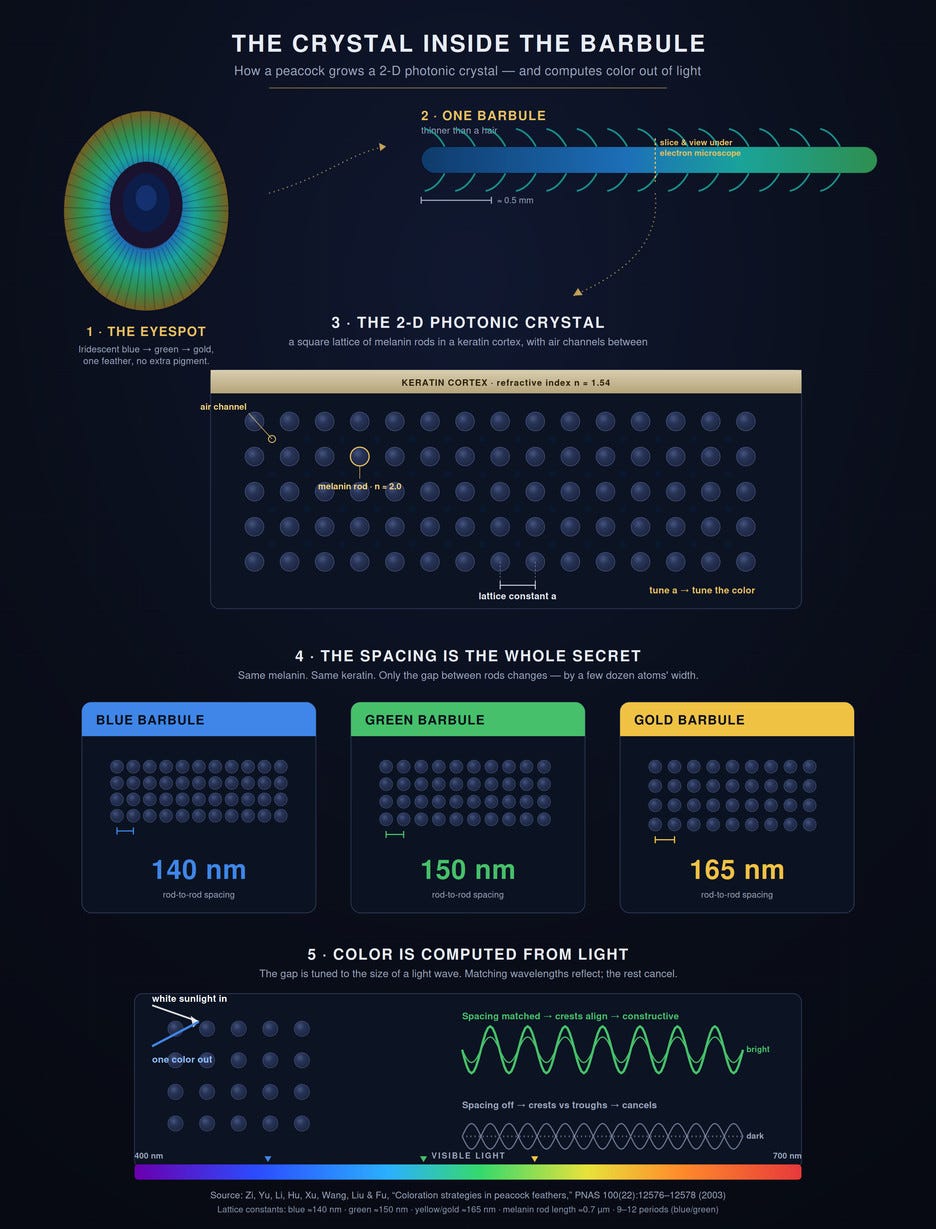
Take one of the tiny branchlets of a peacock feather — a barbule, thinner than a hair. Slice it open, put it under an electron microscope, and you find something that has no business being inside a bird.
A crystal.
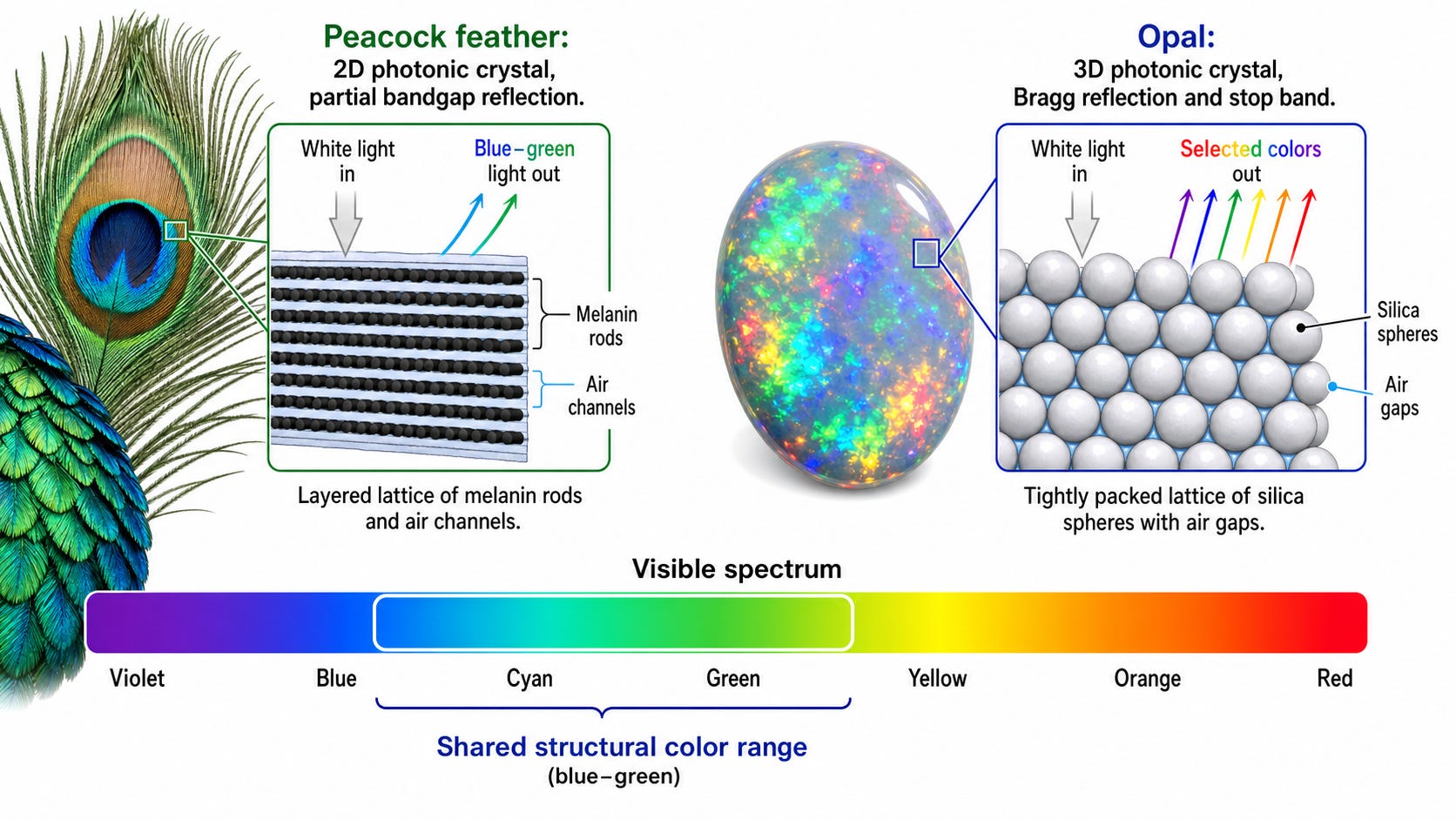
Not a gem — a photonic crystal: a precise, repeating lattice of melanin rods stacked in orderly rows inside clear keratin, with tiny channels of air running between them. A grid. A grating. An array as regular as something etched in a chip factory — grown by a bird, in the dark, out of pigment and air.
And the spacing of that grid is the whole secret. In a landmark 2003 study in the Proceedings of the National Academy of Sciences, the physicist Jian Zi and his colleagues measured the lattice spacing under each color of barbule. The numbers are absurdly small, and absurdly close together:
Blue barbules: rods spaced about 140 nanometers apart
Green barbules: about 150
Yellow barbules: about 165
A nanometer is a billionth of a meter. The entire difference between the blue of the neck and the gold of the train is a change in spacing of about twenty-five billionths of a meter — smaller than a biological nanoparticle, e.g. exosome or virus. The bird tunes its color not with different pigments, but by adjusting the gap between rods by a few dozen atoms’ width.
It would be easy — and the temptation is everywhere — to make the miracle precision: the bird as an impossibly exact machinist, hitting a tolerance our own factories struggle to match. But the real measurements tell a stranger and better story, and it is worth getting right, because the truth here is more astonishing than the legend.
The lattice is not perfect. When researchers looked closely (Freyer, Wilts and Stavenga, 2018), the rows of rods were visibly irregular — sizes wandering, spacing drifting, the grid nothing like the flawless diagram. So they ran the obvious experiment in simulation: they deliberately broke the crystal, letting the rod and channel sizes vary randomly by as much as 30 percent, and recalculated the color.
The color barely moved. A third of the structure thrown into disorder, and the brilliance dropped by less than a tenth.
Sit with that, because it overturns the easy version of the marvel. The peacock does not need nanometer perfection. It can be sloppy — a third of its dimensions can wander — and the blue holds. Think of a single guitar string: tighten it a hair and the note shifts, because everything rides on that one piece. Now think of a great choir: a few singers drift sharp, a few drift flat, and the chord still lands true, because the note is something the crowd makes together, not any one voice. The peacock’s color is choir-like. No single rod matters. The color is an agreement among thousands of them, and an agreement that large does not break when a few members stray.
That is the deeper engineering, and it is the opposite of fragile precision. Evolution did not solve color by achieving an impossible tolerance. It found a structure where the color is a stable, emergent property — something that survives the noise and slop of being grown inside a living cell, by a body with no eyes inside its feathers and no ruler. Not a watchmaker’s miracle. Something better: a design so robust it can afford to be imperfect and shine anyway.
Hold that against your own life. The color does not depend on any single rod being perfect; it emerges from the whole, flaws and all. We are built the same way. The best version of a person is not the flawless one — it is the one who has owned every fragment, the light and the dark together, and learned to shine as a whole rather than in spite of the parts. Perfected imperfection. Not the absence of the flaw, but the brilliance that the flaws, gathered up and owned, turn out to make possible.
The rainbow is born from the black
Now the part I can’t get past.
That melanin — the brown, the darkest thing in the bird — is not the enemy of the rainbow. It is its source. And it works two jobs at once, both of which the color depends on.
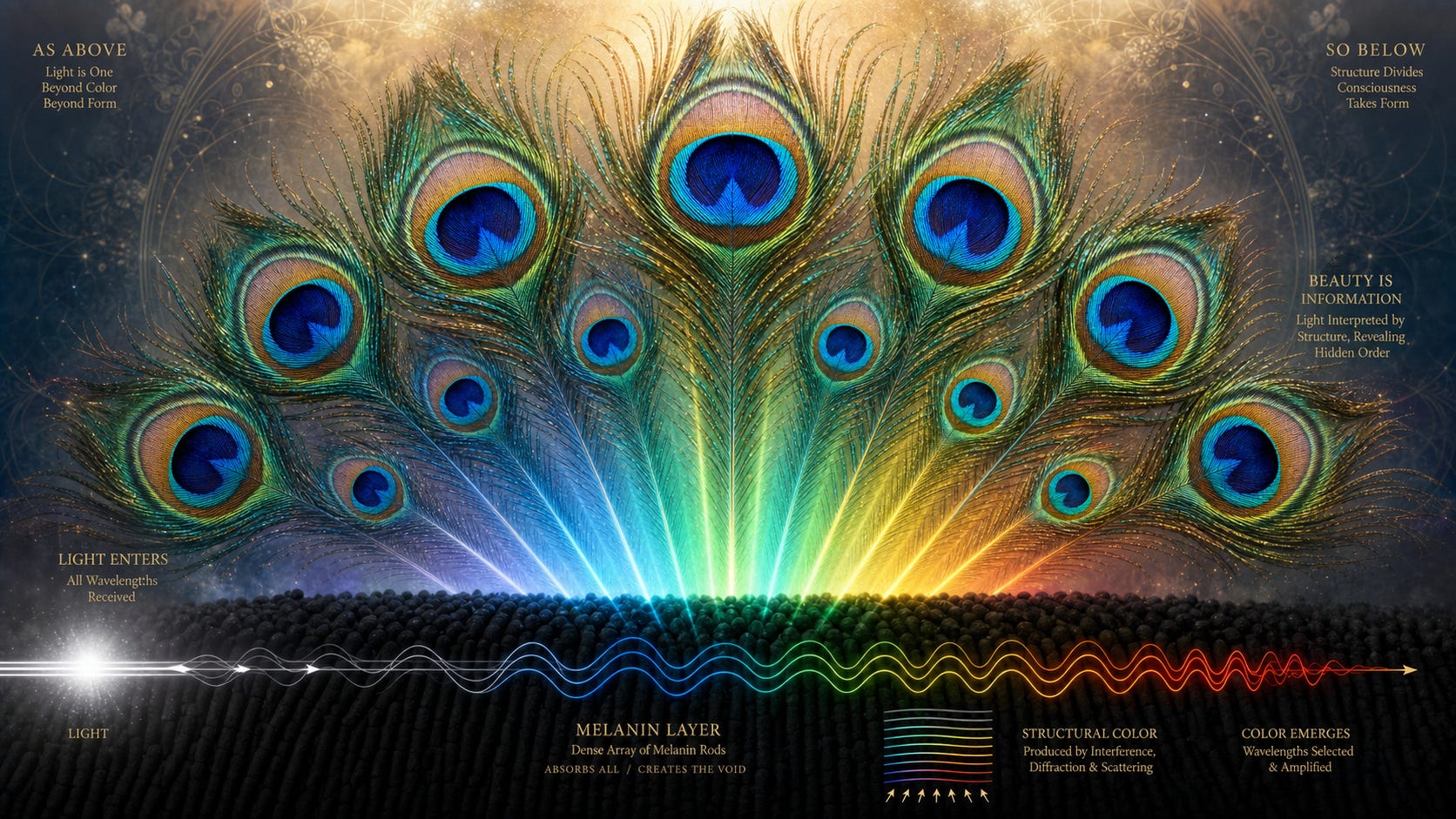
First, melanin bends light hard. Physicists measure this with a number called the refractive index — how much a material slows and turns a light wave passing through it. Melanin’s is about 1.8, higher than the keratin around it (about 1.54), higher than window glass. And the contrast between the dark rods and the clear keratin is exactly what a structural-color grid needs: the sharper the difference in how two materials bend light, the more cleanly the lattice can sort one color out of the white and send it back. The darkest pigment in the body turns out to be a superb material for making color. The dark is not a compromise. It is the right tool.
Second — and this is the part that turns physics into something close to prayer — melanin swallows light. It is one of the broadest absorbers in nature, drinking up wavelengths across the whole ultraviolet-and-visible range. In the peacock’s barbules the absorption is near-total: measurements show that across the blue-green band, less than about one percent of the light that enters comes back out the other side. Shine a light through a barbule and it looks almost black — a deep red-brown — even as its surface flames blue.
Here is why that matters. Behind and around the color-making lattice, the melanin eats the stray, scattered, leftover light — every photon that isn’t the one pure color the structure is sending to your eye. Without that darkness, all that random light would leak back out as a pale gray wash and dilute the color into a chalky shimmer. The melanin devours the noise. And against a background that dark, the surviving color reads as more vivid than it has any right to be — the way a single candle is overwhelming in a black room and invisible at noon.
Read that again, because it is the center of the whole thing. The fire is vivid precisely because the darkness behind it has devoured everything else.
The same molecule is both the architecture and the void that frames it. The rainbow is born from the black. The lotus from the mud. The brightest thing in the bird is built, literally and optically, out of the darkest — and could not shine without it. Beauty here does not arrive despite the darkness. It comes from it, and needs it to be seen at all.
(Nature knows how far this can be pushed. Some birds-of-paradise grow feathers whose microscopic structures trap light in tiny chambers, bouncing it until almost none escapes — absorbing up to 99.95 percent of the light that lands on them. Super-black, blacker than fresh asphalt or charcoal. And those birds grow the super-black right beside their brightest color patches, because against that much dark the eye reads the color as more brilliant than the light alone can explain. The darkness is not the absence of the display. It is part of the display.)
The bird grew an interferometer
Stop and name what the peacock has actually built, because it has a name, and the name is worth earning.
Go back to the stack of layers — melanin, air, melanin, air — and follow a wave of light as it enters. It doesn’t simply bounce off the front. It reflects a little at everylayer it crosses, and all those small reflections travel back out and overlap. Now, light is a wave, with crests and troughs. When two waves meet crest-to-crest, they add and brighten — physicists call this constructive interference. When they meet crest-to-trough, they cancel and go dark — destructive interference.
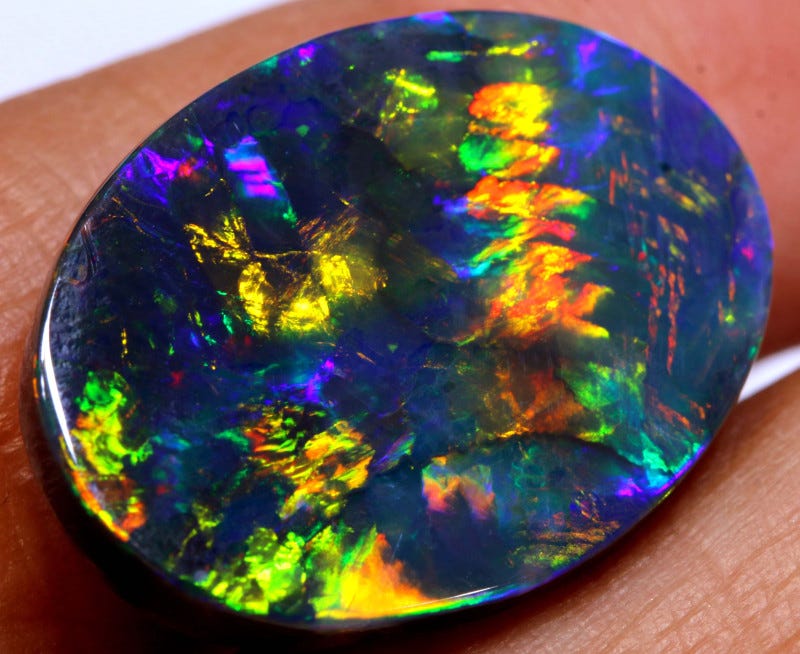
[A glorious “peacock opal,” as jewelers name them]
The spacing of the lattice decides which color does which. At 140-nanometer spacing, all the little reflections of blue light come back lined up crest-to-crest. They reinforce. Blue floods back to your eye, bright. Every other color comes back out of step — crest landing on trough — and erases itself. The blue you see is not light the feather added. It is the one wavelength that survived an enormous, exact cancellation, while every other color was made to annihilate itself into darkness.
A device that splits light into many paths and recombines them so they interfere, letting one result live and cancelling the rest, has a name. It is an interferometer. We build them to detect gravitational waves rippling in from colliding black holes, to measure distances to a fraction of an atom’s width, to tune our most precise lasers. They are among the most exact instruments humanity has ever made — and the peacock’s own scientists named the effect plainly: in the 2003 measurements, the spectra carry the fingerprint of Fabry–Pérot interference, the same physics as a laboratory optical cavity.
The peacock grew one. In the dark. Out of pigment and air. With no eye inside its feather and no instrument but its own growing body. Each barbule is a tiny biological interferometer, and the train is a field of thousands of them, each one keeping a single color alive by making all the others cancel.
And here is the thought I want to leave you holding. The cancellation is not loss. It is creation. The peacock’s color is made of destructive interference — made of what was removed. The fire is what remains after a vast and precise erasure. Glory by subtraction. It is the same gesture as the darkness that frames it: the beauty is what is left when the structure has taken almost everything away.
The peacock is not alone
If the peacock were the only place in nature that built color this way, you could call it a fluke. It isn’t. The same trick — color from structure, not from pigment — has been discovered, independently, over and over, across creatures that share no recent ancestor and no common chemistry. Once you know what the lattice does, you start seeing it everywhere.
The blue of a Morpho butterfly is not blue paint; it is ridged scales, layered at the scale of a light wave, throwing back blue the same way the peacock does. The metallic flash of a jewel beetle or weevil is a three-dimensional lattice inside its shell. And — the one I find most quietly astonishing — the fire inside an opal is the same physics in a mineral: precious opal is built of tiny silica spheres, packed in a regular array, with the spacing tuned to the wavelength of visible light. The gem has no pigment either. Its greens and blues and reds are a photonic crystal made of glass beads and the gaps between them, sorting white light into color exactly as the feather sorts it.
That kinship is worth dwelling on, because it tells you the peacock’s beauty is not a biological accident — it is a physical law that life and geology both stumbled into. A bird grows melanin rods in a two-dimensional grid; a gemstone settles silica spheres into a three-dimensional one; a butterfly stacks ridges in a single dimension. Different builders, different materials, different worlds — and the same answer, because there is only one way for a periodic structure to turn white light into a pure, angle-shifting color, and everything that found beauty found that same way.
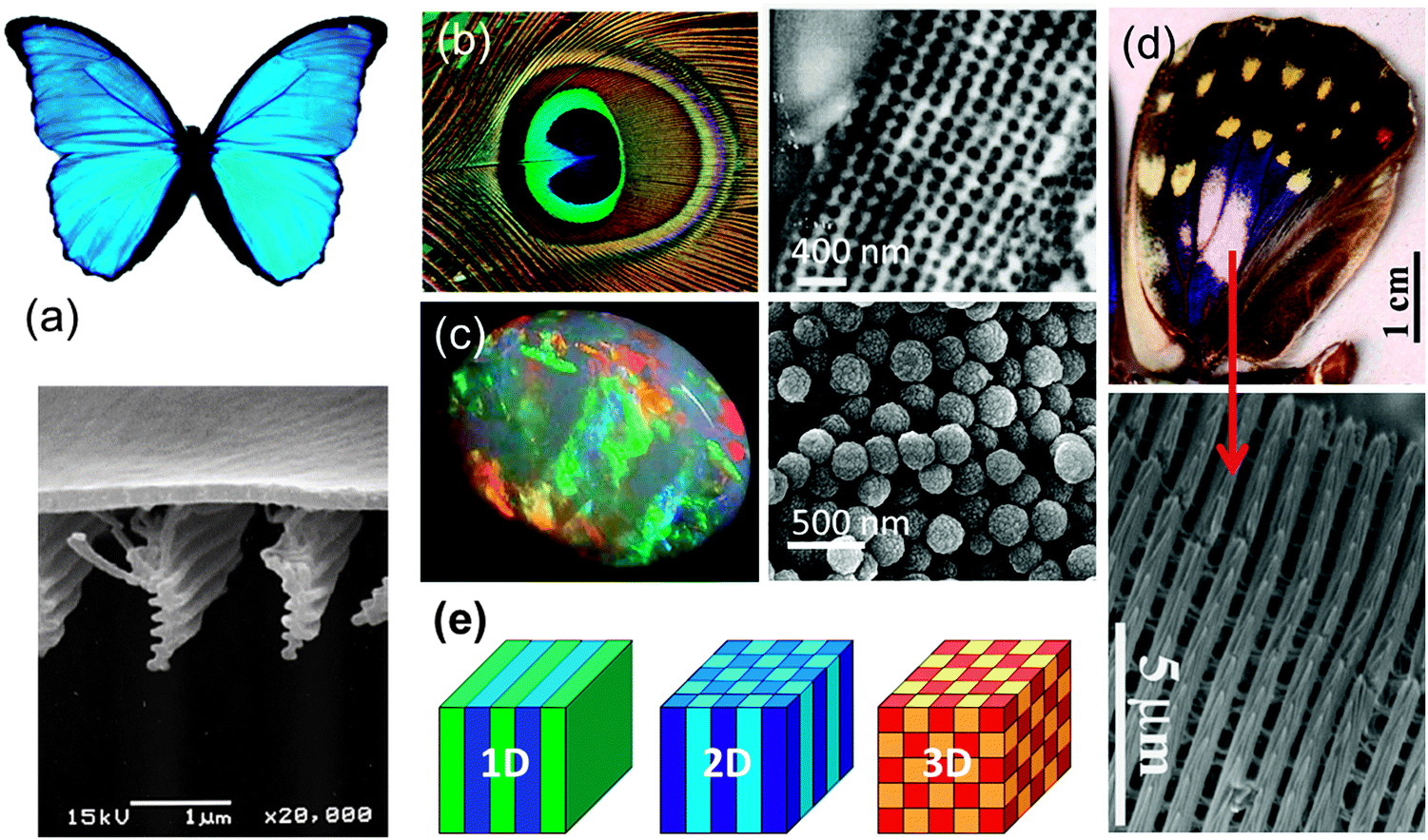
Figure. Structural color across the living and mineral worlds. (a) the blue Morpho butterfly, with an electron micrograph of its layered wing-scale ridges. (b) a peacock eyespot, with a micrograph of the melanin-rod lattice in its barbules — the 2D photonic crystal this essay has been describing (scale bar 400 nm). (c) a precious opal, with a micrograph of its packed silica spheres — a 3D photonic crystal (scale bar 500 nm). (d)an iridescent weevil and the lattice inside its scales (scale bar 5 µm). (e) the underlying scheme: photonic crystals come in one, two, and three dimensions, depending on how many directions the structure repeats in. The peacock is the 2D case; the opal, the 3D. Different kingdoms of nature, one law of light.
The peacock, then, is not a miracle that happened once. It is the most extravagant member of a family — the place where a law that also lit the opal and the butterfly was pushed furthest, by a creature with energy to burn and a mate worth dazzling.
The eye it is made for
A peacock’s color would be half-wasted on us. It was not built for human eyes.
We are trichromats — we have three kinds of color cone, peaking roughly at 424, 530, and 560 nanometers. The peahen the peacock is actually addressing is a tetrachromat. She has four kinds of cone, peaking near 370, 445, 508, and 565 nm — including one tuned into the ultraviolet, a whole band of the spectrum we cannot see at all.
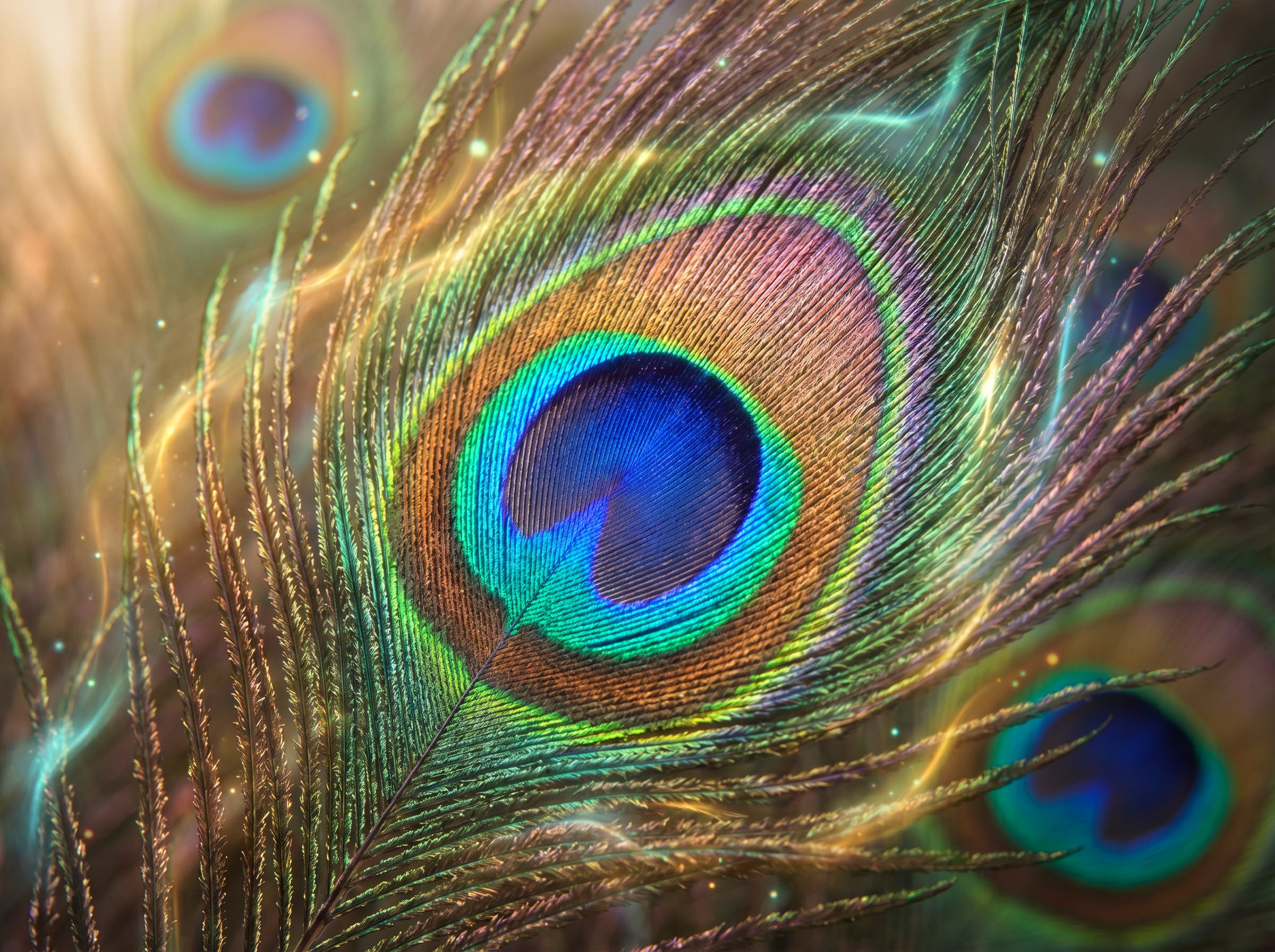
So the peacock’s display reaches into colors we have no name for and no organ to perceive. The blue she sees is not quite the blue we see; it is richer, with a dimension folded into it that our eyes simply drop. When we admire the train, we are seeing a translation — the legible fraction of a far richer signal pitched to an eye more capable than ours. The full glory is addressed to someone else. We are reading a love letter over the peahen’s shoulder, in a language we only partly speak.
It is not only seen. It is felt.
Here the science turns genuinely strange, and genuinely beautiful.
When a peacock displays, he does not hold the train still. He rattles it — vibrating the great fan rapidly, a behavior called train-rattling. Suzanne Amador Kane, Roslyn Dakin and colleagues measured it (PLoS One, 2018). The train-rattle runs at about 25 to 28 cycles per second — a mean near 25.6 Hz.
Then they measured the little crest of feathers on the peahen’s head — the small fan of filaments crowning her. They mounted crests on a mechanical shaker and swept through frequencies to find where they resonated. The crest’s natural resonant frequency: about 28 Hz in females, 26 Hz in males.
The two numbers match.
The frequency at which the male shakes his train is tuned to the frequency at which the female’s crown naturally vibrates. When he rattles, the air carries that pulse across the space between them, and her crest — sitting on mechanosensory nerve endings at its base — begins to resonate, like a struck tuning fork. She does not merely see his display. She feels it, on her head, at her body’s own resonant pitch. And the researchers confirmed: this match does not appear in the peacock’s other feathers, nor in the crests of four other bird species they tested. It is specific. It is tuned.
He is not performing at her. He is vibrating with her, across the air, at a frequency her body was built to answer. The display is a duet between his motion and her crown — a coupling we could not see at all until we measured it.
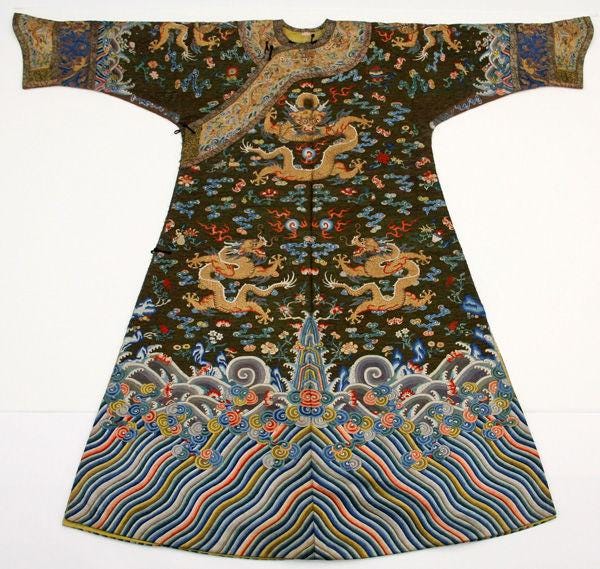
[You are looking at the Met’s “Peacocks and Dragons” material, e.g. a 19th‑century robe where the peacock’s ‘hundred eyes’ and royal aura are stylized into pattern, the lush green hewn from peacock feathers interwoven with silk.]
The hundred eyes
Step back and take in the whole train, and you are not looking at a fan. You are being looked at.
A hundred or more ocelli — the eyespots — turn toward you at once. Each is a target of structured fire: a core of blue-green ringed in bronze and gold, every band a different lattice spacing, every color computed from the same dark pigment tuned to a different gap.
The Romans made a myth of it. When the hundred-eyed giant Argus was slain, they said, the goddess Juno set his eyes into the tail of her sacred bird, so the watchfulness of the world would never close.
To stand before it is to be regarded by a multitude — by a hundred eyes made of geometry, gazing back in colors the bird does not contain.
9. Where the surplus came from
One question remains, underneath all the others. Why? Why would life build something this extravagant — meters of iridescent burden that cannot help the bird fly or hide, that costs enormously to grow and drag and flaunt?
To answer it, go back two billion years.
Once, one cell swallowed another and did not digest it. The captive became the mitochondrion — the power plant. And that single merger, the origin of all complex life, bought the swallower an absurd surplus of energy: far more than mere survival required. Survival was already solved. As the biologist Nick Lane argues, internalizing power this way unlocked an energy budget thousands of times richer per gene than any simpler cell could muster.
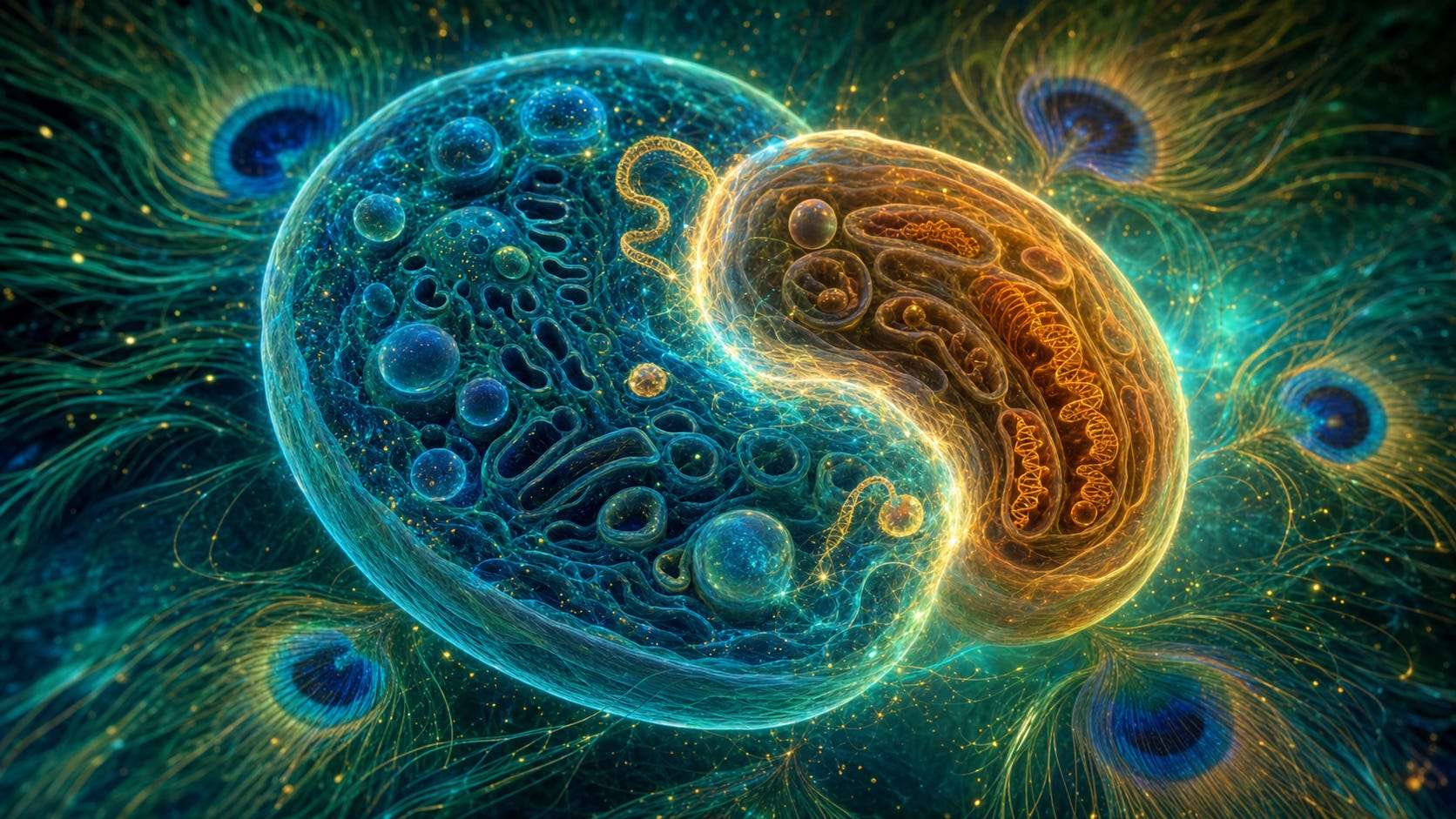
So life spent the excess on something other than survival. On complexity. On nervous systems. On vision. And on a crystal lattice in a feather that bends sunlight into colors it does not own, for no reason mere survival could demand.
Beauty is what the surplus was spent on. Not the opposite of thrift — what thrift looks like when there is that much to give.
When I first saw this in flowers, I called it a benevolent superfluity — the universe overshooting bare function and landing in beauty for no reason survival can account for. The peacock is that same superfluity made feather and fire
And none of us arranged the merger. Every one of us is spending an inheritance we did not earn — wearing colors struck from a gift two billion years older than our names. The peacock does not know it is beautiful. That not-knowing is the holiness in it. The splendor that does not preen is the only splendor worth the word.
The myths were right
For three thousand years, before anyone could slice a barbule or measure a lattice, people looked at this bird and knew things about it. They wrote those knowings as myth. And the strange thing — the thing this whole essay has been circling — is that the science, when it finally arrived, did not overturn the myths. It rhymed with them.
The hundred eyes. We met that myth already — Argus’s eyes, set by Juno into the bird’s tail. A pretty story. But then we learned that the peacock’s display is, in fact, addressed to an eye — to the four-color vision of the peahen, richer than our own three, reaching into ultraviolet we cannot see. The bird that is covered in images of eyes turns out to be speaking, in colors, to an eye. The myth pointed at the truth before the truth could be measured.
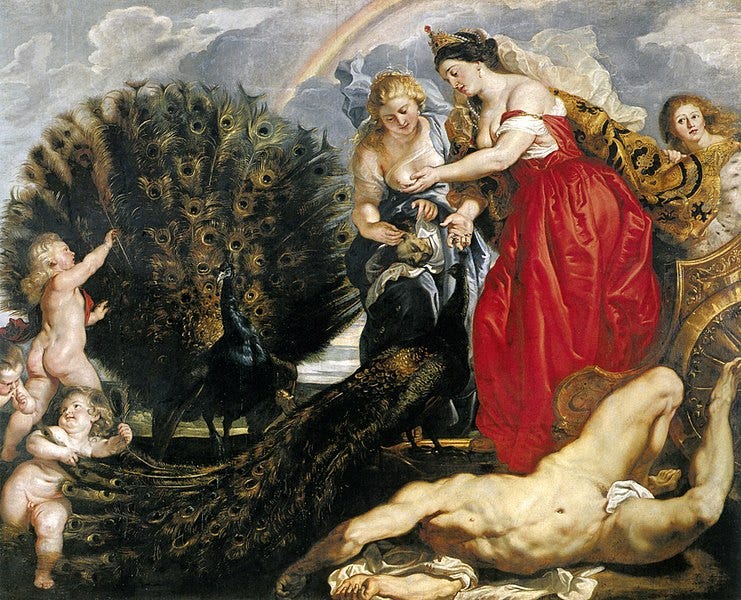
[Hera and Argus – Peter Paul Rubens Public Domain via Wikimedia Commons]
The incorruptible. Early Christians made the peacock a symbol of resurrection and eternal life, on the strength of an old belief — Augustine repeats it — that the peacock’s flesh does not rot. The flesh does rot; they were wrong about the substance. But they were right about the thing. Because something in the peacock genuinely outlasts the body: the color. Structural color does not fade the way pigment does — pigment browns and dulls over the centuries, but the peacock’s blue is not pigment, it is structure, and as long as that structure holds, the fire remains. The blue in a museum drawer burns as bright a hundred years on as the day the bird wore it. The ancients attached the permanence to the wrong layer — the flesh instead of the lattice — but they correctly sensed that here, in this creature, was something that outlasts the body that carries it. The incorruptible was real. It was just made of order, not meat.
The transmutation of poison. This is the one that stops me. In Buddhist tradition the peacock is the great transmuter — the bird that eats what is poisonous and is not harmed, the emblem of taking in toxin and converting it to beauty, darkness converted to radiance. The Peacock Wisdom King, Mahamayuri, is poison swallowed and made into light.
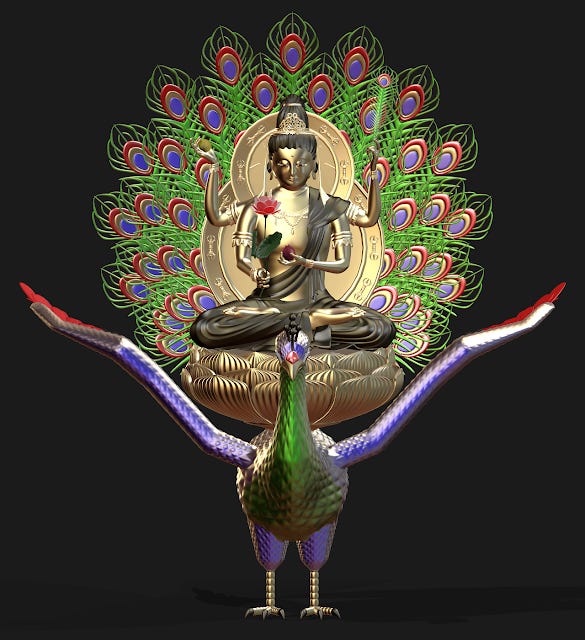
[The Peacock King Mahamayuri Vidyarajni Bodhisattva is a Bodhisattva (an “enlightened” being of compassion) and female Wisdom King in Mahayana and Vajrayana Buddhism.]
And what did we find, when we looked closely? That the peacock builds its entire glory out of melanin — the dark pigment, the dead-leaf brown, the blackest material in the body — and out of cancellation, the destructive interference that annihilates every wavelength but the one it allows to live. The bird makes its beauty by swallowing the dark and erasing nearly everything. The fire is what survives the erasure. The blue is what the darkness did not keep.
The Buddhists had no electron microscope. They looked at the surface and intuited something the depths would later confirm: that here was a creature whose radiance comes out of its darkness, not in spite of it. They could not have known the mechanism — melanin, interference, the cancelled wavelengths — and they did not need to. They sensed the shape of the truth from the outside, and the measurement, when it came, rhymed.
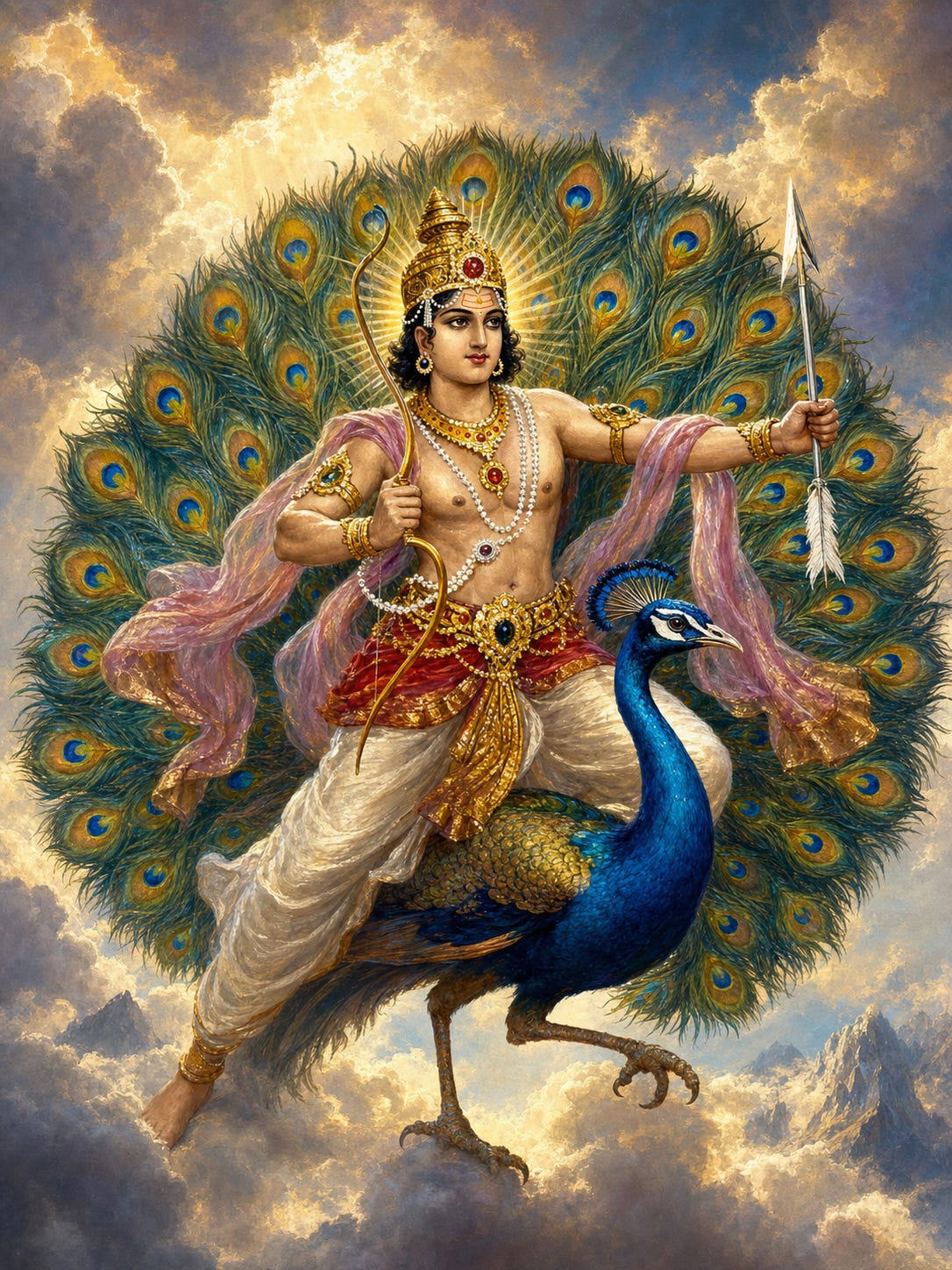
[Kartikeya (Murugan) rides his peacock mount, Paravani, the serpent clutched in its claws.]
The crown. In India, Krishna wears the peacock feather at the crown of his head — the feather at the highest point, the seat of grace. And the science of the display turns on exactly that: the organ that receives the peacock’s courtship is the small crest at the crown of the peahen’s head, the cluster of feathers tuned to resonate at the male’s frequency, the antenna of the crown by which she feels him across the air. The tradition placed the sacred feather at the crown. The biology placed the organ of reception at the crown. Same place. Different millennia.
Each time, the pattern repeats: the myth saw something true on the surface, and the science found it again in the structure. This is what I mean when I say the metaphor came first and was not wrong. The poets and the priests were reading the same bird the physicists would later read — only they read it whole, before we could read it small.
The one myth that got it wrong — and why
There is one tradition that read the peacock differently. In modern Western folklore the bird became the emblem of vanity — “proud as a peacock.” Its feather, brought indoors, became bad luck; its hundred eyes became the evil eye, an omen. The glory was reread as arrogance, the watchfulness as malice.
Notice what happens in that reading. Nearly every culture that held the peacock sacred saw the gift in it — the immortal, the all-seeing, the transmuter, the crown. The reading that calls it vain belongs to an eye that has, somewhere along the way, half-forgotten how to receive a gift at all: an eye trained to see the world as mere mechanism, surface without depth, display without a giver. And to an eye that no longer expects a gift, glory can only look like showing off. The peacock did not change. The seeing did.
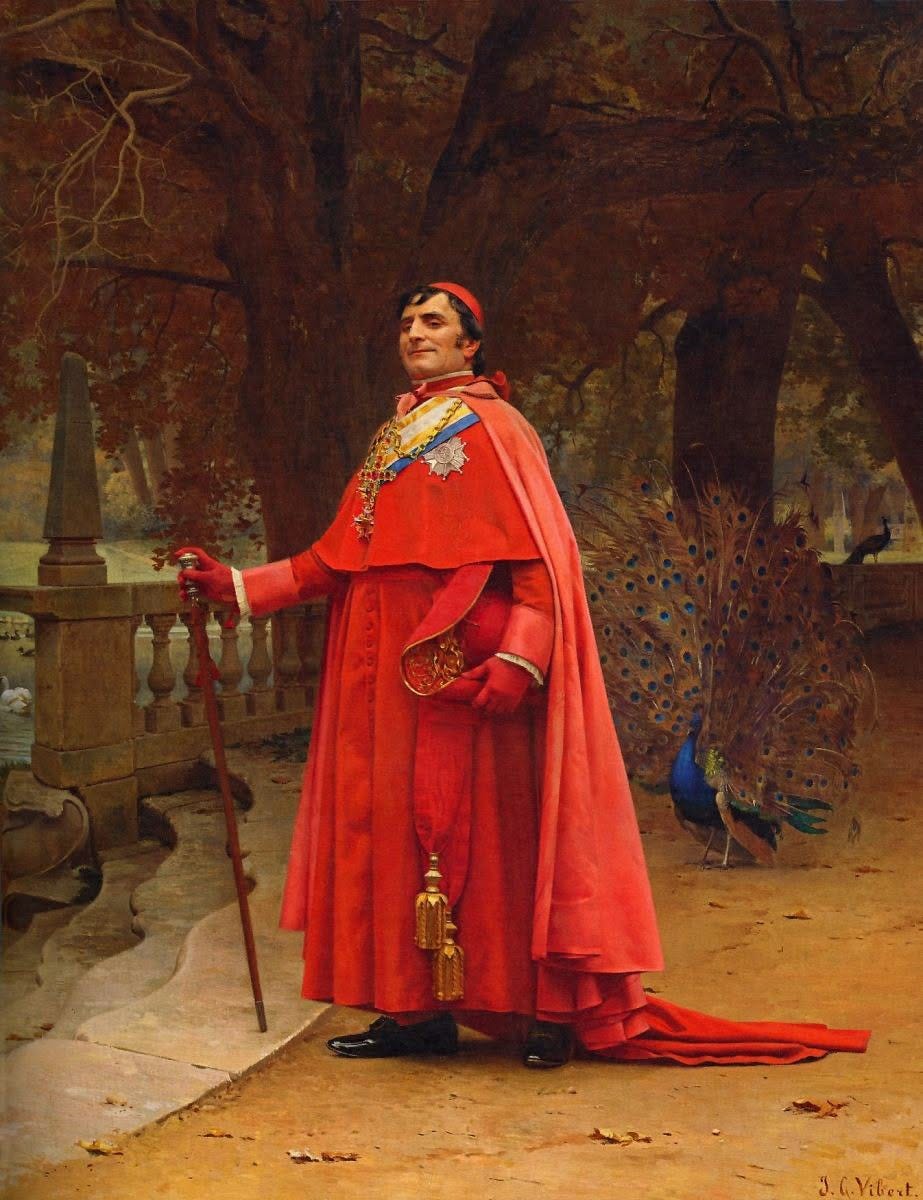
[“The Preening Peacock” by Jehan-Georges Vibert (c. 1880s). Location: Musée d’Orsay, Paris, France]
Here is the irony the science resolves. We have learned that the peacock does not know it is beautiful. It grows its lattice with no eye inside its feathers, tunes its color with no ruler, pays for its splendor out of an inheritance two billion years old that it did not arrange and cannot perceive. There is no vanity anywhere in it. The pride was never in the bird. It was a projection — the inability to receive a gift, accusing the gift of arrogance to excuse itself.
The peacock is the cure for exactly that. To stand before it and feel the old, sacred readings rise again — the eyes, the incorruptible, the transmuted poison, the crown — is to have the forgetting lifted for a moment, and to see what every older culture saw: not a vain bird, but a gift that asks nothing, given by something that did not need to give it.
What it asks of you
So gather the facts and hold them all at once.
A bird grows a crystal in the dark, out of the blackest pigment in nature. It does not paint a color; it builds a shape, and lets the shape compute a color out of raw sunlight, fresh, every instant the light arrives. It does this without eyes inside its feathers and without a ruler — and it does not even need to be precise, because the structure is so robust that a third of it can wander out of place and the blue still holds. It makes the color clean by letting the darkness behind it devour every stray ray that would dull it. The blue you finally see is not light the feather kept. It is the one wavelength left standing after the structure has cancelled all the rest into the dark.
None of it is necessary for staying alive — for eating, for flying, for not being eaten. All of it is real. Every number in this essay is measured, published, and repeatable. And this is the thing I most want you to take: knowing exactly how it works does not shrink the wonder. It is the wonder. Followed all the way down to the lattice, the mechanism does not explain the beauty away — it turns out to bethe beauty, read at the scale where it can no longer hide. The miracle was never in our ignorance of how the trick is done. It was in the trick itself, and it only deepens as you learn it.
This is not only intelligent design — that argument was always too small, a god reduced to an engineer filling gaps. What the peacock shows is something else: artistic design. The lawfulness is real, the evolution-over-time is real, and still the result overflows every requirement of survival into sheer, gratuitous beauty. That overflow is the signature. Not a maker who had to build it, but one who did not have to — and made it gorgeous anyway.
You are not a machine either. You were not assembled toward a use. Whatever has tried to price your worth by your function has mistaken what you are. You, too, are an inheritance spent as beauty. You were divinely inspired and loved into this world, as the peacock was. You, too, wear colors you do not contain — struck into fire each time the light finds you, and, like the peacock’s, built to outlast the body that bore them.
When I tried to follow that obligation all the way into a human life (Gaudi, architect of the Sagrada Familia in Barcelona) — what it means to let beauty, not utility, teach you how to live — I called it the cathedral in the body: the sense that your own being is meant as a place where that surplus beauty becomes action, an onto‑ethics written into flesh.
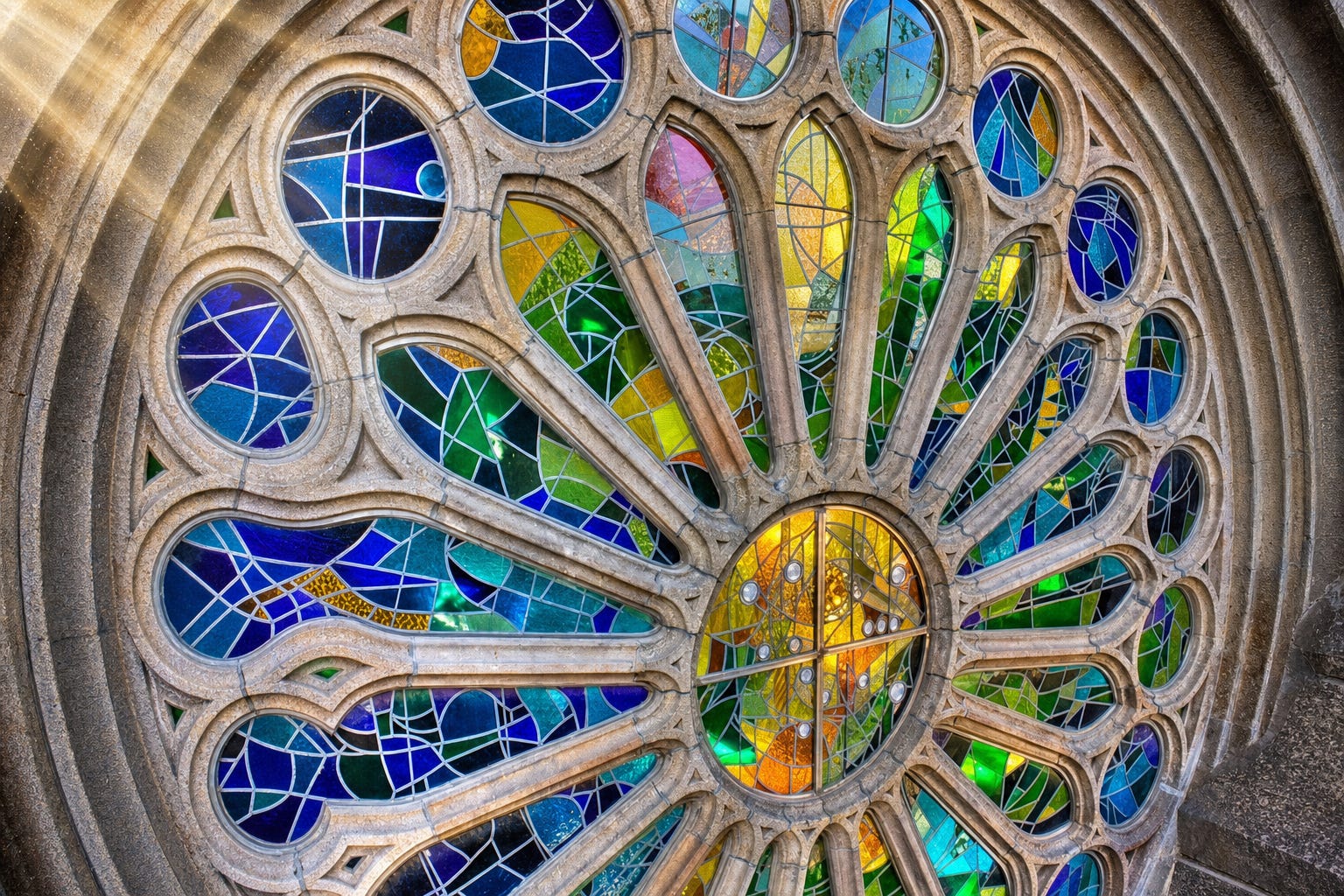
[The Sagrada Familia, Gaudi’s temple of light]
Structural color does not fade the way pigment does. Nor do your acts of selfless kindness and true love. I believe they are carried, timelessly, by everyone you have touched — whether they know it or not. The bird in a museum drawer still burns, a century on. So does a life spent in creative, joyous, selfless acts.
I have tried, this whole way, to show you what I saw. I will end where I might have begun, with the only words that ever quite held it:
God made a rainbow flesh in a bird.
Look. Keep looking. The peacock is only the door. Open it, and everything beyond it glows with the same impossible fact — of being here at all, when there should have been nothing.
Further doorways
If the peacock showed you that beauty is a gift that doesn’t ask for use, the natural next question is how to live inside a world like that. I tried to sketch an onto‑ethics — how love and sovereignty might look in a universe built this way — in The Fold: A Valentine.
If the geometry of the peacock’s lattice — two fields meeting, cancelling, and creating a third thing in the overlap — moved something in you, I tried to follow that same figure into the space between human hands here: Prayer Hands Decoded: The Science Behind Humanity’s Most Sacred Gesture.
If the role of melanin here moved something in you — not just as pigment but as an active, light‑shaping material — I tried to follow that thread into human biology in: The Ultimate Human Superpower You Never Knew You Had: Melanin — The Hidden Solar Panel in Human Biology.
Notes & Sources
Every number in this essay is measured and published. Each source below is paired with the claim it supports.
The single pigment (melanin), the photonic-crystal mechanism, and the lattice spacings (~140 nm blue, ~150 nm green, ~165 nm yellow): Zi, J., Yu, X., Li, Y., Hu, X., Xu, C., Wang, X., Liu, X. & Fu, R. “Coloration strategies in peacock feathers.” Proceedings of the National Academy of Sciences 100(22): 12576–12578 (2003).
The robustness to disorder (≤10% change in color with up to 30% size variation), and the finding that a simple layered model reproduces the spectra: Freyer, P., Wilts, B.D. & Stavenga, D.G. “Reflections on iridescent neck and breast feathers of the peacock, Pavo cristatus.” Interface Focus 9: 20180043 (2018).
Melanin’s refractive index (~1.8, versus ~1.54 for keratin) and its broadband absorption: Jeon, D-J., Paik, S., Ji, S. & Yeo, J-S. “Melanin-based structural coloration of birds and its biomimetic applications.” Applied Microscopy 51:14 (2021).
The near-total absorption inside the barbule (under ~1% transmitted across the blue-green band): measured absorbance values reported in Freyer, Wilts & Stavenga (2018), above.
Super-black feathers absorbing up to 99.95% of incident light, grown beside bright color patches: McCoy, D.E., Feo, T., Harvey, T.A. & Prum, R.O. “Structural absorption by barbule microstructures of super black bird of paradise feathers.” Nature Communications 9 (2018).
Fabry–Pérot interference as the named optical effect in the barbule:reported in Zi et al. (2003), above.
Sayer I absolutely love this layout and the colors are outstanding. God makes everything absolutely perfect
I was aware of the schemochrome color of bluebirds. Their feathers are actually grayish brown, but they reflect a cerulean blue that has captivated poets and artists alike. Delighted to learn about the peacock. Beauty as an expression of the generosity of Source elicits such gratitude in me. I guess humans take an awful lot for granted when we really could be in a perpetual state of awe. Thanks for the inspiration!