
🇺🇸 Don’t Tread on the First Amendment:
How Preston Byrne and the Granite Act Are Drawing a Constitutional Line Against Britain’s Speech War on America

The constitutional limits of foreign authority over American speech stopped being theoretical for me when my lawful U.S.-based expression appeared in a foreign court with no jurisdiction—and when Preston Byrne began designing the legal architecture to ensure it could not happen again, as the State Department, members of Congress such as Rep. Anna Paulina Luna, and Cabinet officials publicly signaled resistance.
In this must-watch featured interview, Preston Byrnes examines the historic and escalating conflict between the United States and the United Kingdom, focusing on serious violations of constitutional liberties and their far-reaching implications.
View the X thread dedicated to this article here.

The Line Has Been Crossed
For years, foreign governments have operated on a quiet assumption about the United States: that when enough regulatory pressure is applied, Americans—particularly American technology companies—will eventually comply. That assumption held through GDPR, through informal “guidance,” and through NGO pressure campaigns dressed up as regulation.
What the United Kingdom did not anticipate was resistance rooted not in platform politics or culture-war theatrics, but in constitutional law itself.
The UK’s Online Safety Act is not merely a domestic public-safety measure. In operation, it functions as an attempt to export British speech controls onto American-owned digital infrastructure—and, by extension, into American constitutional space. That is the line now being crossed. This is precisely why the ongoing effort to deport Imran Ahmed, CEO of the Center for Countering Digital Hate, warrants close attention. Ahmed has publicly taken credit for advancing the Act and has actively sought to replicate its speech-control regime in the United States, pressing foreign censorship standards onto American citizens and platforms in direct conflict with First Amendment protections.
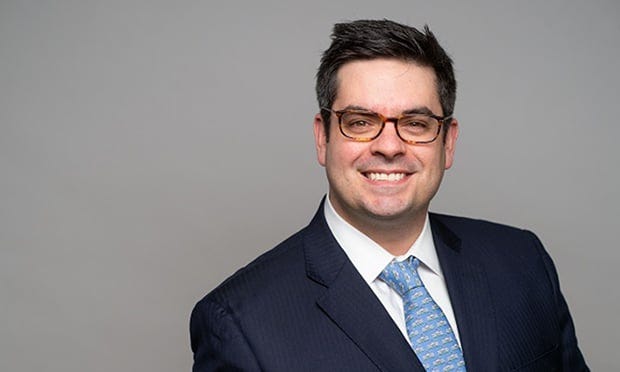
“Over here, over there, on the moon, on Mars, in another galaxy, or in another dimension—nobody tells an American citizen what protected speech they can or can’t utter.”
— Preston Byrne
Who Preston Byrne Is—and Why He Matters
Preston Byrne is neither a provocateur nor a political commentator. He is a dual-qualified US–UK lawyer who understands with precision where British law ends and American sovereignty begins. Since 2018, he has represented U.S.-based companies facing foreign censorship pressure, first from Germany and later from the United Kingdom, warning early on that European regulators were steering themselves toward a direct confrontation with the First Amendment.
When the UK’s communications regulator, Ofcom, began issuing notices, demands, and implied threats to American companies under the Online Safety Act—asserting authority over speech that is constitutionally protected in the United States—Byrne refused to accept the premise that such demands carried any legal force here. He challenged them as a lawyer, not as a rhetorician, and did so on a pro bono basis because, in his view, defending the constitutional perimeter was not optional but obligatory.
The UK’s Fundamental Error: Jurisdictional Fantasy
Stripped of diplomatic language, the British position amounts to the claim that UK law should control speech on American-owned platforms whenever British users can access that speech. This position collapses under even minimal scrutiny.
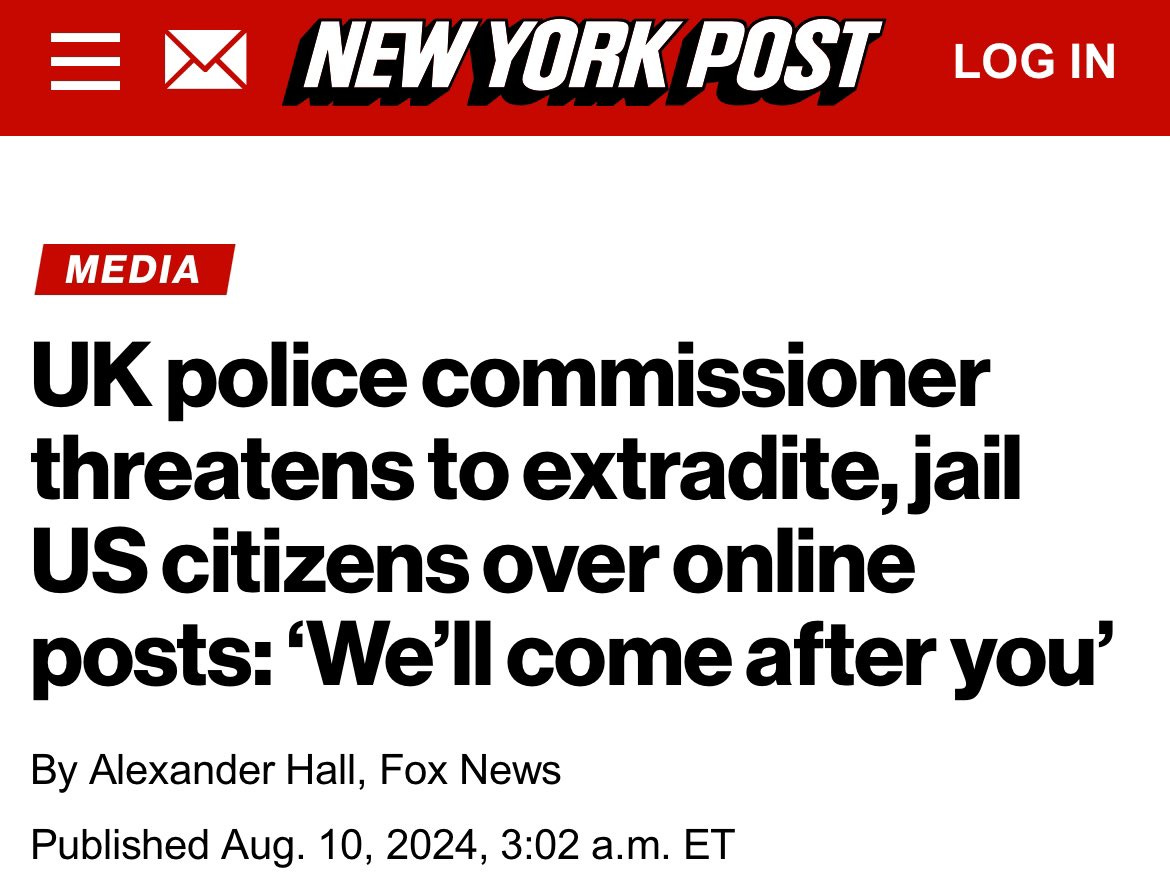
A foundational principle of international law is that a legal instrument issued abroad has no automatic force within the United States unless it is domesticated by an American court. Even then, it must withstand constitutional review. The United States adds an additional and immovable constraint: the First Amendment.
American citizens do not take speech orders from foreign governments, regardless of how formal the letterhead or how severe the implied penalties. As Byrne explains in the interview embedded above, the Online Safety Act places the UK on a collision course with the U.S. Constitution, and in such a collision, foreign law does not prevail.
The Online Safety Act’s Bait and Switch
Publicly, the Online Safety Act is justified through reference to material that commands near-universal condemnation: child exploitation, terrorism facilitation, and explicit criminal conduct. Politically, this framing is effective. And has been attempted here in the US, as well, with a battery of new UK-inspired legislation. Yet, legally, this framing is incomplete.
Once legitimacy is secured on these grounds, the scope of enforcement expands predictably into speech categories that are far more elastic: political dissent, lawful protest, association, and opinions deemed harmful by regulators. In the UK, such expression may be criminalized even though it would receive explicit First Amendment protection in the United States.
The problem is not that Britain has chosen this regulatory model for itself. The problem is that Britain is attempting to project it outward, into the United States, through regulatory threats and enforcement postures aimed at Americans and American systems.
This Is Not Abstract: How Extraterritorial Process Has Already Reached Me
This issue is not theoretical for me.
I am a U.S. citizen engaged in lawful public-interest speech and advocacy within the United States. I have never been charged with, investigated for, or accused of any criminal offense by U.S. authorities or otherwise. Nonetheless, beginning in 2023, my constitutionally protected speech, public communications, and professional associations were referenced within UK legal proceedings to which I am not a party, without jurisdiction over me and without access to U.S. constitutional safeguards.
I have documented publicly how a UK private criminal prosecution—formally brought against another individual—has nevertheless produced extraterritorial effects that reached me. These have included scrutiny of my lawful speech and public activity, attempts to treat my U.S.-based expression as relevant or probative within a foreign legal forum, and efforts to operationalize UK legal process in ways that exposed me to coercive consequences despite the absence of any allegation against me. In one documented instance, UK law-enforcement mechanisms were engaged in a manner that resulted in an attempted arrest action directed at me, notwithstanding that I was not a defendant, not under investigation, and not accused of any crime.
(See my public statement on due process and extraterritorial overreach here:
https://sayerji.substack.com/p/sayer-ji-a-statement-on-due-process)
From a U.S. constitutional perspective, this raises a fundamental concern. When foreign legal processes begin treating American speech as admissible material—divorced from First Amendment protections—and when procedural tools are used to exert pressure on U.S. citizens without jurisdiction or due process, the distinction between domestic regulation and extraterritorial coercion begins to erode.
It is also significant that UK police initially reviewed the underlying complaints and concluded that no criminal investigation was warranted, characterizing the matter as civil in nature. Despite this determination, private criminal proceedings were nevertheless pursued, producing consequences that extended beyond the named defendant and into the realm of my own constitutionally protected speech and associations as an American citizen—including the extraordinary act of labeling a sitting U.S. Cabinet member, my colleague Robert F. Kennedy Jr., as a “disruptive influence.” This experience illustrates precisely the danger Preston Byrne has been warning about: not mass censorship in the abstract, but process-based pressure and jurisdictional creep capable of chilling American speech without ever testing it in an American court.
The Granite Act: A Shield, Not a Symbol
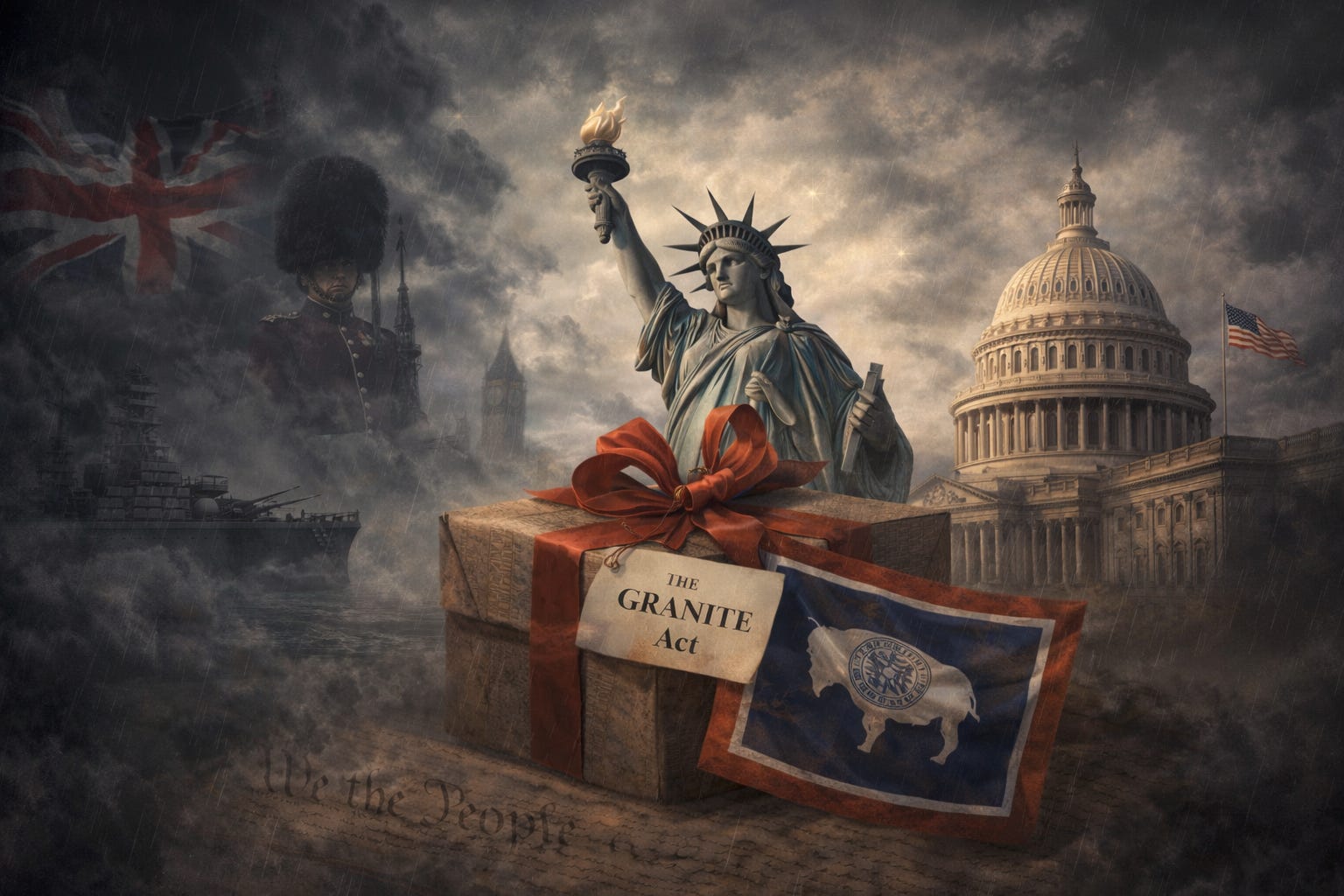
Wyoming is not typically where global speech battles are decided, but that may be changing. Drafted by Preston Byrne, the Wyoming Guaranteeing Rights Against Novel International Tyranny and Extortion (GRANITE) Act converts foreign censorship threats into actionable civil wrongs under American law.
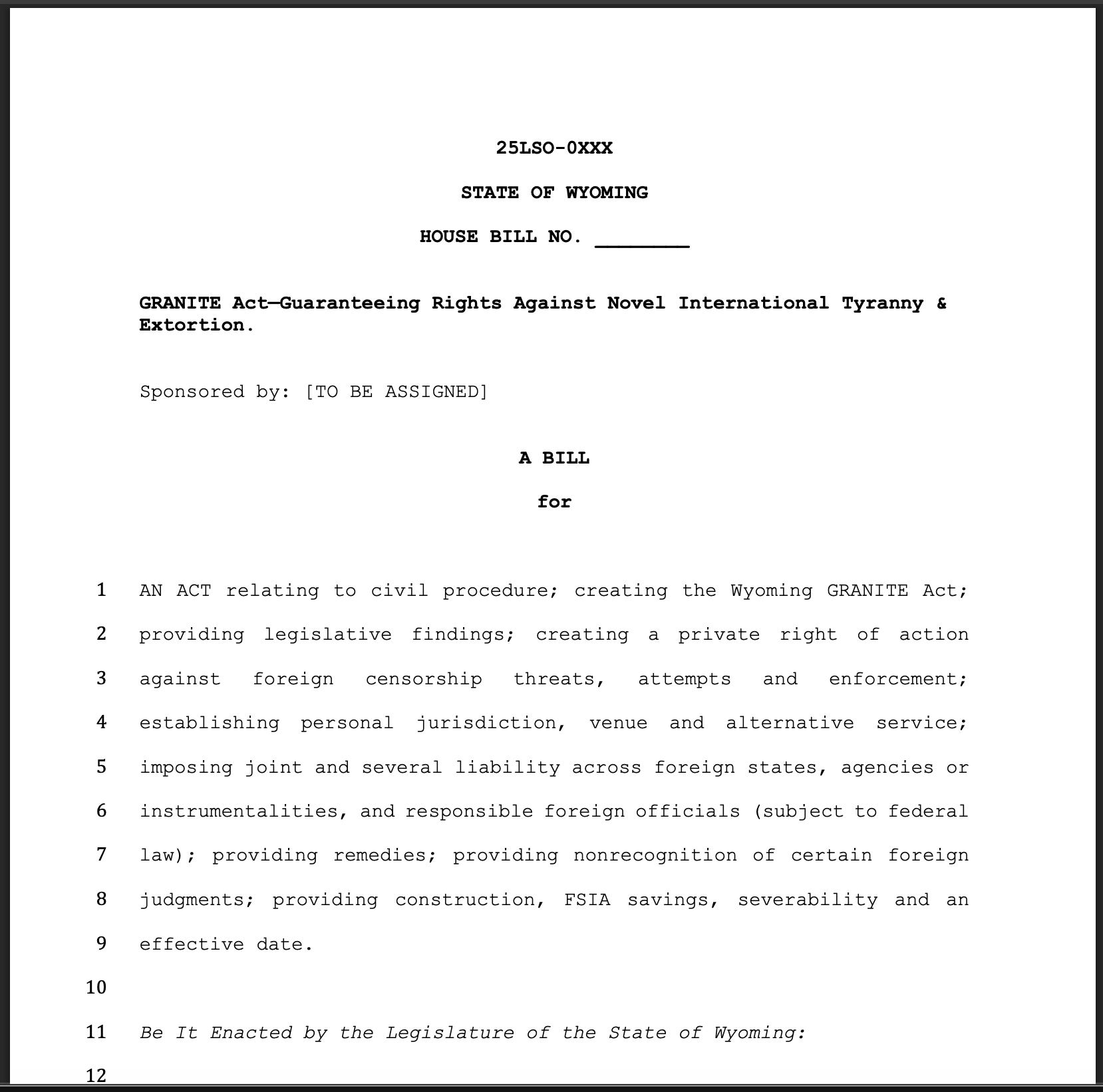
The Act establishes a cause of action against foreign states and international organizations that threaten or attempt to enforce foreign censorship laws against Americans. It treats such threats as completed torts upon receipt, presumes foreign censorship unconstitutional unless rebutted under strict scrutiny, provides meaningful statutory damages, and prohibits Wyoming courts and officials from recognizing or enforcing foreign judgments that violate the First Amendment.
Crucially, the Act’s protections extend not only to Wyoming residents but also to Americans whose protected speech is hosted on servers physically located in Wyoming. Through infrastructure and jurisdiction rather than rhetoric, the Act functions as a national constitutional firewall.
Federal Attention Is Real—and Public
This effort is no longer confined to state experimentation. In his December 18, 2025 year-in-review of the Online Safety Act response, Byrne publicly confirmed that House and Senate resolutions were filed in mid-December 2025 and that a U.S. Senator has announced plans to introduce a federal censorship shield bill modeled on GRANITE. He further noted that Senator Eric Schmitt has committed publicly to introducing federal legislation with the explicit goal of enacting a national shield law substantially similar to the Granite Act.
Wyoming, in other words, is not acting in isolation. It is demonstrating a path forward.
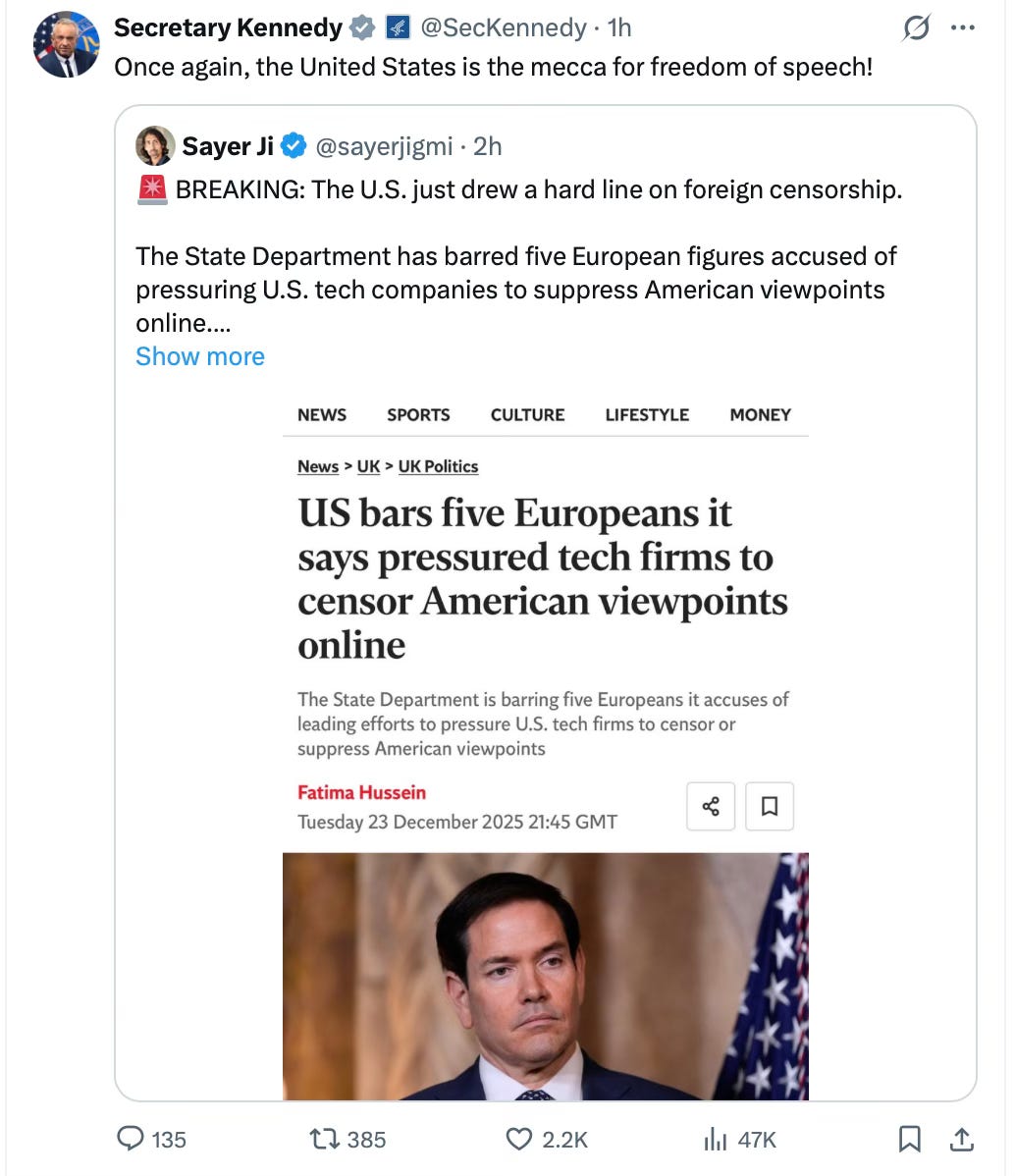
That boundary has now been articulated at the Cabinet level. As Secretary Robert F. Kennedy Jr. stated in response to my X post on the State Department’s action:
“Once again, the United States is the mecca for freedom of speech.”
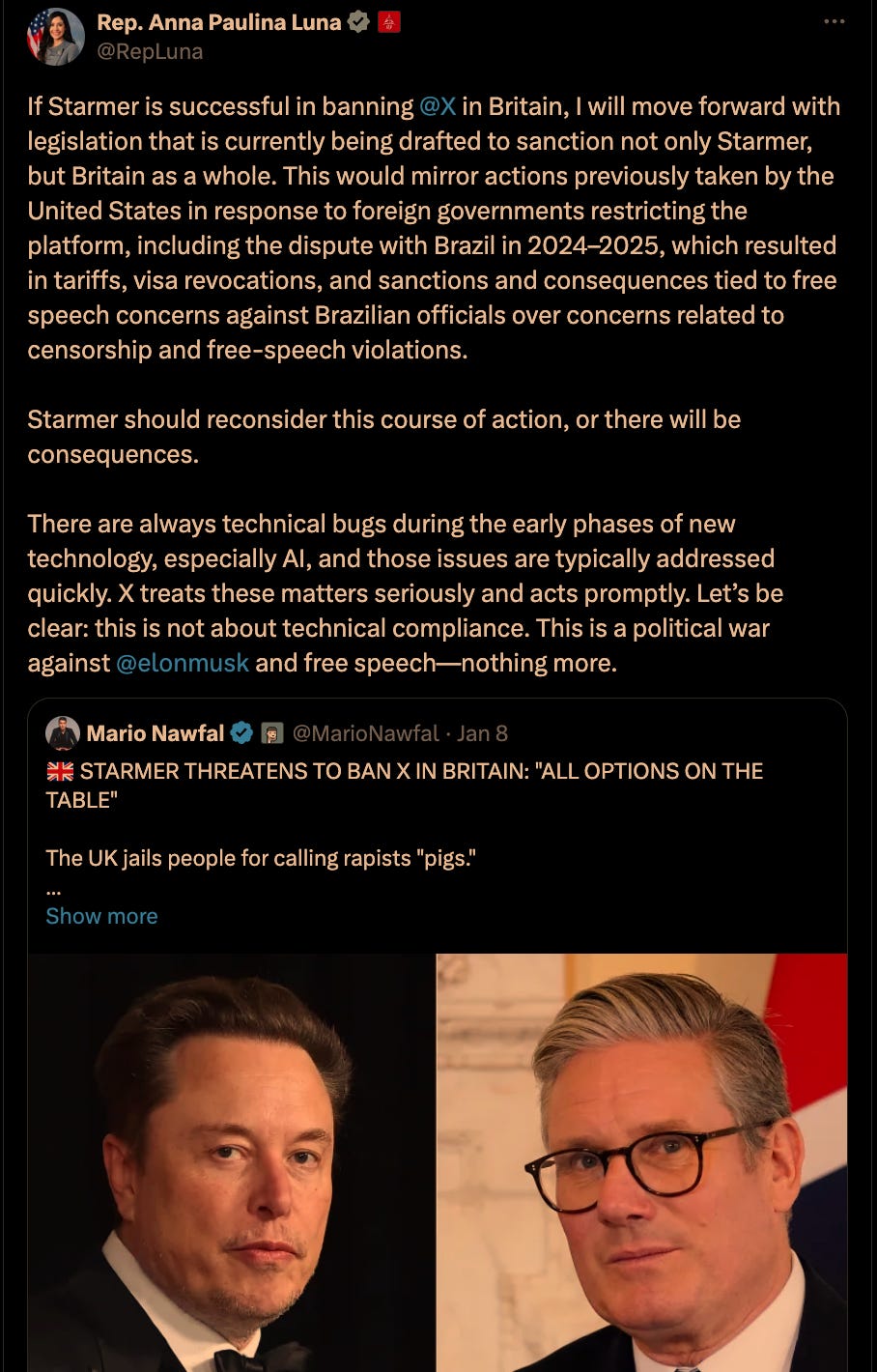
Relatedly, public statements by individual members of Congress indicate that foreign attempts to impose speech controls on U.S.-based platforms are being noticed beyond formal legislative channels. In a widely circulated post on X, Rep. Anna Paulina Luna stated that she would pursue sanctions legislation should the United Kingdom move to block the platform. While no such ban has been announced and no sanctions legislation has been introduced, the statement reflects emerging congressional awareness of the constitutional implications of foreign regulatory actions affecting American speech infrastructure.
Bigger Than Musk. Bigger Than X.
Elon Musk’s platform made this conflict visible (given “killing” his platform and triggering UK/EU regulatory action was CCDH’s primary stated goal in 2024), but the stakes transcend personalities and platforms. The question is whether foreign governments may project speech control into the United States through intimidation, market leverage, and procedural coercion without consequence. The Granite Act offers a clear answer: not here.
A Birthday Gift Worth Giving the Republic
Federalism exists for moments like this. When national institutions move slowly, states can act decisively and sometimes provide the blueprint. Wyoming has offered the country a piece of legal architecture that treats the First Amendment not as a cultural preference but as a sovereign boundary.
Given what has already happened—not only to platforms, but to individual Americans—I can think of few better birthday gifts for the United States than a law that remembers where that boundary lies.
⚖️ Our Case: Taking a Stand Where the Constitution Still Holds
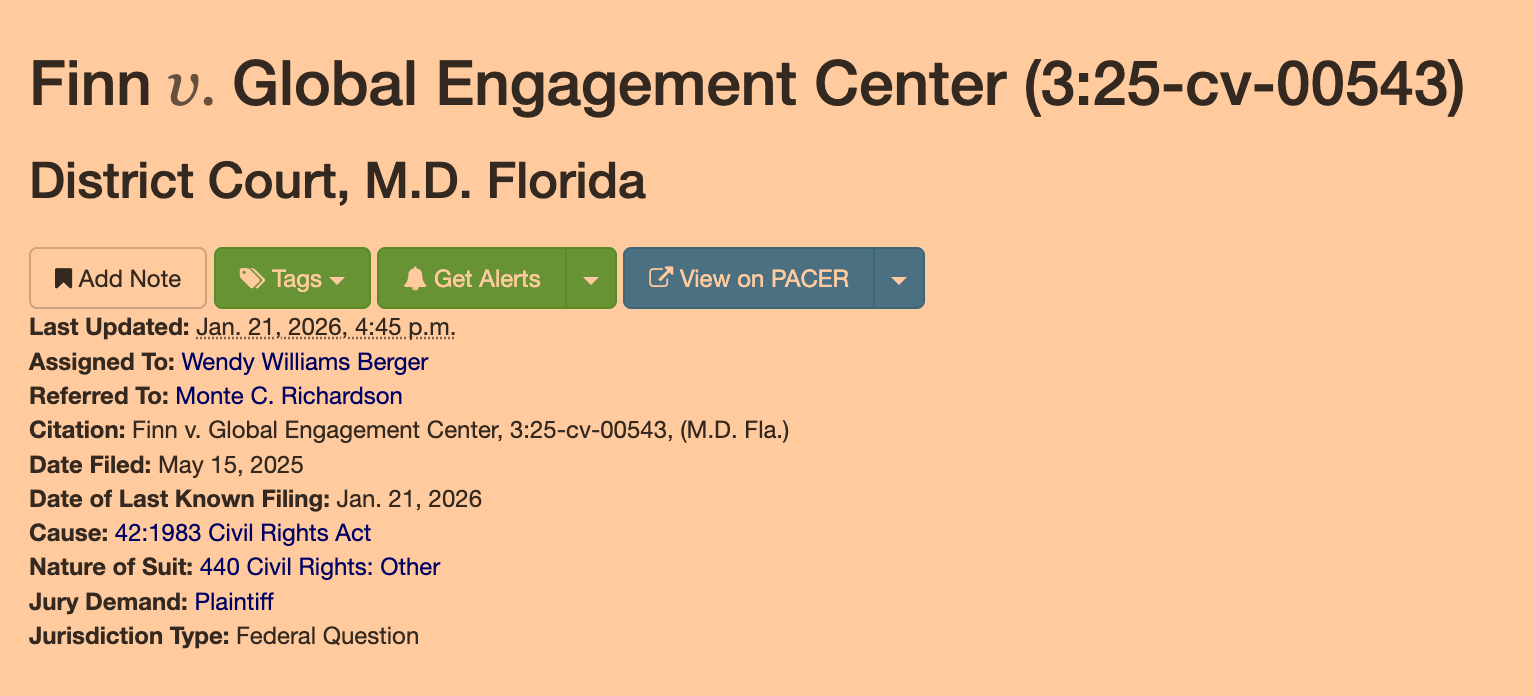
As this article goes to publication, six plaintiffs (including myself) are actively engaged in federal civil rights litigation in the Middle District of Florida, asserting claims tied directly to the abuses documented above.
We are challenging the weaponization of foreign legal proceedings, reputational targeting, and transnational censorship that have violated our fundamental rights—including the First Amendment, due process, and privacy. Our case is not isolated. It is a microcosm of a broader, coordinated threat to American sovereignty, jurisdiction, and liberty.
It is also a line in the sand.
When protected speech in the United States is used—without consent, due process, or notice—as evidence in foreign prosecutions, we all have a stake in the outcome.
When civil litigation reveals how narrative-driven NGOs like the Center for Countering Digital Hate (CCDH) have infiltrated platform policy, congressional hearings, and even legal filings, it’s time for more than commentary. Y
ou can get the latest updated published yesterday on the developing saga here: The Defamation Didn’t Stop. It Escalated — and Moved to a New Courtroom.
📣 Call to Action
If you believe in constitutional rights…
If you believe no American should be punished for their speech on U.S. soil…
If you believe it’s time to end the era of foreign censorship laundering…
Then stand with us.
🟢 Share this article far and wide
🟢 Contact your representatives and demand accountability for CCDH and transnational censorship proxies
🟢 If you’re a legal, media, or congressional ally—we welcome amicus support, press amplification, and direct collaboration
🟢 And if you’re moved to contribute directly to our legal fund: Make a Contribution Here.
This isn’t just our fight. It’s America’s line to hold.


We. Brits are with you! Just remember we are suffering speech censorship too. The 3 am knock on the door and off to jail is very real for many of us when we remark on Social Media that doesn’t comply with Herr Starmers wishes.
This is great for some free speech. But. How can individual states pass laws or "mandates" that are unconstitutional? Most glaring is all the states that forced vaccines to attend certain events, stay employed etc. Mask mandates as well, social distancing. For all the years since covid, NM has put unlawful mandates before legally passed legislation such as the ADA. And now in VA, the newly elected governor, has supposedly signed executive orders that are unconstitutional. Like arrest for anyone approaching anyone near an abortion provider. Doesn't the constitution guarantee citizens the right of free association. And don't even get me started on privacy rights. We don't have any, despite what they pretend. Yet they were used to get Roe v Wade passed.
Thank you for your constitutional fight and speaking out. We need a constitutional reckoning for the entire country.