
"Damaging to Public Confidence"
What the Fauci–Murthy–Walensky texts actually prove, what they don’t — and how the same sentence became diligence in a government group chat and misinformation on your feed


The incoming Surgeon General wrote those four words in January 2021 — his private verdict on the WHO's caution about vaccinating pregnant women. They became the operating metric of American public health. Five years later, they're a prophecy his own texts fulfilled.
Companion piece: “An Open Letter to Chairmen Johnson and Paul: The Seven Searches.”
Story at a Glance
On January 25–26, 2021, Dr. Anthony Fauci, CDC Director Rochelle Walensky, and Surgeon General nominee Vivek Murthy privately discussed a theoretical first-trimester miscarriage mechanism — “a really good point,” two of them called it — inside an evidence base one of them described as “a data free” zone. Nine days later, Fauci told the public the FDA had found “no red flags” for pregnant women.
The viral “82% miscarriage rate” being attached to these texts is statistically invalid, and I will not use it. I’ll show you exactly why — because the documentary record is damning enough without it, and because the broken number is currently doing the officials’ rebuttal work for them.
The day the WHO urged caution on vaccinating pregnant women, Murthy’s private reaction was not to weigh the evidence but to call the caution “potentially quite damaging to public confidence.” The WHO reversed within seventy-two hours. Five years later, the former CDC director is on television articulating the WHO’s original position.
Six months after these texts, the same Murthy became the architect of the federal misinformation campaign that a federal appeals court found “likely coerced” the platforms — a campaign that, per Meta’s own subpoenaed records, sought removal of true information about side effects unless packaged with reassurance.
A disclosure, before anything else: I am one of the twelve people that campaign named. A court has since found my deplatforming followed government pressure and contradicted the platform’s own policy assessment. I’ll show you that finding — and then I’ll show you why this story was never really about the twelve of us.
Five Years to the Week
Five years ago this week — August 11, 2021 — the CDC formally recommended that pregnant women receive the COVID-19 vaccine. “The vaccines are safe and effective,” the agency’s Dr. Sascha Ellington said that day, “and it has never been more urgent.”
This week, the public finally got to read what the people behind that recommendation were saying to each other seven months earlier, when one of them called the entire area “a data free” zone.
On August 10, Senators Ron Johnson and Rand Paul released eleven text messages from Dr. Anthony Fauci’s government iPhone — a device HHS produced to the Senate’s Permanent Subcommittee on Investigations on August 5, containing more than 34,000 messages and 522 voicemails spanning roughly 2014 through Fauci’s departure from government in December 2022. Oddly, the phone lists only three named contacts. The senators say it is too early to determine whether anything was deleted. Johnson calls this first release “the tip of the iceberg.”


Here is what the four-page release says in full — every quote verbatim from the document.
The Document
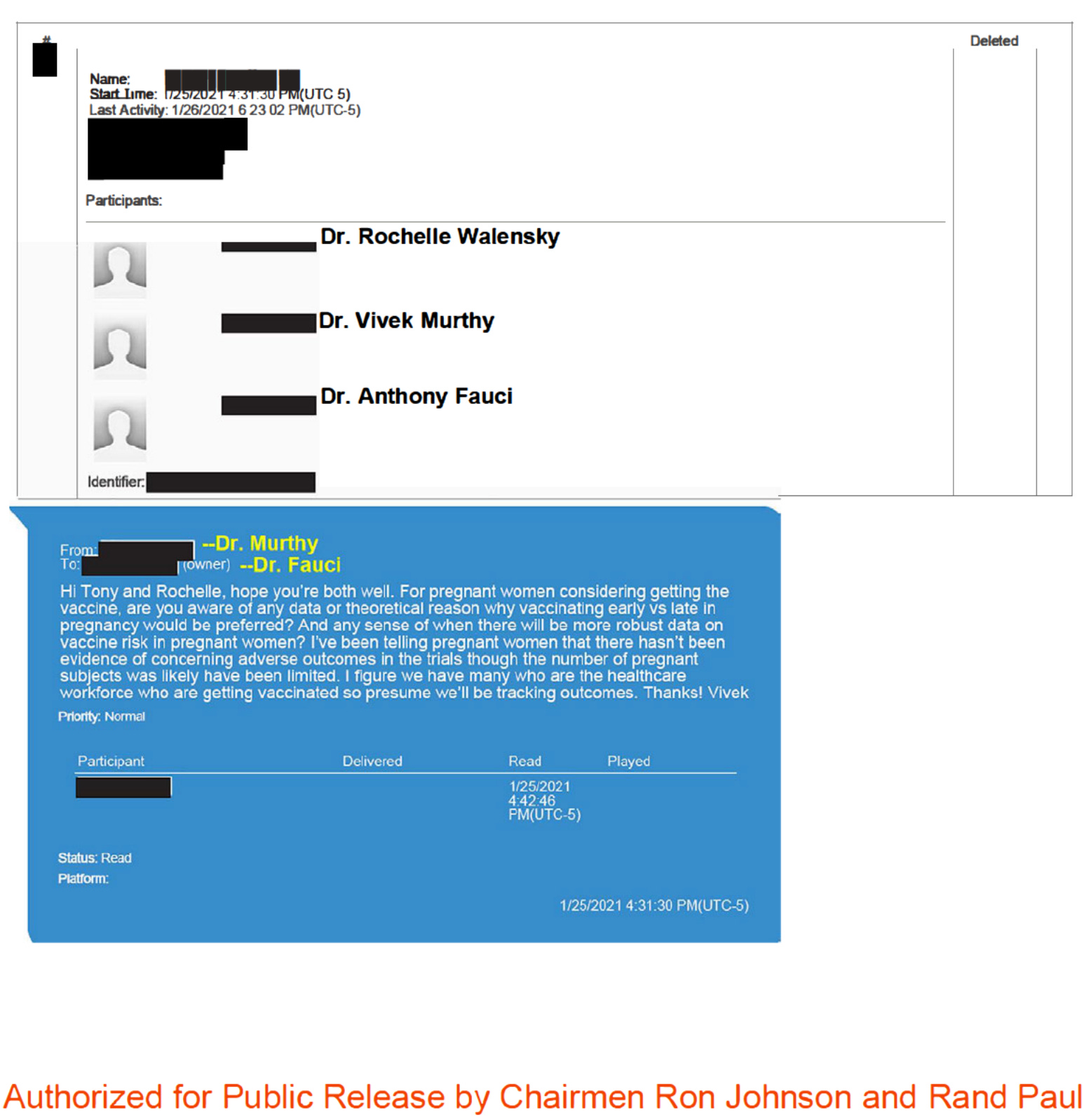
The chain runs January 25–26, 2021. The participants: Fauci, then director of NIAID and chief medical advisor to the new president; Dr. Rochelle Walensky, five days into her tenure as CDC director; and Dr. Vivek Murthy — at that point the nominee for Surgeon General, not yet confirmed, a private citizen participating in federal policy deliberation. Hold that detail; it matters later.
January 25, 4:31 PM — Murthy asks whether any data or theoretical reason favors vaccinating early versus late in pregnancy, and when robust safety data will exist. He admits: “I’ve been telling pregnant women that there hasn’t been evidence of concerning adverse outcomes in the trials though the number of pregnant subjects was likely have been limited.”
4:48 PM — Walensky: “my understanding is that this is all a data free” [zone]. She describes the CDC’s answer to the missing data: the v-safe pregnancy registry, with more than 15,000 pregnant women enrolled, to be followed through their pregnancies — after vaccination.
4:56 PM — Fauci agrees there’s no basis for a timing preference, then notes that “some people (even female health care professionals) feel concerned about injecting a ‘genetic’ vaccine very early in pregnancy” — a “misperception,” he says, “that we need to deal with.”
6:45 PM — Fauci: “I asked around a bit more and another issue came up that you need to be aware of. Since many people have significant cytokines storm and fever after the 2nd dose, this theoretically could be associated with miscarriage in the 1st trimester.”
6:47 PM — Walensky: “Definitely a good point, esp after dose two.”
7:27 PM — Murthy: “This is really helpful, thanks... That’s a really good point re the cytokine storm post second dose.”
January 26, 4:34 PM — Murthy flags that day’s news: “did you see this announcement today from WHO saying they advise against pregnant women taking the Moderna vaccine bc of lack of data? It has led to a flurry of questions... I imagine we will all get asked about this.”
4:55 PM — Fauci drafts the response: with data lacking, weigh risks against benefits; COVID “can be a serious disease especially in pregnancy”; pregnant women were excluded from the trials but more than 10,000 have been vaccinated since authorization; “No issues have arisen”; FDA, ACIP, and ACOG “are all permissive for pregnant women to have a choice.”
4:57 PM — Murthy: “That was my sense as well Tony which is why I was surprised to see WHO put out a strong[ly worded statement] saying they do not recommend moderna in pregnant women. That’s a strong statement to make and potentially quite damaging to public confidence among pregnant women.”
6:00 PM — Walensky: “Agreed... ACIP meeting tomorrow. Shall I flag it for them?”
Read it twice. Then notice what happened nine days later: on February 3, 2021, Fauci told a JAMA Network audience that the FDA had found “no red flags” for pregnant women. And notice the trajectory after that, from the senators’ own compilation of the public record: “may choose” became, by September 29, 2021, Walensky’s formal health alert that CDC “strongly recommends” vaccination during pregnancy; by February 2022, Murthy — by then confirmed — was telling parents that vaccination “anytime” in pregnancy “is actually fine.”
What These Texts Do Not Prove
Now the part of this article that some of my readers will not thank me for. It is also the part that makes everything after it unanswerable.
You have seen, everywhere this week, the claim that the government’s own registry data showed an “82% miscarriage rate” in women vaccinated during the first trimester — an “abortion shot.” The number comes from a real paper: Shimabukuro et al., published by the New England Journal of Medicine in 2021, reporting 104 spontaneous abortions among 827 completed pregnancies in the v-safe registry. Critics observed that 700 of those 827 women were vaccinated in the third trimester — past the twenty-week window in which a miscarriage is even possible — and recalculated: 104 divided by the remaining 127 equals 82 percent.
Here is why that arithmetic is wrong, in one image. Imagine judging a marathon’s dropout rate one hour after the starting gun — counting only the runners who have already left the course. Everyone still running is invisible to your denominator. Your “dropout rate” approaches one hundred percent no matter how healthy the field is.
That is precisely what the 82% does. At the paper’s data cutoff, the vast majority of first-trimester-vaccinated pregnancies were still ongoing — healthy, uneventful, and therefore not yet “completed.” Practically the only way an early-vaccinated pregnancy could appear in the “completed” column that soon was to have ended early. The NEJM’s own correction of October 14, 2021 concedes the point in plain words: no denominator was available to calculate miscarriage risk, because follow-up through twenty weeks “was not yet available for 905 of the 1,224 participants” vaccinated around conception or in the first trimester.
Note what that correction also concedes: the original 12.6% framing was built on the same unusable table. Both camps in this fight have been waving the same broken denominator at each other for five years. The “81%” now circulating from Pfizer’s post-marketing safety document is the identical artifact in different clothing — a ninety-day reporting window can only “know” the outcomes of pregnancies that ended within it.
That correction does not establish that there was no abortive signal. It establishes that the preliminary table was incapable of estimating one. The early registry had no valid denominator for first-trimester loss: most women vaccinated around conception or in the first trimester had not yet been followed through the relevant risk window, while the completed-pregnancy column was dominated by third-trimester recipients. Nor did the contemporaneous passive-report data resolve the question. VAERS had received 46 spontaneous-abortion reports among 221 pregnancy-related reports in the early surveillance period, but reports alone cannot establish either causation or an excess rate. The question that remained open was therefore precise: after complete follow-up, did women vaccinated at a given gestational week experience more losses than comparable women at that same gestational week? The initial paper could not answer it.
When researchers finally did the analysis correctly — following early-vaccinated pregnancies forward through time — the answer came back, twice, in September 2021: a cumulative spontaneous-abortion risk of 14.1 percent (age-standardized, 12.8) against a historical background of 11 to 16 percent, and a case-control study finding no increased odds of miscarriage in the four weeks after vaccination. A Norwegian registry study agreed. Whatever else these texts prove, they do not prove the vaccine was, in Fauci’s private hypothetical, causing first-trimester losses. The theoretical concern was investigated and, on the best available evidence, retired.
So why am I telling you this, at length, in a piece about government deception? Three reasons. Because it is true. Because every hour the 82% circulates, it hands the officials’ defenders a legitimate debunking with which to bury the parts of this story that cannot be debunked. And because the discipline of saying what the evidence does not show is exactly the discipline these officials abandoned — and I decline to imitate them.
A broken denominator cannot exonerate a product any more than it can convict one. The correction means the early v-safe table could not answer whether first-trimester vaccination was associated with excess loss; it does not erase temporally associated reports or settle the question of a subgroup- or timing-specific signal. It means that only complete follow-up, a defined pregnancy denominator, and gestational-age–specific comparison can adjudicate the claim.
What They Do Prove
Strip away the bad statistics and what remains is harder, not softer.
The gap is documentary fact. Privately: a theoretical miscarriage mechanism, endorsed as “a really good point” by the incoming Surgeon General and the sitting CDC director, inside a “data free” zone. Publicly, nine days later: “no red flags.” Those two statements are not, strictly, contradictions — one is a mechanistic hypothesis, the other an empirical observation about surveillance data. But the public was given exactly one half of the epistemic picture, and the half it was given wore the costume of the whole.
The concern wasn’t fringe — it was in the government’s own fine print. Fever in early pregnancy has been a recognized theoretical risk in obstetrics for decades. And the CDC’s own clinical guidance during the rollout said so, advising that pregnant women who develop fever after vaccination take acetaminophen — “because fever, for any reason, has been associated with adverse pregnancy outcomes.” Sit with that. The theoretical basis of Fauci’s private message was disclosed by the government — in clinician-facing fine print, framed as fever management. It simply never made the journey from the footnote to the podium. The informed-consent question of this whole affair is not “did they disclose?” It is: where does disclosure live, and who is it for?
The public was the registry. Pregnant women were excluded from the trials. The plan — stated plainly in Walensky’s first text — was to authorize, vaccinate, and monitor: fifteen thousand enrollees and counting, followed forward to generate the safety data that did not yet exist. There is a defensible version of that strategy in an emergency. There is no defensible version of implementing it while telling its participants the answers were already in.
The escalation outran the evidence, then claimed the evidence’s authority. “May choose” in January. “Strongly recommends” in September. The confident public posture of spring 2021 preceded the definitive data of September 2021. The officials turned out to be right about miscarriage risk — and being right in the end is not the same as being justified at the time. That asymmetry is the entire principle of informed consent, and it does not stop mattering because the coin landed the way they called it.
Seventy-Two Hours in January
Now look again at the most revealing message in the release — the one, incidentally, that CBS’s writeup of these texts managed not to quote at all.
On January 26, the World Health Organization’s advisory group recommended against the Moderna vaccine in pregnancy absent high exposure risk, citing lack of data. This was not a fringe position. It was the cautious reading of the same “data free” zone the three had privately described the evening before.
Murthy’s reaction, within hours, in private: the WHO’s statement was “potentially quite damaging to public confidence among pregnant women.”
Not wrong. Not inconsistent with the data. Damaging to confidence. The nominee for America’s doctor, presented with institutional caution about an open safety question, instinctively classified it not as an evidentiary claim to evaluate but as a messaging problem to manage. Walensky offered to “flag it” for the CDC’s advisory committee, meeting the next morning. Three days later, the WHO reversed itself, announcing there was “no specific reason to believe” risks would outweigh benefits.

Did pressure flow from Washington to Geneva in those seventy-two hours? The texts do not say, and I will not claim what they do not say. What they establish is that the top of the incoming American health apparatus treated the WHO’s caution as a confidence threat the day it issued — and that the paper trail for those three days now has dates, names, and a records custodian. It is a FOIA request waiting to be answered.
And here is the coda, five years in the making. On Tuesday night, Dr. Robert Redfield — who ran the CDC until January 20, 2021, five days before these texts — went on NewsNation and said: “I never thought we should vaccinate pregnant women. I was not in favor of that policy recommendation,” because the vaccine’s demonstrated benefit was preventing severe illness in the high-risk, “largely over the age of 65.” He was careful — more careful than his amplifiers — to add that he has seen no data establishing a miscarriage link.
Read his position closely. Stratified risk-benefit; benefit concentrated in the elderly and vulnerable; blanket recommendation for healthy pregnant women unjustified. That is the WHO’s position of January 26, 2021 — the one the texts show being received, privately, as a threat to confidence. The former CDC director now stands, in 2026, where the WHO stood in 2021, before the reversal.
One more thing about Redfield, and it is not a compliment: he said none of this publicly while the escalation happened. Viewers noticed; the frustration was immediate. Silence in office, candor after — that is not a flaw in this story. It is this story: the same institutional incentive structure, exhibited in real time by its newest witness.
The Enforcement Arm
Everything to this point is about what officials said to each other and to you. Now we turn to what you were allowed to say back — because these texts do not exist in isolation. They are the epistemic interior of a machine whose enforcement exterior is now documented in court records, subpoenaed corporate emails, and, as it happens, my own account history.
Six months after privately calling the miscarriage mechanism “a really good point” and the WHO’s caution a confidence problem, Vivek Murthy — confirmed as Surgeon General on March 23, 2021 — issued the first Surgeon General’s advisory in American history aimed at the information environment itself, declaring health misinformation an “urgent threat.” The next day the President said the platforms were “killing people.” What followed is no longer a matter of inference. In September 2023, the Fifth Circuit Court of Appeals, reviewing the discovery record in Missouri v. Biden, analyzed the White House and the Surgeon General’s office as a single unit — “considering their close cooperation and the ministerial ecosystem” — and found they had likely both coerced the platforms “by way of intimidating messages and threats of adverse consequences” and significantly encouraged them “by commandeering their decision-making processes.” (The Supreme Court later dissolved the case on standing grounds without ever reaching those findings’ substance — so quote them as what they are: a federal appellate panel’s assessment of the record, vacated on procedure, refuted on the merits by no one.)
What was the campaign actually asking for? Here the platform’s own subpoenaed records answer, and I want you to read the key sentence in full, because the truncated version circulating — including, I’ll own it, in my own earlier writing — undersells it. An internal Meta email, released by the House Judiciary Committee, characterized the ask this way: “The Surgeon General wants us to remove true information about side effects if the user does not provide complete information about whether or not the side effect is rare and treatable.”
The conditional clause is the confession. This was not a request to remove falsehoods. It was a contextualization mandate on true speech — truth permissible only when packaged with reassurance. And on a July 2021 call, Meta told the Surgeon General’s office directly how compliance worked: negative side-effect posts and mandate-questioning posts were being demoted — “That’s not false information, but it leads to a vaccine negative environment.” The office was told, in so many words, that non-false content was being suppressed. The campaign continued. The Stanford-led Virality Project, per its internal guidance, advised platforms that “true stories of vaccine side effects” could constitute actionable misinformation. And the Fifth Circuit found platform commitments to reduce the reach of vaccine content even where it “does not contain actionable misinformation.”
Put those four sources side by side — a court, two sets of subpoenaed corporate records, a consortium’s own documents — and the system’s operating definition of “misinformation” comes into focus. It was never epistemic: is the claim false? It was positional: who is saying it, and does it damage confidence?
Which brings us to the test that fuses this article’s two halves. Take Fauci’s 6:45 PM message, word for word — “Since many people have significant cytokines storm and fever after the 2nd dose, this theoretically could be associated with miscarriage in the 1st trimester” — and imagine a nurse posting that sentence to Facebook in February 2021. Under the platform’s written COVID policy, vaccine-miscarriage claims sat in removable territory; under the enforcement practice documented above, even hedged and true variants were demoted as hesitancy-fueling. The same sentence, two fates. Inside the group chat: diligence. Outside it: misinformation.
The apparatus was not suppressing the opposite of what officials believed. It was suppressing unauthorized possession of what officials believed.
Now the personal disclosure I promised, kept brief because the documents carry it. On February 4, 2021 — ten days after these texts — a researcher at the Institute for Strategic Dialogue, a think tank whose government funding is now independently documented, named me personally in a published piece as a prominent “pandemic denier.” Five weeks later, the Center for Countering Digital Hate published its “Disinformation Dozen,” with my name on it — one day, as it happens, after Murthy’s confirmation. In July, the White House cited the list from the podium; the President, walking back “killing people,” narrowed the charge to the twelve of us. And then the finding I want you to read in the court’s own words: Facebook “started removing information posted by the ‘disinfo dozen’... despite earlier representations that those users were not in violation of their policies.” A month later, the panel found, members of the dozen “were deplatformed across several sites.” Meta itself had publicly disputed the list’s central statistic — putting the twelve at a vanishing fraction of vaccine-content views — and enforced anyway. The platform disbelieved the predicate and executed the sentence.
I do not claim these texts show Fauci, Walensky, or Murthy ordering action against me or anyone by name; no such document has surfaced, and I will say so the day one does or doesn’t. What the record shows is confluence, not command — and confluence is enough, because the mechanism never needed a command. It needed only a definition. Once “misinformation” meant confidence-damaging speech by unauthorized speakers, the targeting of those who warned about the shots was not an abuse of the system. It was the system.
One precision, because it will surprise readers on every side: the censorship record runs through Murthy, not Fauci. The same Fifth Circuit found that Fauci’s agency “did not have regular contact with the platforms or flag content,” and dropped it from the injunction. Fauci’s sins in this story are epistemic. The enforcement arm belonged to the man who wrote “damaging to public confidence.”
The Fifth Amendment Corner
The accountability fight now underway is stranger than either side admits. Fauci, protected by a preemptive pardon covering January 2014 through January 2025, invoked the Fifth Amendment 111 times before the Senate in July. The committee held him in contempt, on the theory — with nineteenth-century precedent behind it — that a pardon extinguishes the privilege it renders unnecessary. His lawyers answer that Florida’s attorney general has opened a state investigation the federal pardon cannot touch, and that new testimony carries new exposure. Scholars are genuinely split; the courts may have to draw a line no court has drawn: whether exit-day preemptive pardons neutralize the Fifth Amendment.
Understand what that means before cheering for either outcome. Whatever rule emerges will bind every future president’s pardons — all of them, in both directions. This corner of the story is not about Fauci anymore. It is about the machinery of accountability itself, and it deserves better than gallows emojis.
The Balloon Payment
Here is the paradox I keep returning to, because it is the deepest thing these eleven messages teach.
The theoretical fever concern of January 25, 2021, disclosed plainly, would have cost the campaign a marginal dip in uptake — and then been retired honorably when September’s data came back clean. Instead it was managed: footnoted for clinicians, withheld from podiums, and defended by an apparatus that came to treat true-but-unreassuring speech as a removable hazard. Now, excavated five years later, it indicts everything — including the parts of the official record that were telling the truth. The women who were right to feel unconsulted and the officials who turned out to be right about the risk are locked in a fury neither can win, while the worst statistics in circulation do the work of discrediting the best documents.
Confidence-management is a short position on your own future credibility. The balloon payment always comes due, and it is being paid this week, with interest, by every public-health institution in America — because the risk wasn’t real, and the concealment-shaped handling of it was.
What would getting it right look like now? Not gallows. Searches. The committee holds 34,000 messages and 522 voicemails spanning the entire arc — the “asked around” evening, the WHO seventy-two hours, the Shimabukuro spring, the advisory summer, the September reckoning that either prompted a private course-correction or, more tellingly, didn’t. I have published the seven searches I believe staff should run, and one further request: obtain Murthy’s device and records on the same basis as Fauci’s, because a phone whose preservation cannot be guaranteed needs its cross-checks. Then publish what comes back — favorable or not.
Because the principle at stake was never complicated, and it was never partisan. People being asked to accept a medical intervention are owed what is known and what is not known, in plain language, at the time of the asking — not five years later, from a subpoenaed phone with three contacts and an iceberg underneath.
They owed us the group chat. We settled for the press conference. The difference between the two is the whole story.
Companion piece: “An Open Letter to Chairmen Johnson and Paul: The Seven Searches.”

Let’s get down to the real evil of the recommendation by these talking head experts. This was a completely unnecessary injection for ANY woman of child bearing age - covid death potential under 1%. This was not life saving but experimental. A ruling class that experiments on its population is sick & on pregnant women is diabolical. If this does not confirm this was a depopulation agenda I don’t know what does.
Thanks for pointing out that the 82% miscarriage rate is not correct. I have been trying to tell people that posting that causes more harm than good becuase it is easily debunkable, and when people post about it, and it gets debunked then it gives the impression that the vaccines didn't really increase the miscarriage rate.