

The Drums Inside Your Body
How Heartbeats, Cavitation, DNA, and Crystals Reveal a Hidden Technology of Life

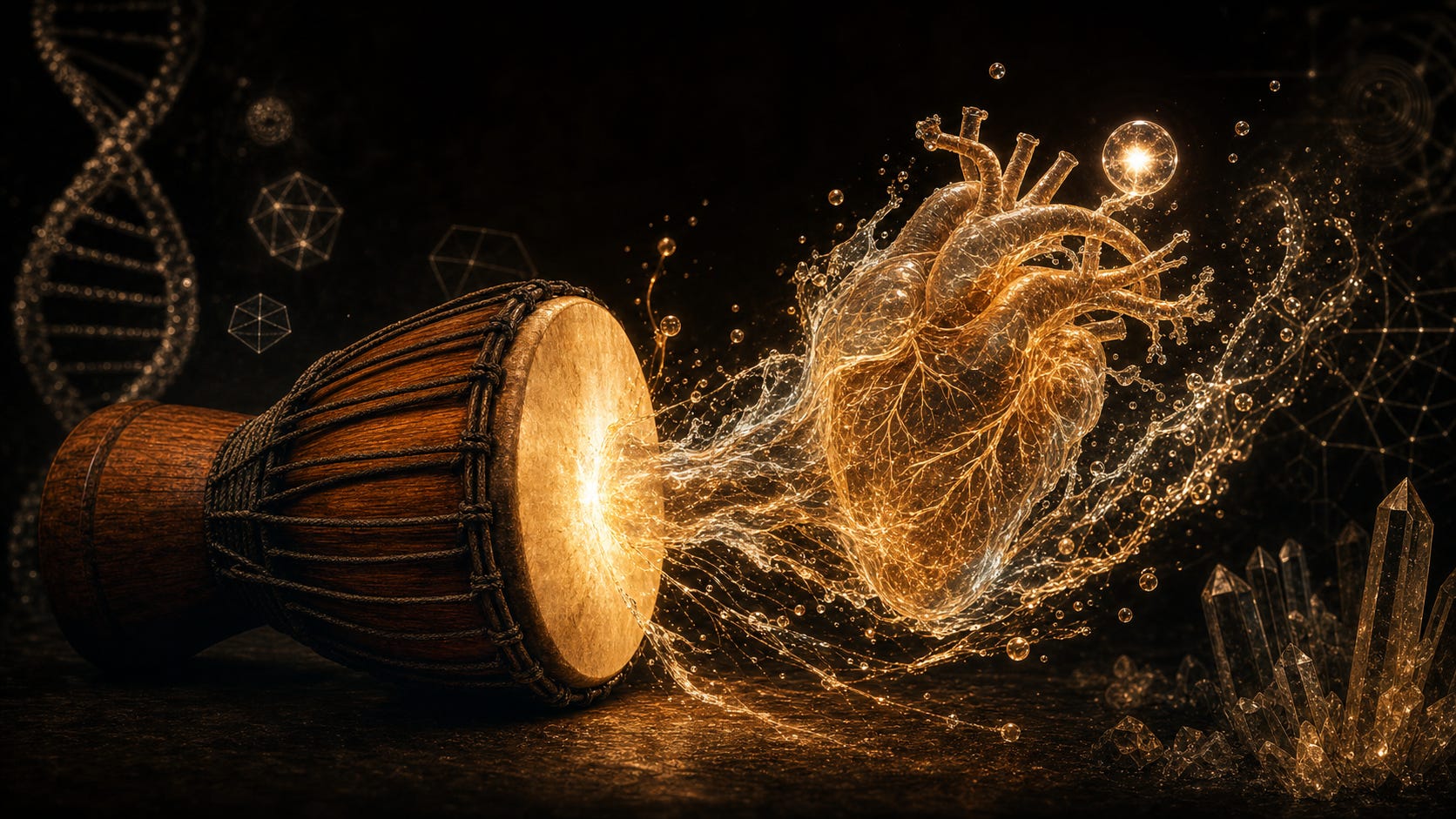
What if ecstasy is not merely emotional? What if it is mechanical, optical, electrical, and biological all at once?
This is part of my Sacred Technology & Philosophy series of essays.
In the presence of a great drum—especially the deep, closed resonance of the dun dun—something happens that will not stay inside psychology. The room changes. The body changes. Time loosens. During drum circles, people who arrived as separate beings begin to breathe, sway, and feel as if they are moving inside one larger field.
What if the drum is not merely an instrument, but a mirror? What if the body itself is a kind of closed resonant chamber—a living dun dun, also encased in skin—driven by pulses, vortices, pressure waves, and luminous codes? And what if the states we call healing, coherence, bliss, and connection arise when these layers begin to line up?
Biology already uses forms of physics we were told belonged only to extremes: cavitation hot enough to mimic stars, nanobubbles that can fire neurons, pressure waves that couple heartbeats to brain activity, liquid‑crystalline tissues that turn vibration into electricity, and DNA that couples to electromagnetic fields like a fractal antenna.
The question is no longer whether life is using advanced physics. The question is whether we are finally ready to recognize it.
At a Glance
Biology demonstrably uses extreme physics—cavitation, plasma-like collapse, mechanotransduction—in ways that are precise rather than destructive.
The heartbeat is not only a pump stroke; it is a repeating pressure-wave and vortex event that has now been shown to directly modulate neuronal firing in the brain.
The body and the dun dun share a striking structural overlap: wood/bone, skin/membrane, metal/conductive constraint, each shaping standing waves and resonant states.
Mechanical rhythm may propagate from phonons to membranes to DNA to biophotons, offering a bridge between touch, emotion, physiology, and light.
More speculative frontier models—from Konstantin Meyl, Dan Winter, and my father Sungchul Ji—ask whether coherence involves not only chemistry but information-rich conformational and field phenomena. These are not consensus science, and I treat them as the open questions they are.
The First Shock: Water Is Not Simple
The first crack in the old worldview came from cavitation.
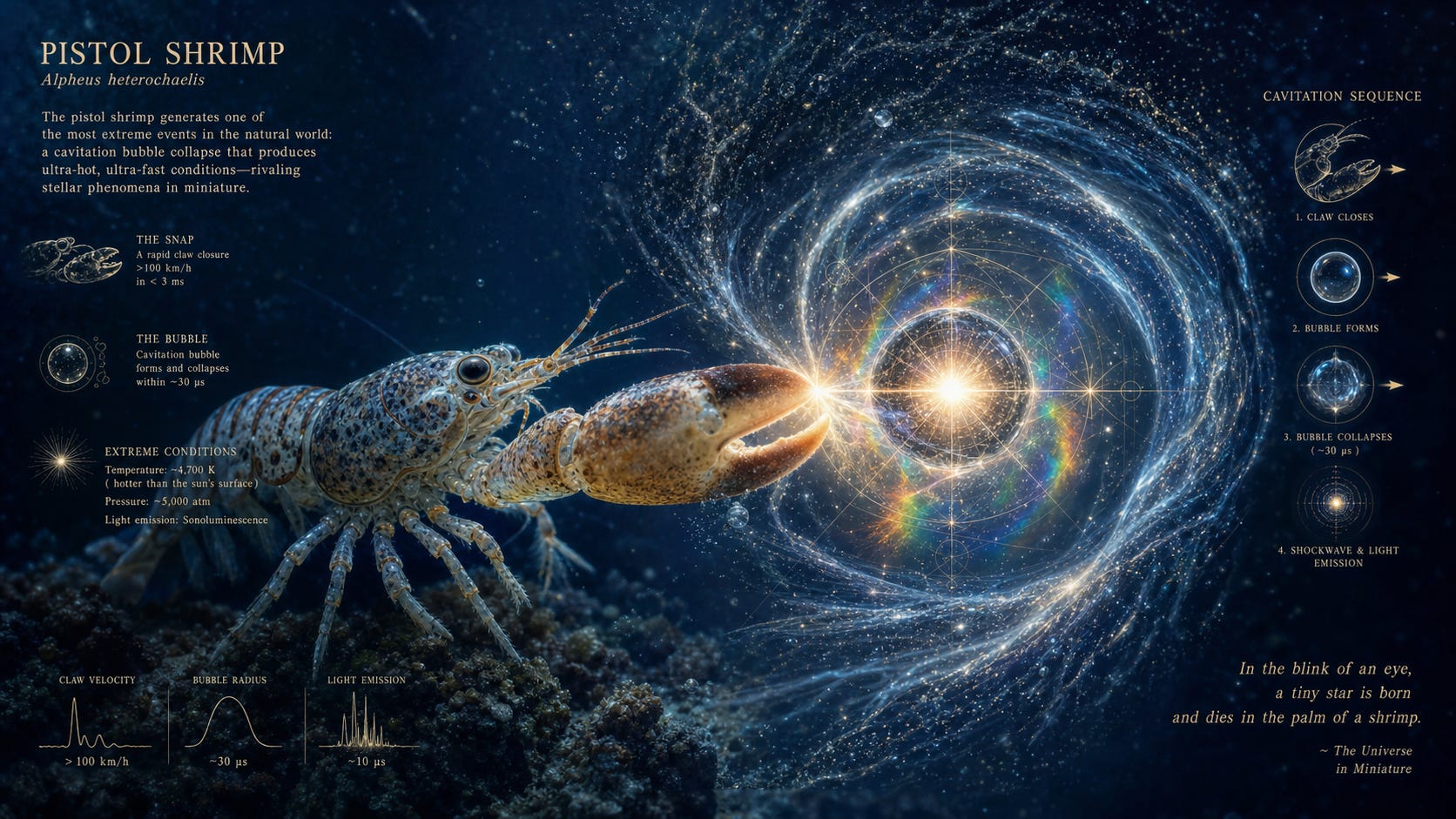
When a pistol shrimp snaps its claw, it creates a collapsing bubble that emits a flash of light and reaches temperatures estimated in the thousands of Kelvin. A living creature uses imploding water to produce conditions that resemble a tiny plasma event—without destroying itself. A living plasma event.[1]
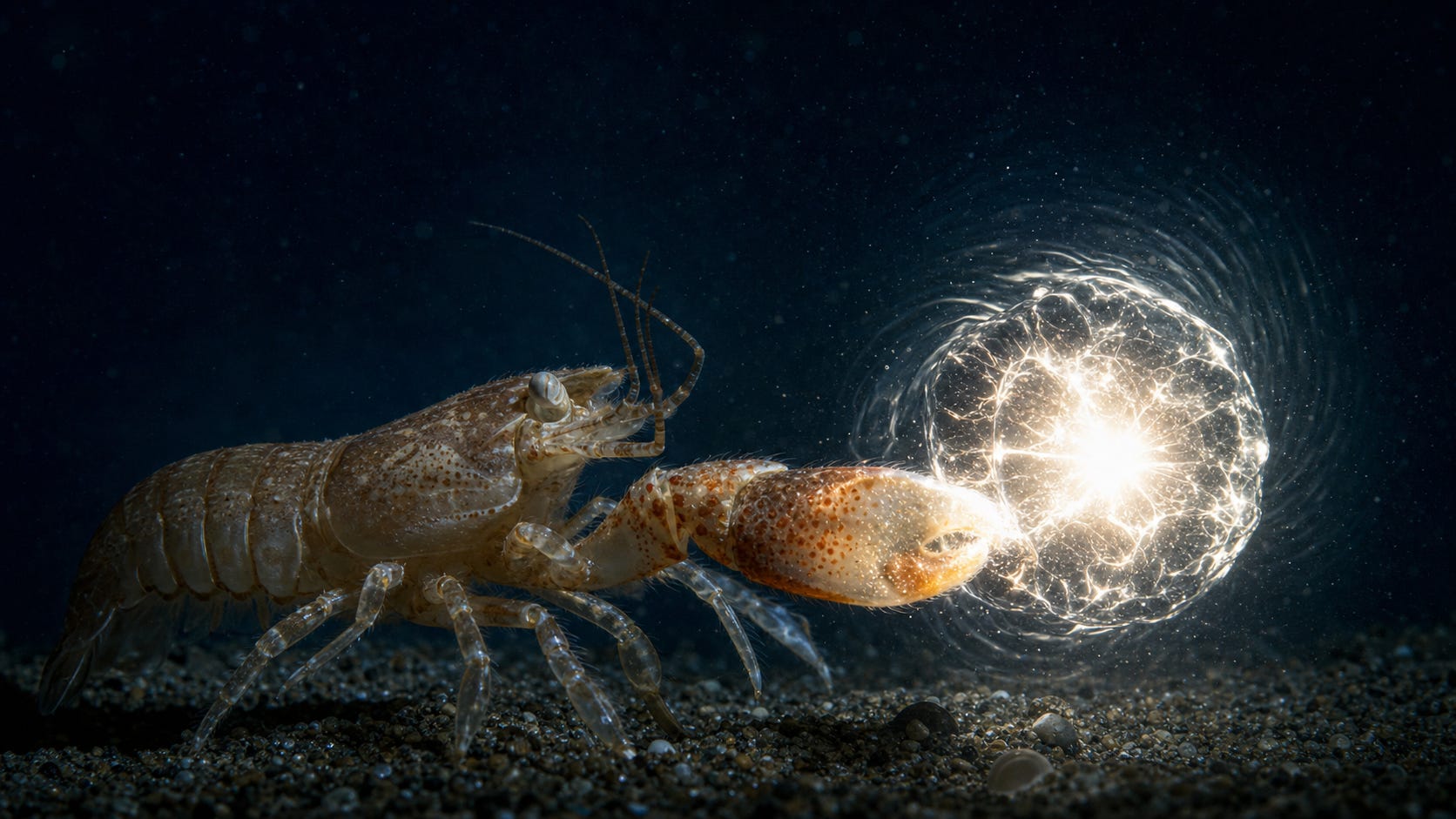
That fact alone—solid, measured, published in Science—should have forced a revision in our idea of what biology is allowed to do.
Beyond this, the trail leads into more experimental territory.
At the far, contested edge of cavitation research, engineer Mark LeClair has reported that water‑based cavitation reactors can yield apparent new elemental signatures, including transmutation of elements, which he interprets as evidence of nucleosynthesis at the collapse front. A related conference‑paper record is available through the Italian National Research Council repository here. These results sit outside mainstream physics for now: they appear mainly in conference presentations, company‑linked documents, and press releases, rather than in a body of independently replicated, peer‑reviewed experiments. If even part of this effect is confirmed, it would greatly widen what we believe cavitation in water can do. I explored the highest potential of LeClair’s discoveries recently in my article: When Water Becomes Sovereignty and the Oldest Reason for War Dissolves.

Transmutation and the de novo synthesis of elements out of the “quantum vacuum” or “ether” may underlie the much older biodynamic line of work—Lili Kolisko, Ehrenfried Pfeiffer, and Rudolf Hauschka—which explicitly proposed that living systems can, under certain conditions, generate or transform minerals rather than only absorbing them from soil. Their experimental and interpretive work points toward the possibility of genuine “biological transmutations,” in which living organisms take an active role in elemental change as part of a wider, formative field of life. More recent agronomic studies comparing organic and conventional farming also report distinct elemental “fingerprints” and mineral patterns across different cultivation systems, suggesting that life and farming practice leave their own signatures in matter, even though scientists still debate the mechanisms in more conventional language.
Rudolf Hauschka summed up this reversal of the usual picture in a simple phrase: “plants make the soil,” not only the other way around. In that view, fields and bodies are not passive products of chemistry; they are ongoing participants in shaping the very elemental landscape they appear to grow from.
This can no longer be brushed off as “magical thinking.” There is something very real here asking to be explored.
It also fits a pattern traced in Crystals & the Code of Life: How IBM’s Marcel Vogel and Fritz Popp’s Biophoton Discovery Bridged Science and Spirit, and it leans on the same cavitation lesson found in the astounding sonoluminescent pistol shrimp—a one‑inch animal whose collapsing cavitation bubbles briefly reach thousands of Kelvin and emit flashes of light inside water itself, an effect so firmly measured that it has become a benchmark example of living cavitation in the literature.
Biology Already Uses Extreme Physics
Cavitation is not just a weird trick in shrimp claws or lab devices. Biology often runs at the edge of pressure, shape, and phase change, and this part is backed by peer‑reviewed science.
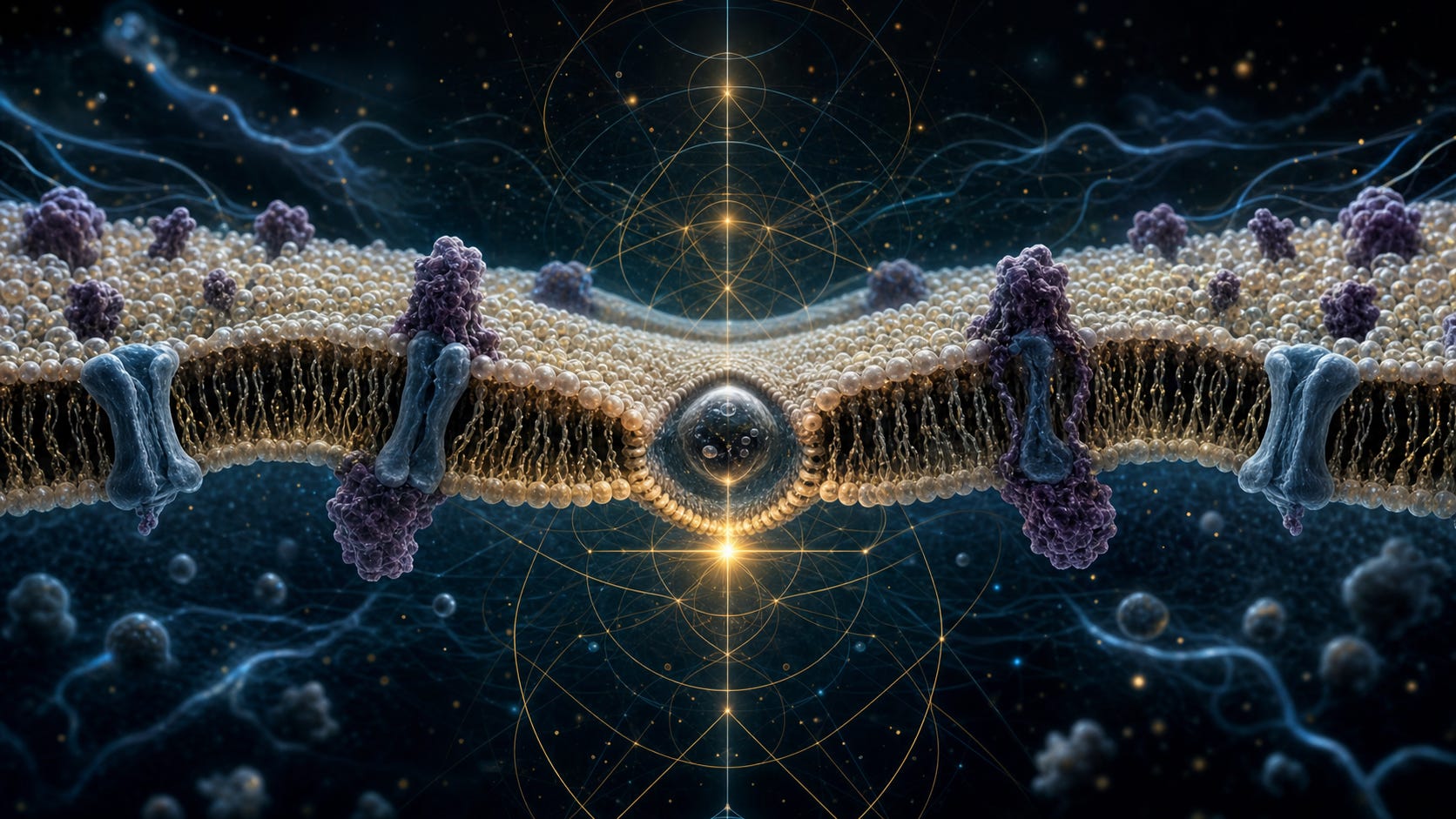
A striking example comes from intramembrane cavitation. The bilayer sonophore model—published in Physical Review X—shows how ultrasound can induce nanoscale gas pockets within cell membranes, mechanically deforming the bilayer and changing its capacitance until neurons fire. This is not metaphorical pressure. It is nanoscopic bubble dynamics embedded in the machinery of sensation and signaling.
Crucially, these events are non‑destructive at physiological intensities: the bubbles form and collapse within elastic limits that the membrane can tolerate, acting more like reversible valves than tearing shocks. In that light, living membranes may be using cavitation‑like events as a subtle, cyclic gating mechanism rather than as a source of damage, although the pistol shrimp has been genius at weaponizing it.
What matters here is not merely that ultrasound can stimulate neurons. It is that living membranes may use non-destructive cavitation-like events as a gating mechanism.
That insight changes the scale of the conversation. Cavitation is not just something that happens in oceans, turbines, or industrial devices. It may also belong to the intimate physics of cell membranes, nervous systems, and mechanosensation.
Which means the body is not only biochemical. It is vibro-mechanical all the way down.
The Heart as an Internal Drum
Now bring the focus inward.
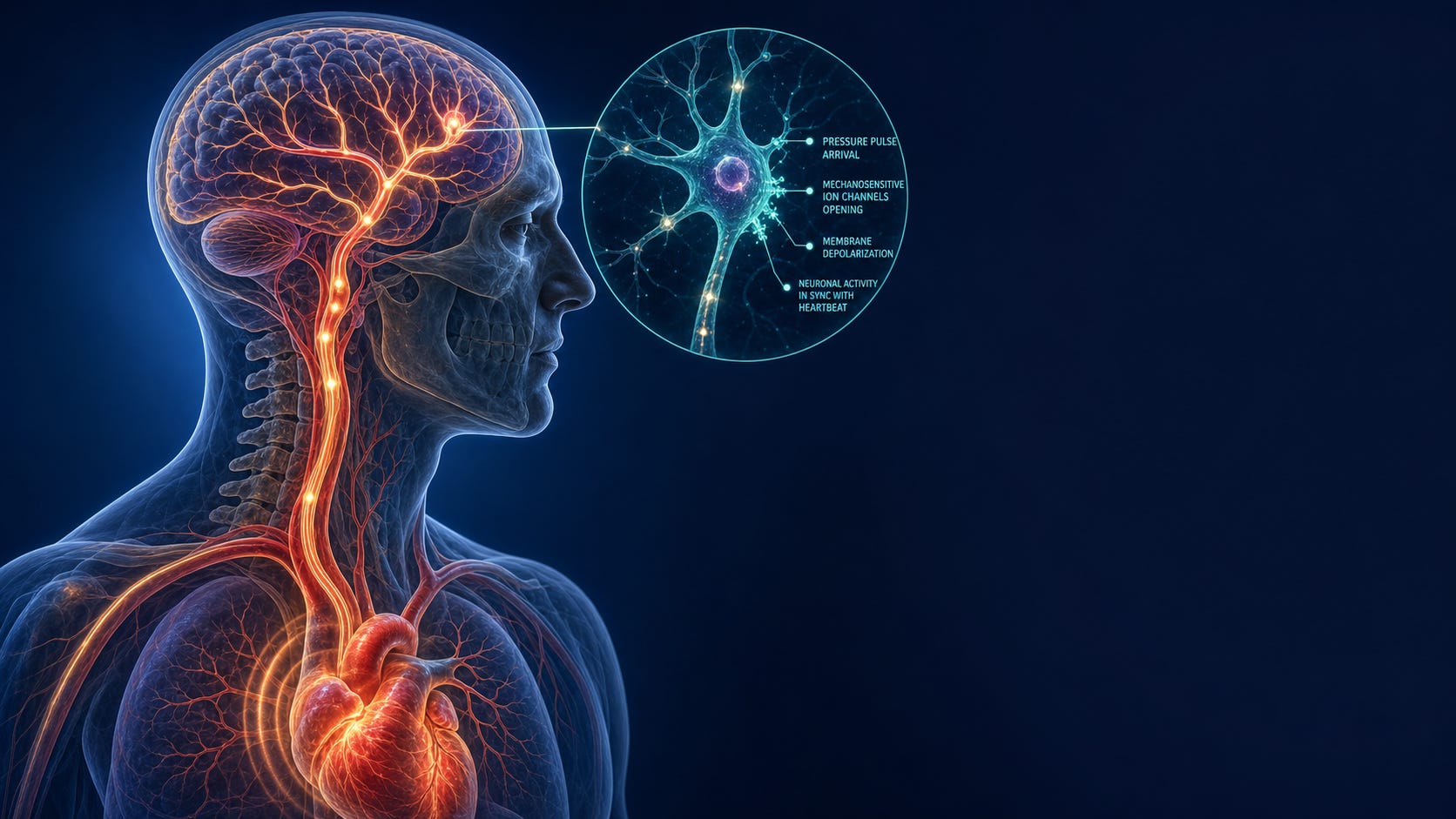
Every heartbeat sends a pressure wave through blood, tissue, cerebrospinal fluid, and vessel walls. For generations this was treated mostly as plumbing. But in 2024, a study in Science showed something remarkable: arterial pressure pulsations can directly modulate the activity of central neurons. The effect is mechanical—mediated by pressure-sensitive ion channels of the Piezo family—rather than a conventional synaptic signal. The heartbeat, in other words, is not merely felt by the brain; it physically reaches in and shapes neuronal timing.
That finding is profound.
It means the heartbeat is not simply supplying the brain with oxygen. It is also writing rhythmic mechanical information and energy into neural activity.[3]
In other words, the heart is already doing what drummers know how to do: setting the pulse to which perception organizes itself.
This deepens the argument I first explored in Your Body’s Hidden Technology: The Scalar Field Between Your Hands, where embodied coherence begins not in abstraction, but in felt patterning between living structures.
The Heart Is Also a Vortex Generator
The heart does not move blood as a crude piston.
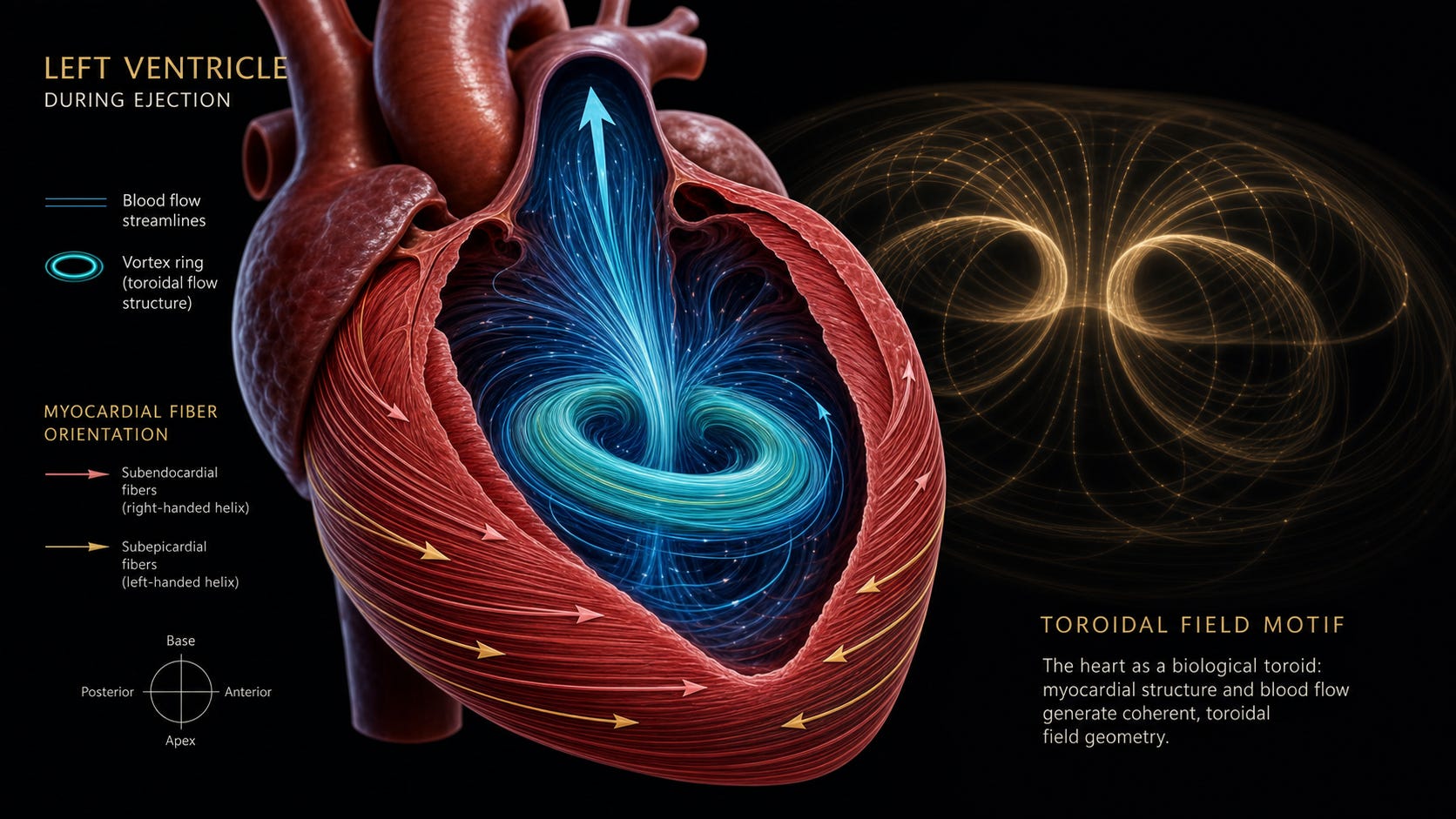
It twists, coils, and releases. Modern imaging shows that healthy ventricular filling involves organized vortex rings; Leonardo da Vinci correctly identified vortices in the sinuses of Valsalva as central to valve dynamics; and the helical ventricular myocardial band model proposes that the heart’s muscle fibers are arranged in spiraling layers rather than simple stacked pumps. (The vortex rings are well established by 4D-flow MRI; the fully helical-band anatomy is a respected but still-debated model—worth naming the difference.)
This matters because vortex motion is not random turbulence. It is structured flow—an elegant way of storing momentum, reducing dissipation, and distributing force through curved space.
Dan Winter has long argued, in a far more speculative register that mainstream science does not endorse, that the coherent heartbeat is best understood as an implosive vortex event: a rhythmic convergence of charge, pressure, and harmonic proportion. I find the intuition evocative; I hold the mechanism as unproven. What the peer-reviewed record does support, plainly, is the heart as a vortex engine.
And once we accept that, the bridge to pressure waves, field effects, and whole-body entrainment no longer seems fanciful. It becomes a frontier extension of something already visible.
We Are, in Important Ways, a Closed Drum
This is where the dun dun becomes more than an analogy.
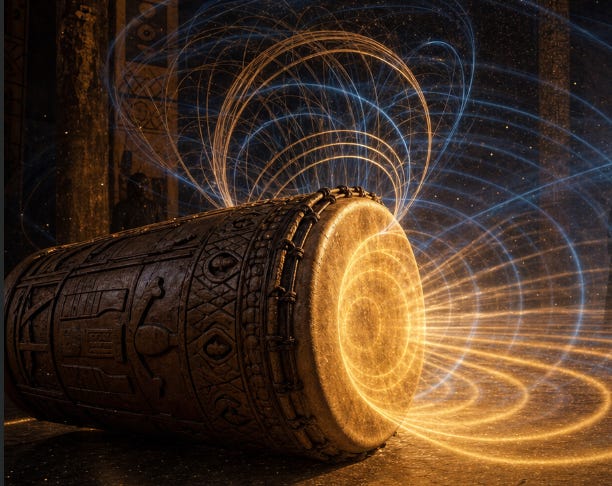
A closed drum works by launching waves into a bounded cavity. Opposing wavefronts reflect, interfere, partially cancel, and organize themselves into standing-wave and pressure-wave patterns. The drum does not merely make noise. It creates a resonant geometry.
So does the body.
The skull is a chamber. The thorax is a chamber. The abdomen is a chamber. Blood vessels, sinuses, membranes, fascia, and fluid spaces are all components of a living acoustic architecture. Every heartbeat and breath excites this system with recurring pulses, reflections, and standing-wave potentials.
Nature already exploits exactly this kind of tuning between bodies. As I described in yesterday’s peacock piece, the male “drums” his train at about 26 hertz — the precise pitch at which the small crest of feathers on the peahen’s head naturally resonates. She does not merely see his display; she feels it, her crown vibrating in answer across the open air. One resonant structure, tuned to set another ringing.
And the material overlap with the dun dun, my favorite drum to play, is almost uncanny.
Wood is piezoelectric, and so is bone.
Animal skin behaves as a tensioned membrane, just as collagen-rich tissues, fascia, vessel walls, and cell membranes do.
Metal rings and hardware hold tension and constrain form, much as ionic gradients, conductive blood, mineralized tissues, and protein scaffolds stabilize structural states in the body.
This is not a loose metaphor. It is a cross-scale structural rhyme.
The dun dun is a three-part resonator of wood, skin, and metal.
So are we.
Wood, Bone, and the Secret of Piezoelectric Life
One reason this overlap matters is piezoelectricity: the ability of a material to convert mechanical stress into electric charge.
Bone is piezoelectric because collagen and hydroxyapatite form a composite that generates charge under deformation—a phenomenon first demonstrated by Fukada and Yasuda in 1957 and tied to growth and remodeling by Becker and Marino. These local fields are not trivial; they are implicated in bone remodeling, cellular signaling, and regeneration.
Wood, too, exhibits natural piezoelectric behavior through the crystalline arrangement of cellulose. Recent engineering work has shown that modified wood can generate measurable voltage under compression.
Now picture what happens in a drumming circle.
A wooden body under rhythmic force creates patterned electrical potentials. A bony body under rhythmic force does the same.
The old divide between “instrument” and “organism” begins to dissolve. The drum is not just being heard by the body. It is resonating with a body built on materially similar transduction principles.
The body is not merely listening. It is answering.
From Phonons to Membranes to DNA
At this point we can trace a deeper chain.
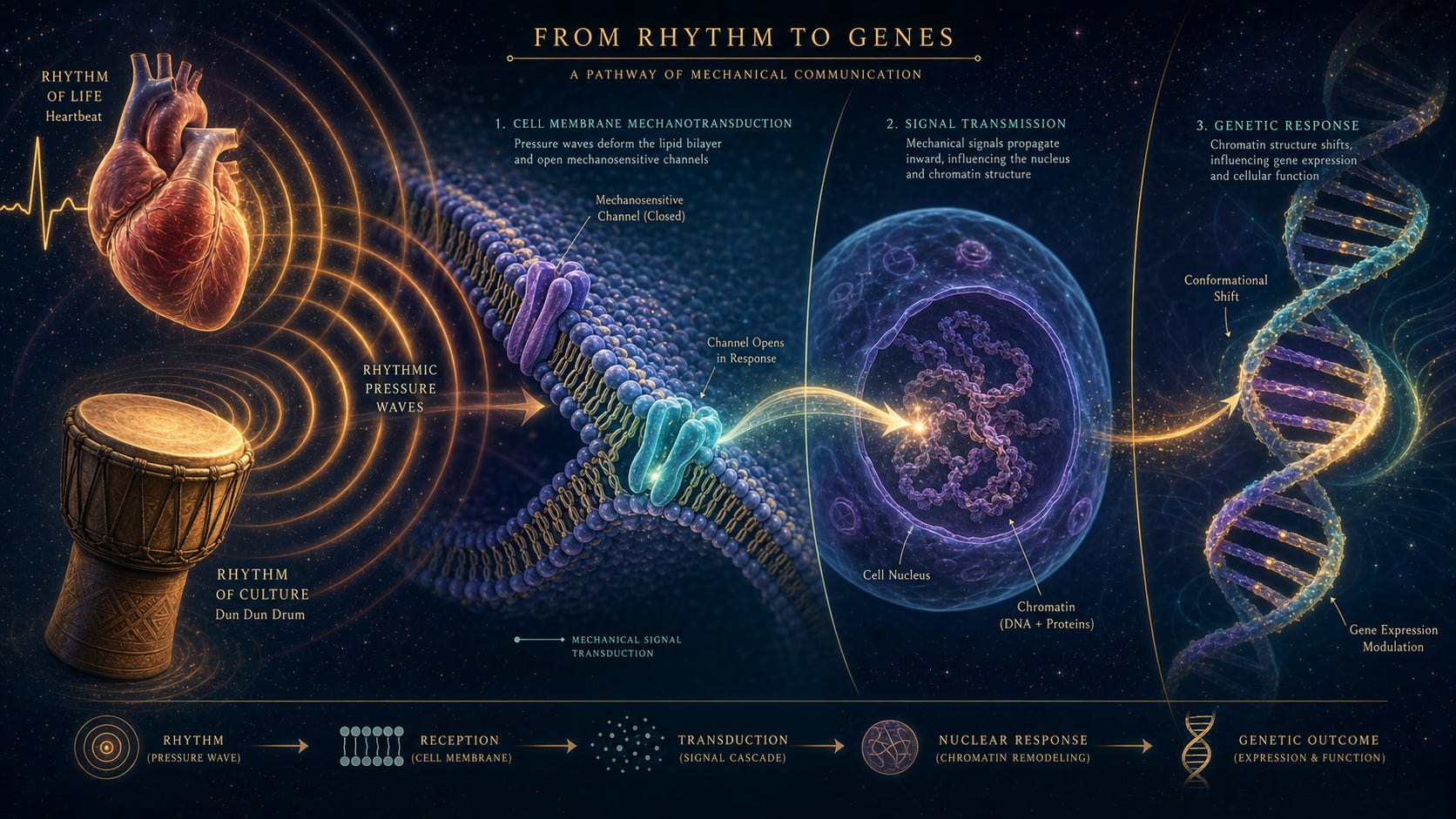
Mechanical pressure waves—phonons, in the broad sense of organized vibrational energy in matter—move through fluids, membranes, connective tissues, and cytoskeletal networks. Some is gross and audible; some microscopic and silent. But all of it is information-bearing if the receiving structure is tuned to respond.
Some ion channels, like the Piezo family, turn pressure into changes in the cell’s electrical activity. Intramembrane cavitation models show that tiny bubbles forming inside the membrane can change how well it holds charge and can even help start nerve spikes. The cell surface is not just a wrapper; it is a finely tuned interface that feels and responds to pressure.
From there, the signal does not necessarily stop at the membrane.
The cytoskeleton transmits force to the nucleus. Chromatin architecture shifts in response to mechanical loads. DNA itself is not rigid text but a dynamic molecule with multiple conformations and measurable structural transitions.
This is where Sungchul Ji’s concept of the conformon becomes valuable. Ji proposed that proteins and DNA contain localized conformational states carrying both free energy and information—discrete shape-events that act as units of stored work and coded instruction. It is a heterodox but published, quantitative idea: a bridge between mechanics and meaning. Shape becomes signal.
If rhythm can alter conformational states, and conformational states carry information, then a pressure wave is not merely moving matter. It may be nudging biological possibility.
DNA as an Antenna: What Is Known, and What Is Conjectured
Most biology textbooks say DNA is mainly a storage device: a codebook, a template, an archive of sequences. That picture may be incomplete.
In peer‑reviewed work, Columbia researchers Martin Blank and Reba Goodman suggested that DNA behaves as a fractal antenna for electromagnetic fields. In simple terms, they argue that because of its structure and the way charge can move along it, DNA can interact with a wide range of frequencies. This shows that DNA responds broadly to electromagnetic fields. It does not yet show that DNA sends out clear, information‑rich signals, and it does not prove anything about special “scalar” waves. The “antenna” part is supported; the exact “message” is still unknown.
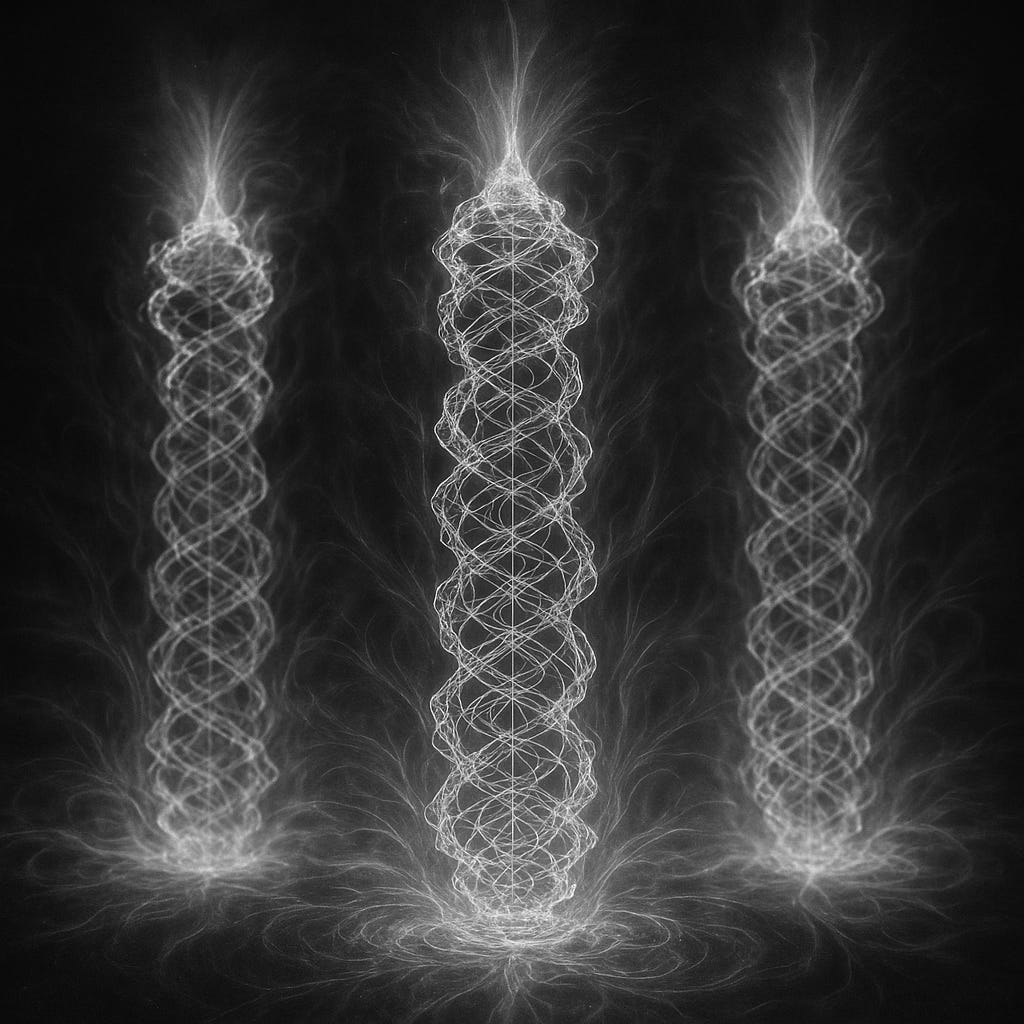
At the edge of current ideas, Konstantin Meyl goes further. He proposes that DNA is a helical antenna for longitudinal magnetic “scalar” waves, with frequencies based on its geometry that are close to the range of biophotons (very faint light from living cells). To his credit, he treats this as a real physics problem: he calculates wavelengths, predicts frequencies, and even asks what it would mean if cells really sent out light in this way.
From the view of mainstream physics, there is a gentle but important concern. Meyl builds part of his theory on the discovery of “magnetic monopoles in spin ice”—special behaviors inside certain crystals. In those studies, scientists describe these monopole‑like objects as effects inside a solid material, not as free particles in empty space, and not as proof of new kinds of waves in the vacuum. Most physicists keep this as a condensed‑matter effect, while Meyl uses it to argue for a much larger field theory of life.
The important thing here is less about whether Meyl is fully right or wrong, and more about the question he raises: how does the DNA helix actually read, write, and share the information it carries in a body that is full of electricity, light, and fields? That question is still open.
So a careful, but still powerful, statement is this: DNA is a helical, charged, moving structure that changes shape and lives in a sea of fluid, ions, light, and electromagnetic fields. Even without any new physics, that already makes it more than a static code. It is a resonant structure—an antenna whose full ways of sending and receiving signals we are only starting to map
Coherent Light, Biophotons, and the Return of the Crystal
This is where the story begins to glow.
Fritz-Albert Popp’s work on biophotons established that living systems emit ultraweak light—a measured, replicated phenomenon. Popp went further, proposing this light is coherent and that DNA is a storage and regulatory site for it; those interpretations remain contested, and I flag them as his hypotheses rather than settled fact. But the bare phenomenon stands: cells emit light.
If cells not only exchange chemicals but also exchange light, then biology begins to look less like a machine and more like a luminous ecology—a possibility worth taking seriously even before we settle what the light means.
This is one reason the question of crystals matters. In Crystal Healing: New Age Hoax or Leading Edge Science? and Crystals & the Code of Life: How IBM’s Marcel Vogel and Fritz Popp’s Biophoton Discovery Bridged Science and Spirit, I explored whether ordered lattices—quartz, collagen, bone, membrane domains, structured water—might serve as information-rich resonant media rather than inert matter.
The crystal is not the opposite of life. It may be one of life’s favorite strategies.
Bone is partly crystalline. Cellulose is crystalline. DNA packs into liquid-crystalline arrangements. Membranes exhibit ordered phase behavior. Even water, under certain conditions, appears capable of adopting structured domains. These are not fringe claims; they are textbook material structure, reread for what it might mean.
The old materialist imagination assumes order is secondary. But what if order is primary? What if life is what matter looks like when rhythm, geometry, and information begin to cohere?
Dan Winter’s Implosive Heart
Dan Winter’s writings occupy a controversial, provocative place in this picture, and I’ll mark them as such: this is interpretive vision, not peer-reviewed result.
Winter argues that heart coherence is more than psychological emotion—that coherent feeling states organize heart and brain harmonics into fractal, often golden-ratio relationships that allow waves to implode non-destructively, producing centripetal ordering and what he calls “bliss in DNA.” He links the phonon harmonics of heart, brain, and craniosacral rhythm to the braiding of charge into DNA.
Much of this language will strike conventional readers as speculative—and that is fair. I share the reservation. But beneath the terminology lies a legible intuition worth stating in plain terms:
If the heart is a vortex engine, if the heartbeat modulates neurons through pressure, if membranes are mechanosensitive, if DNA is conformationally dynamic, and if living systems emit light, then it is at least coherent to ask whether ordered rhythmic states reorganize the body toward greater order.
Winter names that movement implosion. A systems biologist might call it coherence. A mystic might call it bliss. The honest scientist says: this is a hypothesis awaiting a measurement. I offer it as a question, not a conclusion.
Why the Drum Can Feel Like Ecstasy
At a certain point, the established science alone begins to explain the experience.
A closed drum such as the dun dun launches structured low-frequency pressure waves into the room. Those waves meet bodies that are themselves closed resonant chambers full of piezoelectric, liquid-crystalline, and mechanosensitive tissues. The heartbeat modulates the brain. Group rhythm aligns breathing. Standing waves develop in air and flesh. Electrical and mechanical boundaries begin to synchronize.
No wonder people feel changed.
What we call ecstasy may sometimes be the felt signature of multi-layer coherence: pressure, autonomic, neural, perhaps conformational. The boundaries between people soften not because individuality disappears, but because multiple bodies begin to participate in a shared field geometry.
This is why the experience can feel renewing. A more ordered pattern has entered the room—and entered us.
In Bridging Energy and Information: Codality in an Aetheric Framework, I explored the possibility that reality is best understood not as inert matter in empty space, but as energy and information braided within a deeper substrate. The drumming body may be one of the clearest places where that abstraction becomes visceral.
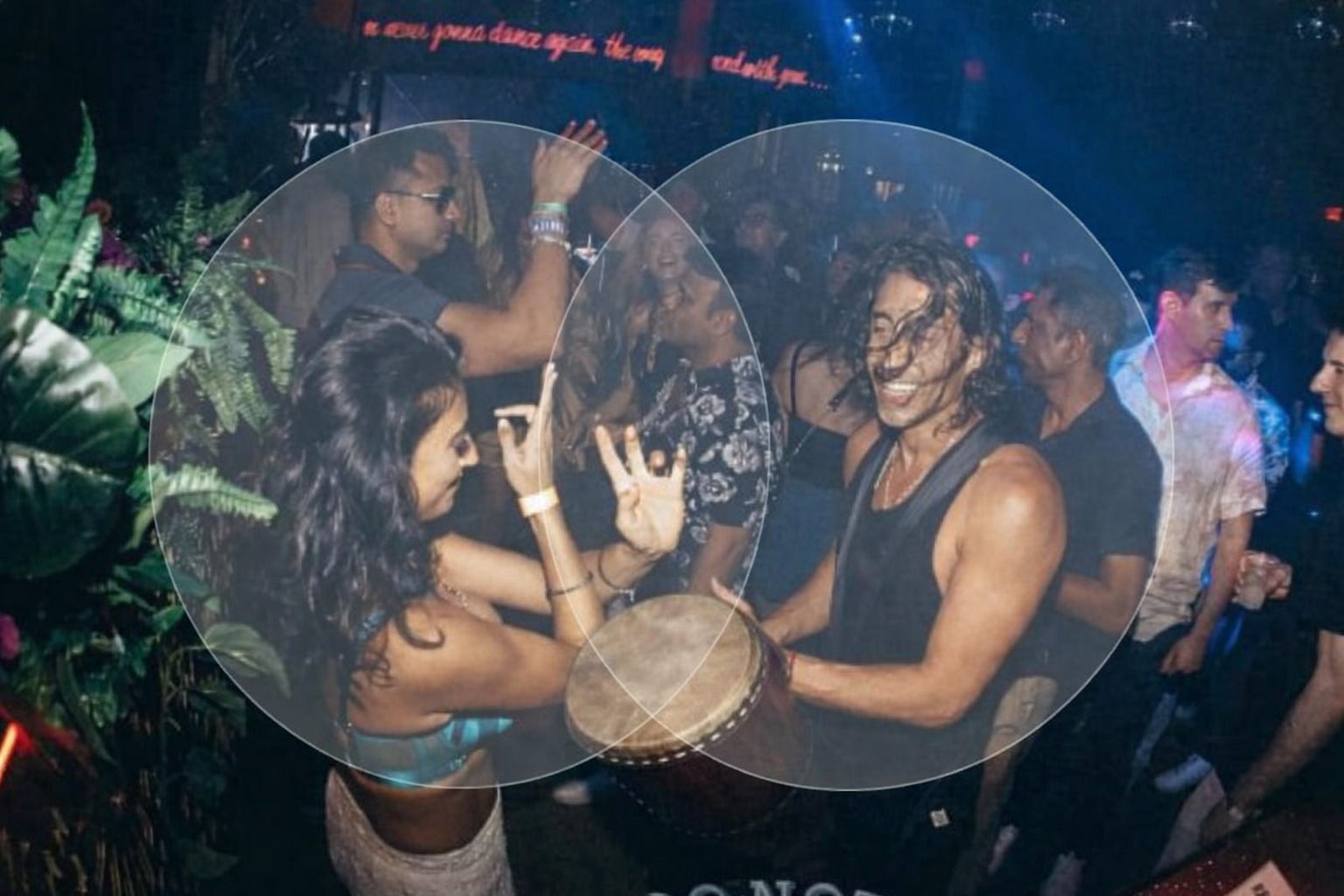
[This is me drumming in Tulum at my legendary DJ friend Steve Lawler’s event—proof that a real djembe braided into electronic music can be as ecstatic as any barefoot beach circle.]
A New Synthesis Is Emerging
The old view says the body is biochemical, the drum is cultural, the crystal is decorative, DNA is a code, and ecstasy is subjective.
A different picture is coming into focus—and I want to be precise about which parts of it are footed in established science and which remain frontier:
Established: Membranes can host cavitation-like events that gate neurons. Heartbeats modulate neuronal activity through pressure waves. Bone and wood transduce mechanical force into electricity. DNA couples broadly to electromagnetic fields and shifts conformation. Cells emit ultraweak light.
Frontier and awaiting independent validation: that water performs nucleosynthesis; that DNA broadcasts coherent scalar signals; that golden-ratio implosion organizes “bliss in DNA.”
The first list is enough to upend the purely biochemical body. The second list is where the adventure lies—and where intellectual honesty demands we keep our footing visible.
When all of this is set into motion by rhythm—especially shared rhythm—the result may be something our ancestors understood long before we had the equations.
The drum is not primitive. It is advanced. More than that: it is recognizably biological. And for those who have mastered this incredible technology, both the experience and the results can be described as nothing less than magical.
And if the body is itself a living drum, then healing may depend less on adding new information from outside than on restoring the conditions under which our deepest patterns can resonate again.
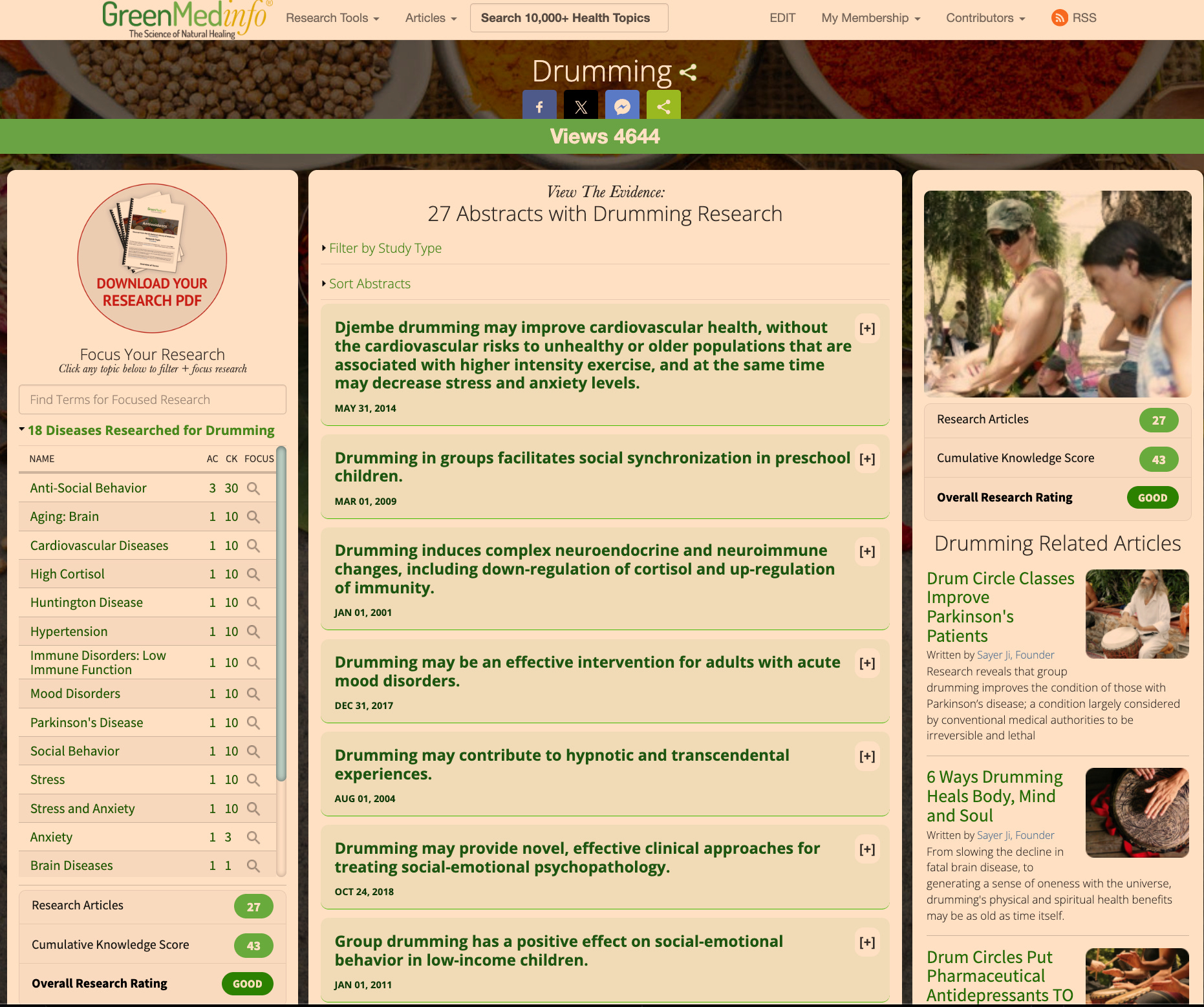
For more research on the healing properties of drumming, you can visit my database on the subject on Greenmedinfo.com.
What This Could Mean
If even the established core of this synthesis is taken seriously, its implications are large.
It would mean physiology cannot be fully understood apart from acoustics, fluid dynamics, geometry, and field effects—not because these lack mechanism, but because their mechanisms cross disciplines our institutions have kept artificially separate.
It would also mean that ancient practices involving drums, chanting, prayer, and rhythmic entrainment may preserve empirical wisdom about coherence that modern science is only now recovering in fragments. And we do not have to wait for the frontier questions to resolve before testing the claim, because the clinical signal is already visible. My own indexed research on GreenMedInfo documents drumming's measurable effects across immune function, stress and cortisol regulation, mood, and neurological conditions , and I've summarized six of the clearest mechanisms elsewhere: 6 Ways Drumming Heals Body, Mind, and Soul]. The mechanical-coherence model offered here is, in part, an attempt to explain why those documented effects occur.
It would also mean that ancient practices involving drums, chanting, prayer, and rhythmic entrainment may preserve empirical wisdom about coherence—wisdom that modern science is only now beginning to recover in fragments.
Most of all, it would suggest that life is far more participatory than modern biology has allowed. We do not merely inhabit the world. We resonate with it.
Closing Return
When I return in memory to the deep pulse of the dun dun, I no longer hear only percussion.
I hear a model of the body.
I hear the heart in the skull’s chamber. I hear the blood pulsing through vessels. I hear the subtle strain of bone, the shimmer of membrane, the coiling of myocardium, the whisper of structured water, the antenna-hum of DNA, and the faint possibility that light itself is listening.
Perhaps that is why the drum can make a room feel whole.
Not because it imposes order from outside.
But because it reminds the body of what it already is: a miracle of creation, and technology so perfect, when expressed optimally, is capable of experiences and expressions bordering on magic.
This is part of my Sacred Technology & Philosophy series of essays.
Footnotes
[1] On snapping-shrimp cavitation and sonoluminescence: M. Versluis, B. Schmitz, A. von der Heydt & D. Lohse, “How Snapping Shrimp Snap: Through Cavitating Bubbles,” Science 289 (2000): 2114–2117. For general sonoluminescence physics, see L. A. Crum, “Sonoluminescence,” Physics Today (1994).
[2] M. Plaksin, S. Shoham & E. Kimmel, “Intramembrane Cavitation as a Predictive Bio-Piezoelectric Mechanism for Ultrasonic Brain Stimulation,” Physical Review X 4 (2014): 011004. See also Y. Tufail et al., Neuron 66 (2010): 681–694, on transcranial ultrasound neuromodulation.
[3] Kim et al., “Blood pressure pulsations modulate central neuronal activity via mechanosensitive ion channels,” Science 384 (2024): eadk8511.
[4] M. Blank & R. Goodman, “DNA is a fractal antenna in electromagnetic fields,” International Journal of Radiation Biology 87 (2011): 409–415. (Peer-reviewed; establishes broadband EMF coupling of DNA, not coherent or “scalar” signaling.)
[5] Konstantin Meyl, DNA and Cell Resonance (INDEL GmbH, 2nd ed. 2011). A frontier-speculative framework most physicists reject; see Note 12.
[6] Broader cavitation / sonoluminescence literature on biologically relevant plasma-like collapse conditions; see D. Lohse, Physics Today 56 (2003): 36–42.
[7] B. Coste et al., “Piezo1 and Piezo2 Are Essential Components of Distinct Mechanically Activated Cation Channels,” Science 330 (2010): 55–60; and the mechanosensitive-channel literature underlying Note 3.
[8] Ventricular vortex and helical-heart literature; see Notes 21–23.
[9] E. Fukada & I. Yasuda, “On the Piezoelectric Effect of Bone,” J. Phys. Soc. Japan 12 (1957): 1158; A. Marino & R. Becker, “Piezoelectric Effect and Growth Control in Bone,” Nature 228 (1970): 473–474.
[10] J. Sun, I. Burgert et al. (ETH Zurich), work on voltage generation from delignified/engineered wood (2021).
[11] Literature on cellulose piezoelectricity and wood electromechanics.
[12] Meyl’s scalar-wave DNA-antenna model. Note: Meyl’s condensed journal article, “DNA and Cell Resonance: Magnetic Waves Enable Cell Communication,” DNA and Cell Biology 31 (2012): 422–426, was retracted in 2013. His model rests on a contested reading of the 2009 spin-ice “magnetic monopole” results (Morris et al., Science; Castelnovo, Moessner & Sondhi, Nature, 2008)—emergent quasiparticles in matter, not free monopoles altering Maxwell’s equations in vacuum. Cited here for the question it raises, not as established physics.
[13] Dan Winter, self-published lectures and writings on heart coherence, implosion, and golden-ratio harmonics. Not peer-reviewed; included as interpretive frontier vision, explicitly labeled.
[14] S. Ji, “Free energy and information contents of conformons in proteins and DNA,” BioSystems 54 (2000): 107–130; and Molecular Theory of the Living Cell (Springer, 2012).
[15] M. LeClair / NanoSpire, Water conference materials and press releases on cavitation-induced elemental synthesis. Not independently replicated or peer-reviewed; included as an unconfirmed anomaly, not as evidence.
[16] Secondary reports describing LeClair’s cavitation reactor and the “LeClair effect.” Same caveat as Note 15.
[17] Comparative elemental-fingerprint studies in organic vs. conventional agriculture (e.g., Foods 10 (2021): 1272); mechanisms debated.
[18] Biodynamic / anthroposophic research traditions on elemental anomalies (Pfeiffer, Kolisko, Hauschka milieu). Historical; not established science.
[19] R. Hauschka, The Nature of Substance (1951), and related biodynamic streams. Interpretive tradition, flagged as such.
[20] Reviews and models of ultrasound-induced membrane deformation and neuronal excitation (bilayer-sonophore lineage following Note 2).
[21] J. Westenberg et al. and related 4D-flow MRI literature on ventricular vortex rings. (Well established.)
[22] M. Gharib et al. on Leonardo da Vinci’s sinus-of-Valsalva vortices and aortic-valve mechanics.
[23] F. Torrent-Guasp, The Cardiac Muscle: Its Helical Architecture. A respected but still-debated anatomical model.
[26] Literature on body cavities, standing waves, and physiological pressure propagation in cranial and thoracic fluid systems.
[27] Bone’s natural electricity and its regenerative implications (following Note 9).
[28] H. Langevin et al., fascia and connective-tissue tension literature; collagen-rich biological membranes as tensioned surfaces.
[29] NMR and structural-biology literature on experimentally detected DNA conformational transitions and dynamic states.
[32] F.-A. Popp, Biophotons: Background, Experimental Results, Theoretical Approach and Applications. The ultraweak-emission phenomenon is established; the “coherence” and DNA-source interpretations remain contested.
[33] Material-structure literature on liquid-crystalline DNA packing, ordered membrane phases, and structured-water domains.
Dr Tom Cowan WROTE THE BOOK on the heart not being a pump!
"...but because their mechanisms cross disciplines our institutions have kept artificially separate."
"...life is far more participatory than modern biology has allowed. We do not merely inhabit the world. We resonate with it."
I concur. I live next door to the massive building that is the Francis Crick Institute in London, where hundreds of scientists are, well, I'm not quite sure exactly what they're doing, but a Knowledge Quarter conference I attended had an independent representative espouse various DNA research that triggered my instincts around the 'artificially separate' lens' so many employ. Everything is connected. Everything lives in an environment. And everything is relational. Thank you for another stunning piece.