
Engineering Humanity: Inside the Emails Linking Epstein to CRISPR’s Commercial Dawn
Part 10 in a Series

Newly examined EFTA documents reveal Jeffrey Epstein framing CRISPR as a “taboo” science he helped curate; credited with catalyzing a collaboration between Martin Nowak and George Church on gene drive research; engaged as a prospective investor in early CRISPR commercialization ventures; and holding equity in a longevity genomics startup run by Church’s network — all documented between 2014 and 2017 before the gene-editing technology completed its shift from laboratory breakthrough to commercial infrastructure.
Read the X thread dedicated to this article.
Executive Summary
Six document clusters, each grounded in the uploaded EFTA records, establish distinct but converging threads:
Epstein described CRISPR and gene drives as “taboo” science under review at MIT — a self-positioning maneuver that Rupert Sheldrake immediately corrected by pointing out CRISPR is entirely mainstream.
Martin Nowak credited Epstein with personally inducing a collaboration between his group and George Church’s lab on CRISPR gene drive technology in natural populations.
Epstein held 2% equity in Androcyte LLC — a supercentenarian genomics company in Church’s orbit — and pressed George Church on whether its CRISPR-based human cell editing pipeline had a viable profit model.
Church pitched Epstein directly on eGenesis — a xenotransplantation venture proposing to deliver human-transplantable organs through engineered animals — with a $1.5 million convertible note at structured investment terms.
Introduction: The Story Behind the Story
Jeffrey Epstein’s public legacy is defined by his criminal conviction for sex trafficking. But a separate paper trail has received comparatively little sustained scrutiny: his documented proximity to, and connective influence within, frontier genetic engineering at the precise moment CRISPR was transitioning from laboratory breakthrough to investable commercial infrastructure.
The documents examined here do not show Epstein inventing CRISPR, designing experiments, or directing research. They show something more subtle and, from a governance standpoint, more interesting: a convicted sex offender who positioned himself as a curator of taboo science, held equity in a genomics startup, was named by a senior evolutionary biologist as the catalyst for a significant research collaboration, and was pitched structured investment terms by one of the world’s most prominent geneticists in a domain — engineering animals to produce transplantable human organs — of profound ethical weight.
The story here is not one of conspiracy. It is a story about how porous elite science networks can be, and what it means when someone with Epstein’s profile is allowed to occupy connective tissue between capital and transformative technology.
I. The “Taboo Science” Frame: Epstein as Curator of the Edgy
SOURCE: EFTA00829980 — RUPERT SHELDRAKE TO JEFFREY EPSTEIN, APRIL 6, 2016
In April 2016, writing to biologist Rupert Sheldrake, Epstein mentioned that at MIT he was beginning a “taboo” science review — and named CRISPR and gene drives among its subjects.[1]
The framing matters. Epstein was not just following CRISPR as a curious lay observer. He was actively positioning himself as someone who identified and convened inquiry at the frontier edges of science — the kind of figure who sees what institutions hesitate to look at directly. It is a self-presentation designed to appeal to unconventional thinkers and to generate intellectual debt.
Sheldrake’s response is revealing precisely because it deflates the frame:
“I would not have said crispr etc is taboo — it’s as mainstream as you can get, and scientific journals are full of papers about it.[1]”
Sheldrake pivots to his own preferred taboo territory — low energy nuclear reactions — and CRISPR largely drops from the exchange. But the exchange preserves something important: Epstein’s rhetorical strategy. He did not approach frontier biology as a passive philanthropist. He approached it as a connoisseur of the edgy and suppressed, using that framing to forge relationships with scientists who might be attracted to a patron willing to fund what others won’t touch.
In this light, the MIT “taboo science review” is less a program than a persona.

II. The Nowak Email: “Induced By You”
SOURCE: EFTA00707374 — MARTIN NOWAK TO JEFFREY EPSTEIN, APRIL 6, 2017
This is the document that changes the frame most decisively.
On April 6, 2017 — exactly one year after the Sheldrake exchange — evolutionary biologist Martin Nowak wrote to Epstein to share a new paper on CRISPR gene drive technology in natural populations. The paper itself concerns one of the most consequential and contested applications of genetic engineering: the use of gene drives to alter inheritance patterns across wild populations, with potential ecological effects that are, by design, difficult to reverse.
Nowak’s message is brief. Its final line is the document’s entire significance:
“the collaboration with george church was induced by you!![2]
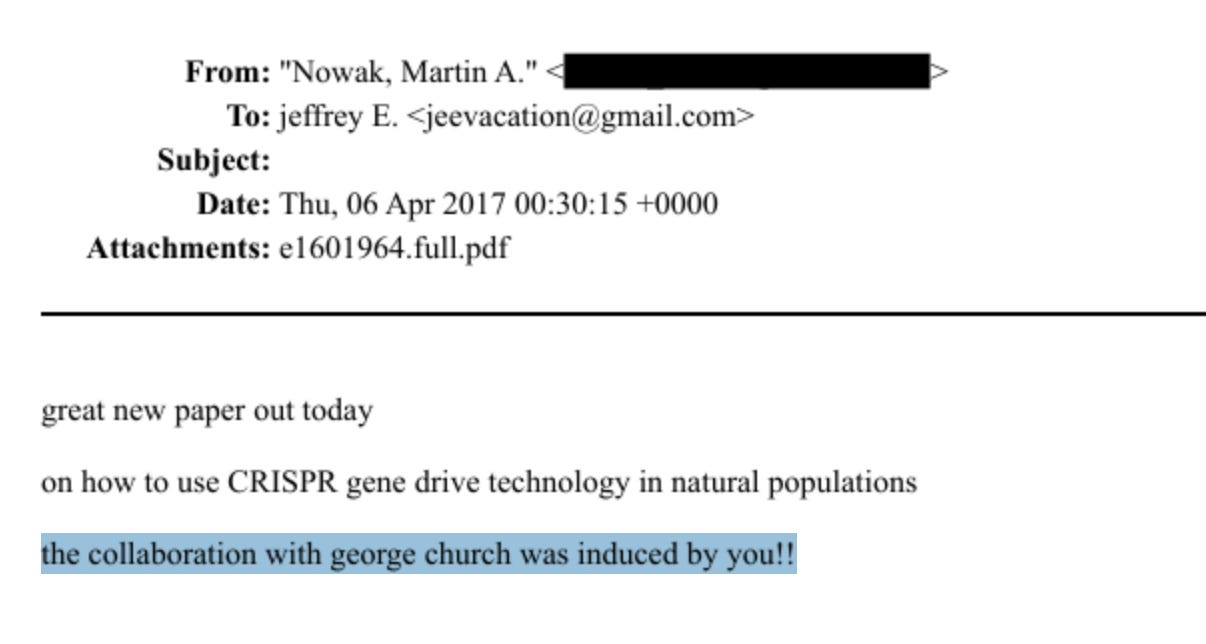
“Induced by you” is not casual phrasing. It is an attribution of causality. Nowak is crediting Epstein not with funding the research, not with attending a talk, but with bringing about the collaboration itself — between Nowak’s evolutionary biology group and the Church lab, one of the most influential genetics operations in the world.
Gene drive governance is a serious international discussion. The technology has biosecurity implications, ecological irreversibility concerns, and is the subject of ongoing regulatory deliberation. When the connective tissue of a significant collaboration in this space runs through a figure like Epstein, that is a governance question, not merely a reputational one.
The document does not establish what Epstein said or did to induce the collaboration. It establishes that a senior Harvard scientist believed he had done it, and thought it worth noting. That is sufficient to warrant scrutiny of the vetting norms that governed his access.
The April email was not an isolated gesture. Two months later, on June 28, 2017, Nowak wrote again — this time to arrange meetings between Epstein and graduate researchers at Harvard’s Program for Evolutionary Dynamics. He offered two names: Chuck Noble, working on CRISPR gene drive, and Carl Veller, working on sex-determining chromosomes. “Both amazing!” Nowak wrote. Epstein replied within four minutes: “Sure.”[2a]
This follow-up exchange matters for what it reveals about the nature of the access. The April email established peer-level scientific correspondence and attributed catalytic influence to Epstein at the senior investigator level. The June exchange shows that access was being extended downward — into the active research personnel of a group working directly on gene drive systems. The documents do not confirm the meetings took place. They confirm they were offered by the group’s director and accepted by Epstein without qualification.
III. The Androcyte Equity: Already Inside
SOURCE: EFTA00997325 — CHURCH / CLEMENT / JEFFREY E. EMAIL CHAIN, SEPTEMBER 2014
The original draft of this story described the Androcyte thread as Epstein “evaluating” a CRISPR investment. The documents reveal something more specific: Epstein was already inside the company before the diligence exchange took place.
In a September 4, 2014 email from James Clement — the Androcyte founder — included in the chain forwarded to Epstein by Church, Clement writes:
“You were given 2% of the company’s initial stock and the other four advisers were given 1 percent each.”[3]
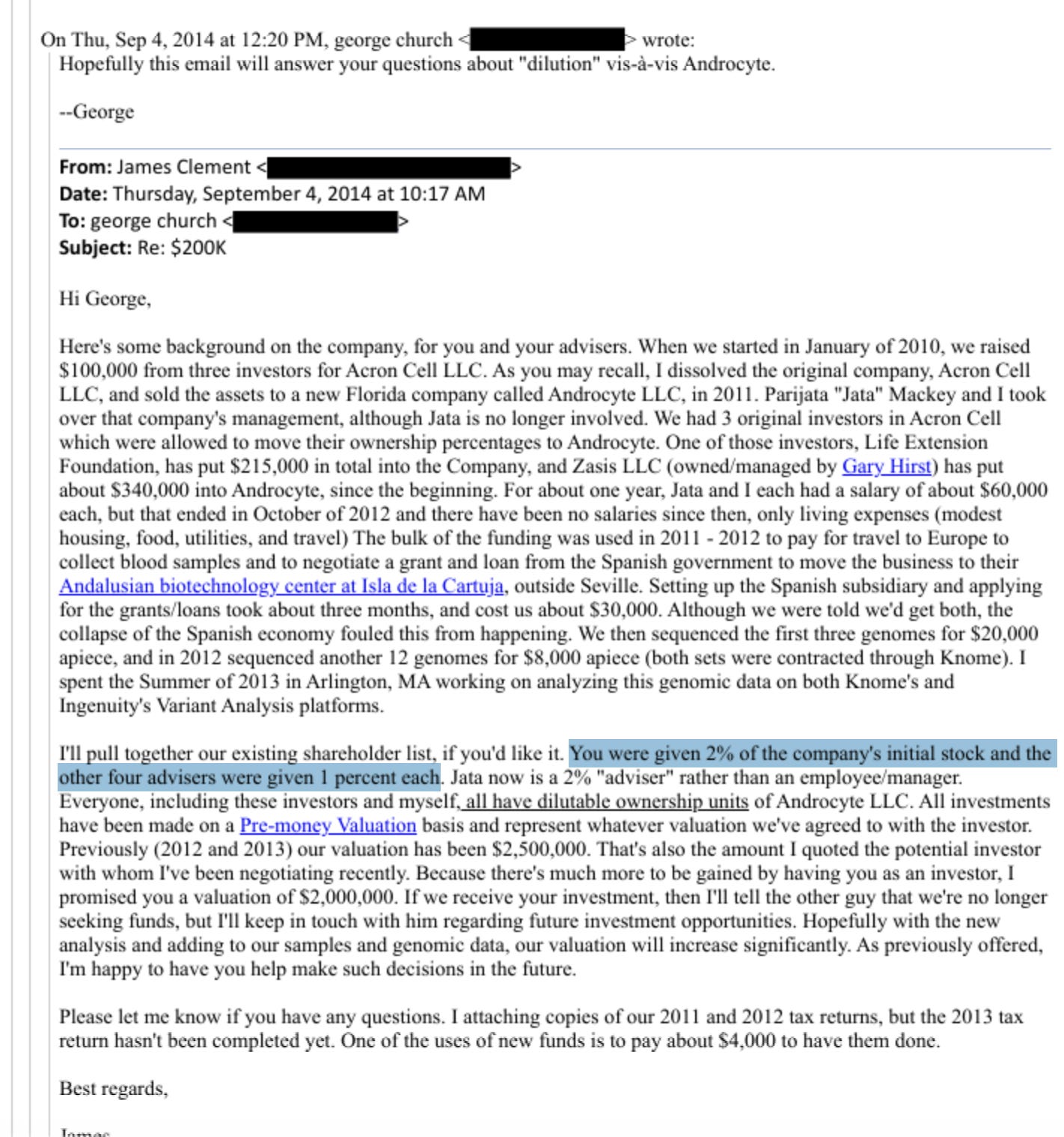
This reframes the subsequent exchange in which Epstein questioned whether the company had a viable profit model. He was not an outside investor conducting arm’s-length diligence. He was already an equity-holding adviser pressing the company to sharpen its commercialization story.
The Androcyte pitch itself is substantively significant. George Church’s September 6, 2014 email to Epstein describes the business model in precise terms: patent products based on genomic variants unique to supercentenarians, use those variants to design CRISPR guide-RNAs, apply those guide-RNAs to edit DNA in human cells — stem cells, neurons — to replicate longevity-associated variants, then partner with pharmaceutical and skincare companies for development.[3]
Church notes that Androcyte had co-invented the CRISPR technology and had the most supercentenarian genomic resources of any entity, positioning it for swift therapeutic development.[3] The first patent was targeted for December 2014.
Epstein’s reply — questioning the profit model and saying the use of funds looked more like a research grant than a for-profit investment — reads not as skepticism from an outsider but as pressure from a stakeholder who wanted the venture to be investor-grade.[3]
The detail that he already held equity also raises a question the documents do not answer: how was he given that stake? On what basis was a 2% advisory equity position extended to someone whose principal qualification appears to have been connective access rather than scientific or operational expertise?
IV. eGenesis: Engineering Animals for Human Organs
SOURCE: EFTA02090913 — GEORGE CHURCH / LUHAN YANG TO JEFFREY EPSTEIN, OCTOBER–NOVEMBER 2014
One month after the Androcyte exchanges, George Church pitched Epstein on eGenesis — a separate venture with a more immediately startling ambition. Church’s October 23, 2014 email opens:
“we deliver human transplantable organ by engineering animals.[4]”
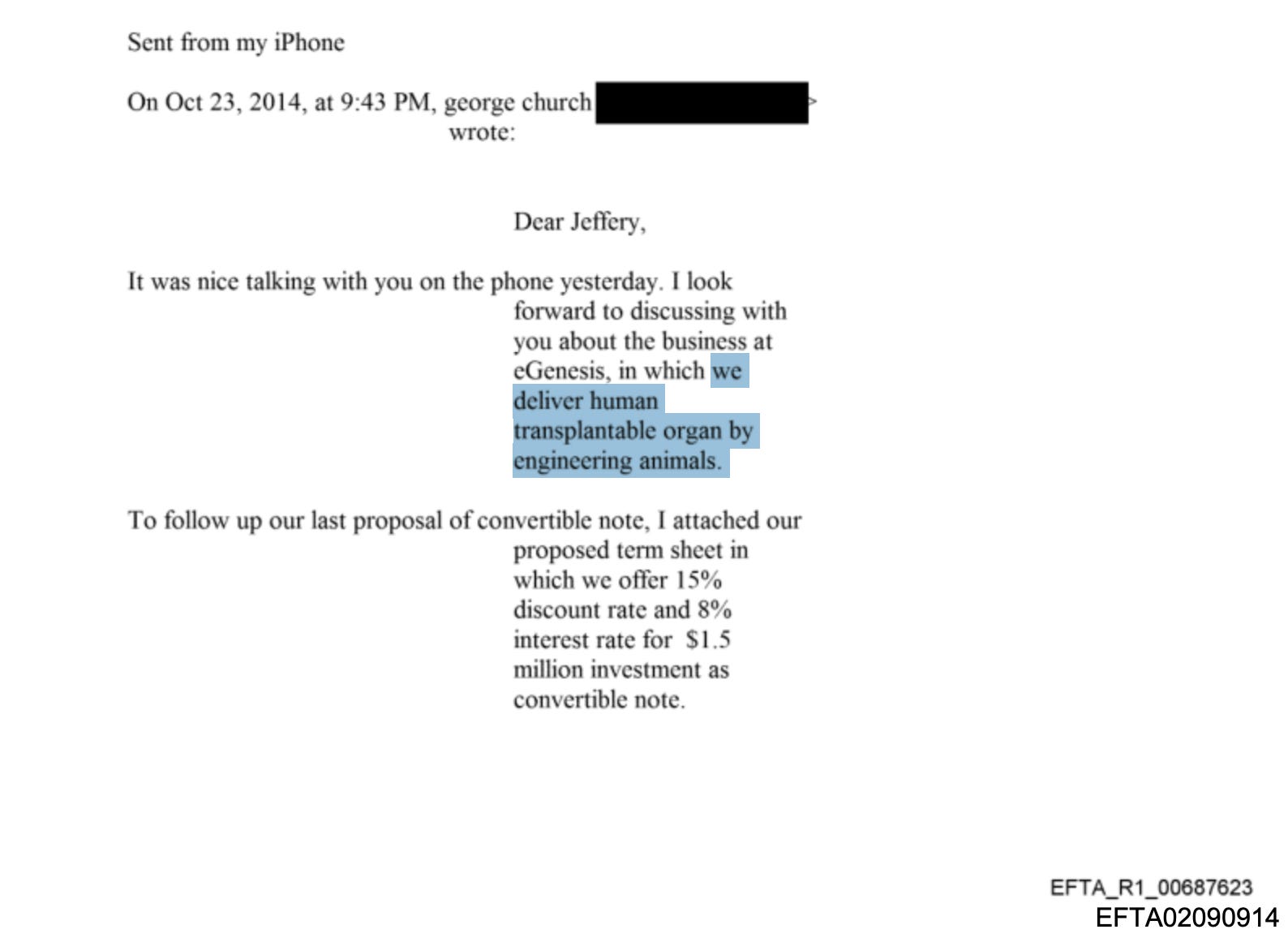
The mechanism was xenotransplantation through genetic engineering: modifying pig genomes to remove immunological barriers to human organ transplant. eGenesis, which would go on to become one of the higher-profile biotechs in that space, was at this point a seed-stage company being pitched to Epstein with structured investment terms.
Church offered two structures: a $1.5 million convertible note at 15% discount and 8% interest, or a 9.09% preferred equity stake at a $15 million pre-money valuation.[4] These are standard early-stage biotech terms, and their specificity places this squarely in the category of formal deal solicitation.
Epstein’s response, relayed through his assistant Lesley Groff, was to request a detailed business plan — use of funds over two to five years — and to indicate he would then propose a deal structure he believed worked.[4]
The follow-up emails, from Luhan Yang (then a postdoctoral fellow at Harvard Medical School’s Department of Genetics), document multiple weeks of check-ins as Yang waited for Epstein’s response. A file referenced in the email chain is named, explicitly: “20141101_eGenesis Inc_shared with Jeffery Epstein.pdf.”
What the documents do not show is a completed transaction. What they do show is George Church soliciting Epstein for early capital in a significant CRISPR-era biotech, and Epstein engaging with deal-level specificity.
V. The Philanthropist as Brand: Epstein’s Self-Presentation
SOURCE: EFTA01056271 / EFTA01056282 — DAVID GROSOF TO JEFFREY EPSTEIN, JANUARY 20, 2017
A January 2017 birthday email from David Grosof — a technology and policy figure in Grosof’s own description — adds a dimension the original draft missed entirely.
Writing to Epstein on what appears to be his birthday, Grosof describes several areas where he thought he could be useful. Among them:
“publicity for your cool-ass creative and important philanthropy in support of really good and adventuresome, high-risk basic science research.[5]”
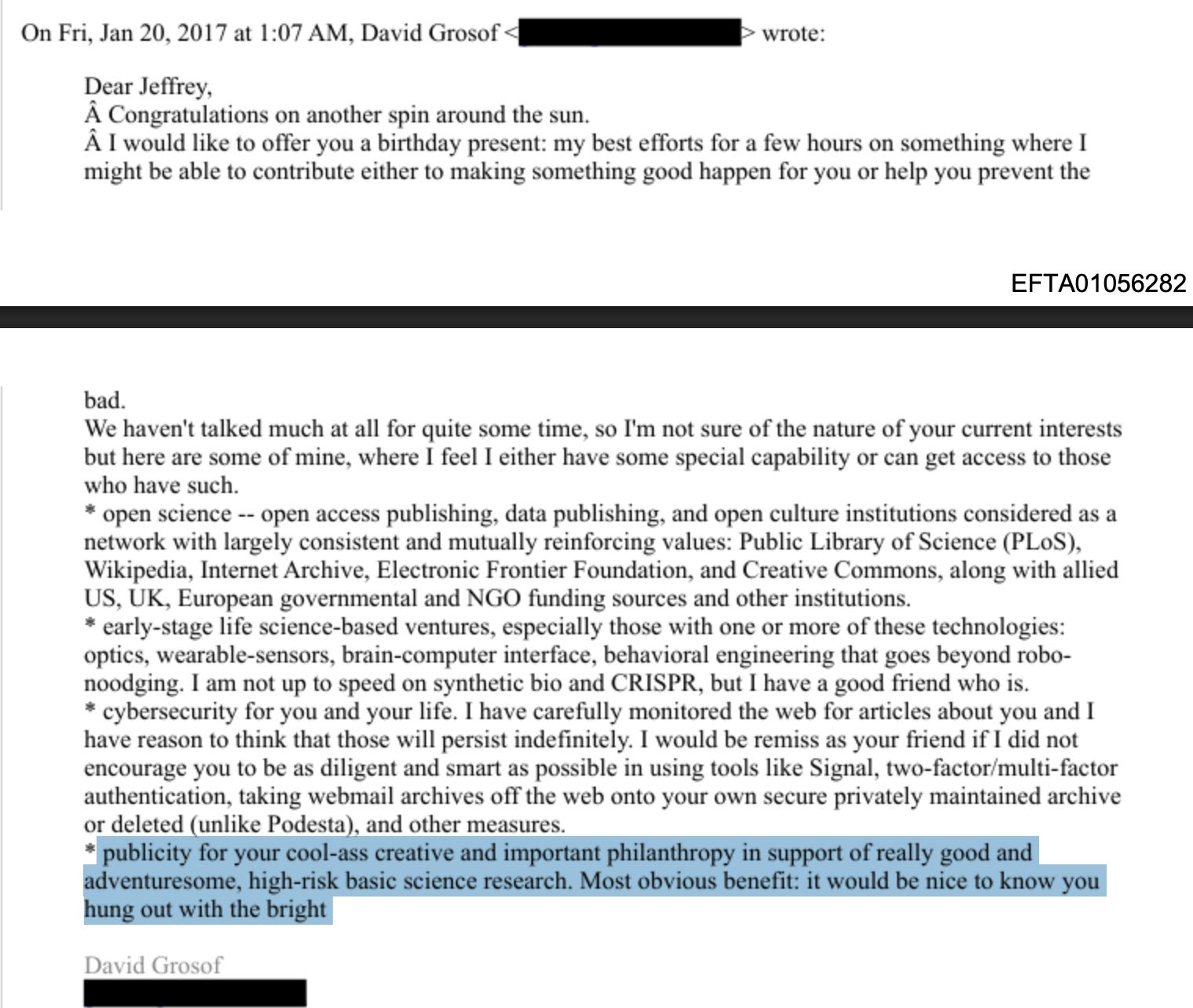
This is the science philanthropist persona being explicitly articulated from the outside, by someone seeking to cultivate or maintain a relationship with Epstein. Grosof wanted to help Epstein publicize that identity.
Grosof also offered cybersecurity assistance, specifically recommending that Epstein use encrypted communications tools and move webmail archives off commercial servers — advice that implicitly acknowledged the vulnerability of exactly the email communications now constituting part of the public record.[5]
Epstein’s reply listed his areas of scientific interest as: distributions in nature, deception, sleep, power, money, music and the brain, and signal intelligence in biological systems.[5] It is the intellectual menu of someone who approached science as a network of curiosities rather than a research program — and who had the resources to convene conversations around that menu at the highest levels.
VI. The Pattern
Taken together, these documents describe a consistent architecture:
Epstein cultivated access to frontier science by positioning himself as a patron of the edgy and suppressed — the “taboo science” framer. That frame was, as Sheldrake’s pushback shows, somewhat confected: CRISPR was not taboo. But it was effective at generating the impression of a discerning and unconventional mind.
Within that network, Epstein moved between philanthropic, advisory, and investor roles in ways that blurred their distinct norms. He held equity in Androcyte while presenting himself as a potential additional investor. He was pitched formal deal terms by George Church while simultaneously circulating as a scientific convener. He was credited with inducing a research collaboration in gene drive technology while having no documented scientific qualification to evaluate gene drive research.
None of this required Epstein to understand the science in depth. Connective influence in elite networks operates differently: it is about who you can bring together, whose calls get returned, whose proposals get forwarded. By those metrics, the documents establish that Epstein was genuinely operating at the frontier of early CRISPR commercialization — not as a scientist or a funder, but as a node.
One additional thread sits alongside the commercialization documents without fitting neatly into any single category. In July 2015, Boris Nikolic — a prominent biotechnology investor who had served as Bill Gates’ science advisor — wrote to Epstein while in the middle of closing a CRISPR/Cas9 investment round. His characterization: “mind-blowing how hot,” with investor demand exceeding five times the size of the round.[6] The email contains no strategic deliberation and no discussion of specific companies or patents. What it documents is something simpler and, in context, telling: Epstein was a routine correspondent of one of biotech’s most connected capital allocators at the precise moment CRISPR investment fever peaked. He was not peripheral to the capital environment surrounding CRISPR. He was inside its conversational bloodstream, and that fact belongs in the record.
VII. Why This Matters: The Governance Questions
CRISPR is no longer an experimental curiosity. It is a therapeutic platform, a biosecurity variable, an agricultural tool, a germline ethics flashpoint, and increasingly a geopolitical capability. Gene drives, specifically, have been the subject of serious international biosecurity governance discussion, precisely because their effects on wild populations can be irreversible.
The documents examined here raise questions that are not about Epstein himself — he is dead — but about the institutional environments that accommodated him:
What vetting mechanisms, if any, were applied before extending Epstein advisory equity in a genomics company? What did the researchers who credited him with inducing significant collaborations understand about his history at those moments? How did an individual whose prior criminal record was publicly documented maintain access to, and apparent influence within, elite bioscience networks at the moment CRISPR was becoming commercially and strategically significant?
These are governance questions — the kind any functioning institutional oversight structure should be able to answer. The documents suggest those answers, wherever they exist, have not been publicly examined.
Conclusion
The core evidentiary pivot in this record is a single sentence, preserved in the archive and worth quoting verbatim again:
“the collaboration with george church was induced by you!![2]”
Martin Nowak wrote those words to Jeffrey Epstein in April 2017. They credit him with catalyzing — not funding, not attending, but inducing — a collaboration involving one of the world’s most influential geneticists in one of the most governance-sensitive domains of genetic engineering.
Layered around that finding are the other documents: Epstein framing CRISPR as taboo science to generate a patronage persona; holding equity in a CRISPR-era longevity startup before pressing its founders on profit models; receiving a formal investment pitch from George Church for a xenotransplantation company; and being offered, by a would-be ally, help publicizing his identity as an adventuresome science philanthropist — an identity whose cybersecurity vulnerabilities the same ally quietly flagged.
This is a story about network leverage, institutional porosity, and the apparent absence of vetting at the intersection of capital and transformative science. That absence did not end with Epstein. It is structural.
This is the tenth installment in an ongoing series examining what the Epstein files reveal about the architecture connecting private capital, institutional science, and public health infrastructure. Earlier entries have traced the JPMorgan–Gates pandemic finance pipeline, the biosecurity-as-governance framework embedded in Project Molecule, and the classified intelligence trails running through British political networks. What this piece adds is the layer closest to the science itself: a convicted sex offender operating as a connective node inside the laboratories and boardrooms where gene editing was becoming commercially real. The full series is available at sayerji.substack.com/t/epstein-files. The EFTA archive at Jmail.world contains 74 references to CRISPR across the Epstein files. This piece addresses six of them. The remaining record is public and searchable.


Read and share the X thread dedicated to this post here.
Document Notes
1. Rupert Sheldrake to Jeffrey Epstein, April 6, 2016 (EFTA00829980). Sheldrake’s email quotes Epstein’s prior message: “at MIT we are beginning a ‘taboo’ science review. crispr, gene drives. etc.” Sheldrake responds: “I would not have said crispr etc is taboo — it’s as mainstream as you can get.”
2. Martin A. Nowak to Jeffrey Epstein, April 6, 2017 (EFTA00707374). Full text of Nowak’s message: “great new paper out today / on how to use CRISPR gene drive technology in natural populations / the collaboration with george church was induced by you!!” Paper attachment: e1601964.full.pdf.
2a. Martin A. Nowak to Jeffrey Epstein, June 28, 2017 (EFTA01041719); Epstein reply, June 28, 2017 (EFTA01041720). Nowak offers meetings with Chuck Noble (CRISPR gene drive) and Carl Veller (sex-determining chromosomes), both researchers at Harvard's Program for Evolutionary Dynamics. Epstein's reply — "Sure" — was sent at 20:01:33 UTC, approximately four minutes after Nowak's message at 19:58:05 UTC.
3. George Church / James Clement to Jeffrey Epstein, September 2014 email chain (EFTA00997325). James Clement’s September 4 email states Epstein received 2% of Androcyte’s initial stock. Church’s September 6 email describes the Androcyte CRISPR guide-RNA and human cell-editing pipeline. Epstein’s September 4 reply: “is there and was there a biz plan? how does the co intend to make money? when/? the use of funds, appears more like a research grant than a for profit investment.”
4. George Church / Luhan Yang to Jeffrey Epstein, October–November 2014 (EFTA02090913). Church’s October 23 email describes eGenesis as delivering “human transplantable organ by engineering animals” and proposes either a $1.5M convertible note (15% discount, 8% interest) or 9.09% preferred equity at $15M pre-money valuation. Epstein’s relayed reply requests use-of-funds projections and states he will “send a structure that i believe works.” Business plan file explicitly labeled: 20141101_eGenesis Inc_shared with Jeffery Epstein.pdf.
5. David Grosof to Jeffrey Epstein, January 20, 2017 (EFTA01056271 / EFTA01056282). Birthday email offering assistance in several domains including publicity for Epstein’s science philanthropy and cybersecurity improvements. Epstein’s areas of interest listed in reply: distributions in nature, deception, sleep, power, money, music and the brain, signal intelligence in biological systems.
6. Boris Nikolic to Jeffrey Epstein, July 27, 2015 (EFTA02493205). Nikolic describes closing a CRISPR/Cas9 investment round, characterizes demand as "mind-blowing how hot," and notes investor interest exceeded five times the round size. The exchange is primarily logistical (hotel recommendations for Palo Alto) with the CRISPR commentary embedded in a status update.
Human cloning at Harvard.
Yes... it is the most disturbing of all the Epstein files.
And they use AI for that.
Designer Viruses and Genetically Targeted Biological Warfare.
Sterilization through GMO Food.
And Designer Babies.
George Church is Evil.
Most disturbingly he is the head teacher at Harvard... Master of Deception... master of Indoctrination.
They literally want to clone a Masterrace and eliminate the rest of us.
https://fritzfreud.substack.com/p/human-cloning-at-harvard
Your series is awesome, you are able to dig past the sensational to find the real issues